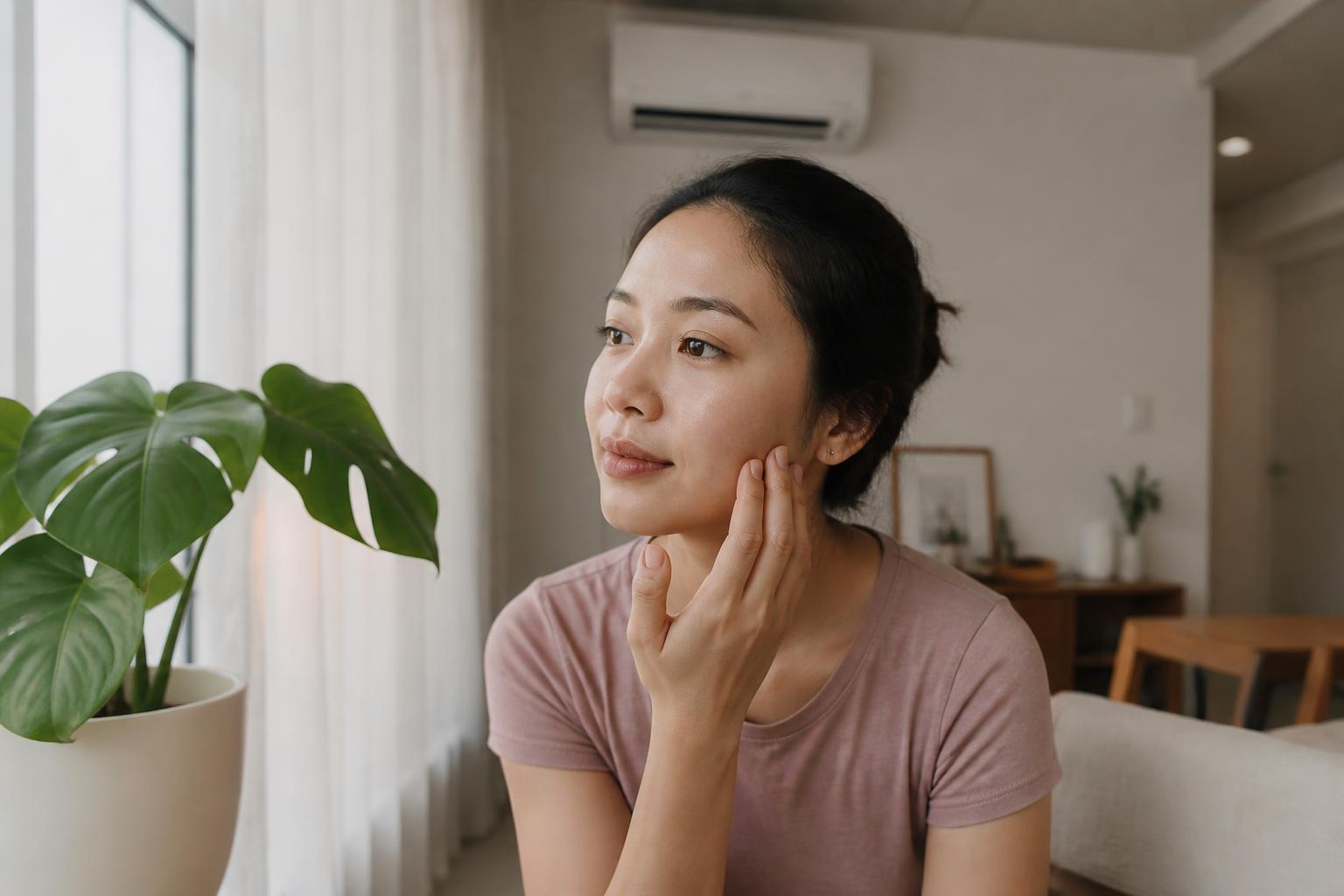
You step out of the MRT into 32°C air that sits on your skin like a wet towel. Twenty minutes later you're in an office where the AC keeps your arms cold but your T-zone still feels slick. By evening your skin is tight, shiny in patches, and you can't tell if it needs more moisture or less.
Formullogic, a Malaysian skincare brand, just launched in Singapore with a pitch built around this exact climate whiplash. They call it "barrier care for Southeast Asia," which sounds like marketing until you look at what that actually requires. Humid air doesn't mean your skin stays hydrated. Air-conditioned interiors pull water out of your skin faster than you realize. And barrier care formulated for temperate climates often assumes your skin needs occlusion first, when what it really needs is a way to hold onto water without trapping heat.
What Barrier Care Means in Tropical Humidity
Your skin barrier is the outermost layer of your epidermis, made of cells held together by lipids. When it's intact, it keeps water in and irritants out. When it's compromised, you get dryness, sensitivity, and a cycle where everything you apply either stings or slides off.
Most barrier-repair products are built for cold, dry climates. They lean on thick occlusives like petrolatum and shea butter to seal in moisture. In Singapore's humidity, that approach can backfire. Your skin doesn't need help trapping moisture when the air is already 80% humidity at 7 a.m. It needs ingredients that help your barrier hold water without creating a layer that feels heavy or triggers congestion.
Formullogic's approach centers on lightweight ceramides, niacinamide, and centella. Ceramides are lipids that fill gaps between skin cells. Niacinamide supports your skin's natural ceramide production and calms inflammation. Centella has been used across Southeast Asia for generations, and it shows up in their formulas not as an exotic add-on but as a consistent supporting ingredient.
The difference is texture. Their barrier serum is a gel-cream that sinks in fast. Their moisturizer is light enough to wear under SPF in the morning without pilling. That's not accident or preference. It's design that assumes you'll be moving between extreme temperature swings all day.
What Climate-Appropriate Formulation Actually Looks Like
Climate-appropriate doesn't mean swapping one ingredient for another. It means rethinking the vehicle. You can have the same actives in a product built for Seoul and one built for Singapore, but if the base is wrong, the actives won't matter.
In humid climates, emulsions need to be lighter. Oil content needs to be balanced so the product absorbs without leaving a film that traps sweat. Humectants like hyaluronic acid and glycerin still work, but they need to be formulated in a way that doesn't pull too much water to the surface and then evaporate when you step into the AC.
Formullogic's products use a silicone-light base. Silicones smooth texture and help products spread, but too much can feel occlusive in heat. Their texture lands somewhere between a watery gel and a cream, which makes them easier to layer without buildup.
That's the trade you're making when you choose products formulated for this region. You get immediate comfort and wearability. You lose some of the richness that people in dry climates rely on for long-lasting occlusion. If your skin is dehydrated or your indoor environment is aggressively air-conditioned, you might still need a heavier layer at night.
Who This Approach Works For
Barrier care is not one thing. Your barrier can be compromised by over-exfoliation, by using actives without adequate support, by hard water, by stress, by indoor heating or cooling that strips moisture faster than your skin can replace it.
Formullogic's line is built for people whose barrier is stressed by climate, not necessarily by a damaged moisture barrier that needs intensive repair. If your skin feels fine in the morning but tight and reactive by afternoon, or if you're dealing with redness and sensitivity that gets worse when you move between indoor and outdoor environments, this kind of lightweight barrier support makes sense.
If your barrier is severely compromised, you might need a more occlusive routine at night regardless of climate. If your skin is very oily, you might find even these textures too much during the day. The advantage of a regionally focused brand is that the baseline assumption matches your daily reality. You're not adapting a K-beauty routine or a French pharmacy staple. You're starting from a formula that expects heat and humidity as the default.
How to Integrate Barrier Care Without Overloading Your Routine
Adding barrier care doesn't mean overhauling everything. It means identifying where your routine is creating stress and where it's missing support.
Start by looking at your cleansing step. Foaming cleansers with high pH or sulfates strip your barrier. If you're using one because your skin feels oily, you might be creating a cycle where your skin overcompensates. A low-pH gel or cream cleanser leaves your barrier intact, which means the products you apply after it can actually do their job.
Next, check your layering order. Barrier-supporting ingredients work best on damp skin. After cleansing, while your face is still slightly wet, apply a hydrating toner or essence. Then add your barrier serum or treatment. This approach helps humectants pull water into your skin instead of just sitting on the surface.
Finally, match your moisturizer to the time of day. A lightweight lotion or gel-cream in the morning under SPF keeps your skin protected without feeling heavy. A slightly richer texture at night gives your barrier time to repair while you sleep. Track your routine with Roona to see which combinations keep your skin comfortable across the day, especially when you're testing new products.
What to Expect When You Start
Barrier repair is not dramatic. You won't see results overnight. What you will notice is that your skin stops reacting to things that used to irritate it. Redness fades. Tightness after cleansing goes away. Products that used to sting or pill start absorbing normally.
Give it two to three weeks. Your skin's outer layer turns over roughly every month, so you need at least that long to see whether the new routine is supporting your barrier or just adding steps.
If you're also using actives like retinoids, acids, or vitamin C, keep them in your routine but make sure you're giving your barrier adequate support around them. A strong barrier makes actives more effective, not less, because your skin can tolerate them without becoming sensitized.
Where Formulogic Fits in Singapore's Skincare Landscape
Singapore's skincare market is crowded. Guardian and Watsons stock Korean, Japanese, European, and American brands. Sephora carries luxury and cult favorites. Dermatologist-adjacent brands like CeraVe and La Roche-Posay have strong followings. Formulogic is not trying to replace any of them. It's filling a gap for people who want effective, research-backed formulas that don't assume their baseline environment is cold and dry.
The brand is available online and in select retailers. Prices sit in the mid-range, comparable to K-beauty or local clinic brands. That positioning makes sense for Singapore, where readers compare ingredients and expect transparency, but won't pay luxury prices for untested claims.
If you're already happy with your routine, you don't need to switch. If you've been adapting products from other climates and wondering why they feel too heavy or too stripping, this kind of regional focus gives you a starting point that matches where you actually live.
Barrier care works when it's built around your skin's real conditions, not an idealized version of perfect skin in a controlled environment. Humidity, AC, heat, and stress are not obstacles to work around. They're the context your routine needs to address directly. Formulogic's launch is one answer to that. Whether it's the right answer for your skin depends on how well it matches the specific ways your barrier gets stressed, and that's something you'll only know by testing it in your own routine over time.
Trend source: The Malaysian Reserve (SG)
Keep reading
-
Volufiline in Singapore: What The Ordinary Serum Can Do
A clear look at Volufiline in The Ordinary's viral serum, including what it can change, what it cannot, and how to test it in Singapore's climate. 1 September 2026 -

Ceramides Explained: Barrier Care in Malaysia's Heat and AC
Moving between humid Malaysian air and cold office AC can leave skin tight and reactive. What ceramides do and how to use them in a simple routine. 10 August 2026 -

Barrier-First Routines for Tropical Climates: Hot, Humid Care
Barrier repair works differently in heat and humidity. Here's how to protect your skin when sweat, sun, and moisture are part of every day. 26 July 2026