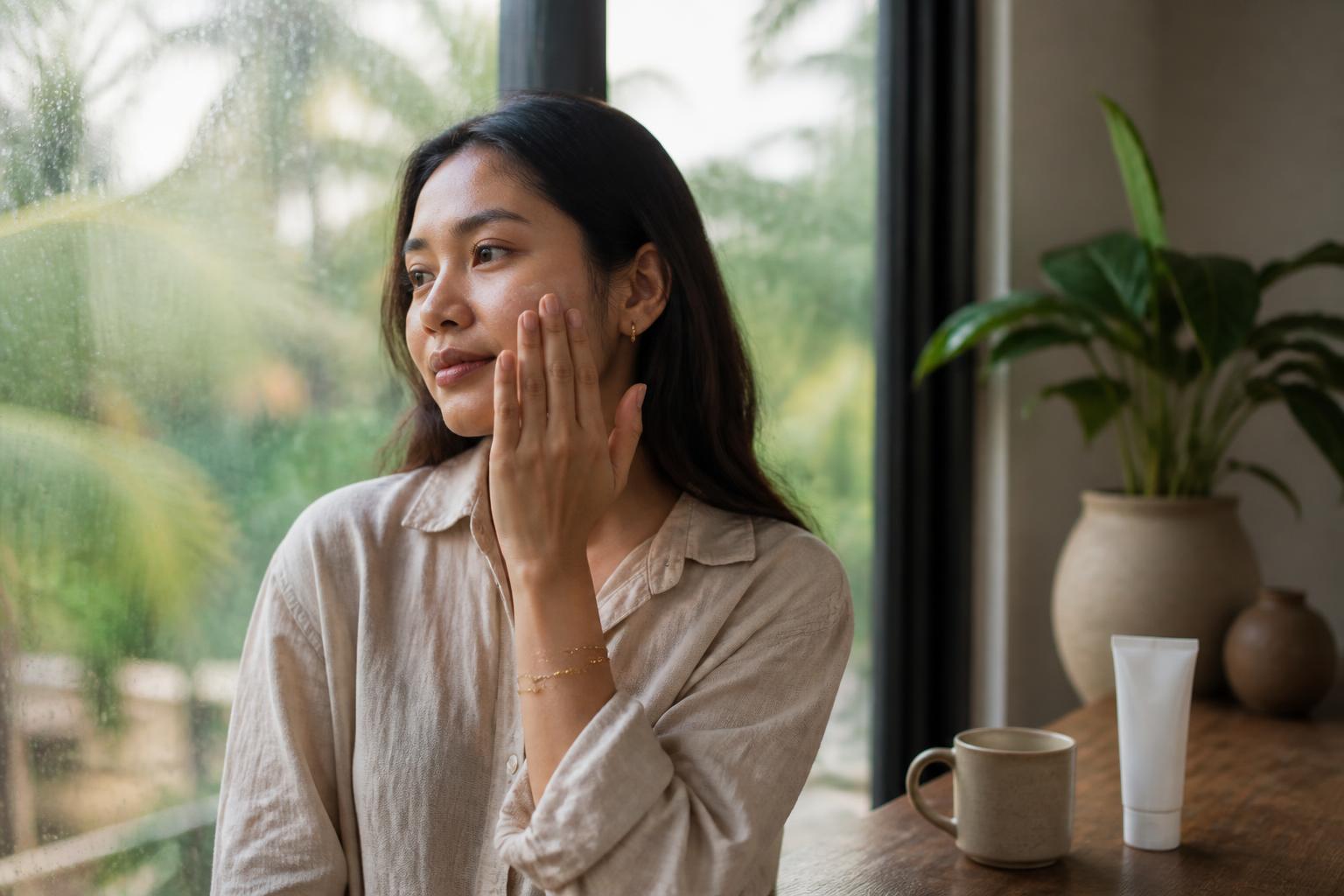
You step out of the LRT station at 8.40am and your shirt is already sticking to your back. Twenty minutes later you are at your desk under a vent blowing cold, dry air straight at your face, and by 11am your cheeks feel oddly tight even though your T-zone is shiny. That combination confuses a lot of people. Oily and dehydrated at once, in the same hour, in the same face.
That feeling usually points at your skin barrier, and ceramides are one of the main things holding it together.
What ceramides actually are
Think of the outermost layer of skin as bricks and mortar. The bricks are dead-but-useful skin cells. The mortar is a mix of lipids, and ceramides make up the largest share of that mortar, alongside cholesterol and fatty acids. Their job is to keep water in and keep irritants out.
When that mortar thins out, water evaporates from your skin faster than it should. You feel it as tightness, a stingy reaction to products you used to tolerate, patches that flake under makeup, or a face that looks dull no matter how much toner you pat in. Oily skin gets this too. Sebum sitting on the surface has nothing to do with whether the lipid layer underneath is intact.
Ceramides in skincare come in a few forms you will see on Malaysian shelves: ceramide NP, ceramide AP, ceramide EOP, sometimes listed as ceramide 3, 6-II and 1 on older packaging. They are usually paired with cholesterol and phytosphingosine, because the mortar works as a blend rather than a single ingredient.
Why Malaysia's climate is hard on the barrier
The outdoor air here is humid enough that your skin rarely feels dry the moment you walk out of the house. Indoors is a different environment entirely. Office towers, malls, cinemas, Grab cars and most bedrooms at night run air-conditioning that pulls moisture out of the air, and your skin loses water to that drier air continuously.
So you are not dealing with one climate. You are cycling between two, sometimes six or seven times a day. Each transition asks your barrier to adjust, and a barrier already low on lipids handles that badly.
A few local habits add to the load: long, hot showers after a sweaty commute, which strip surface lipids faster than lukewarm water; double cleansing twice a day when once at night would do, especially with foaming cleansers that leave skin squeaky; high UV exposure year round, which degrades lipids and collagen even on overcast days; sweat sitting under a face mask, hijab or helmet, then drying in cold AC; and adding an acid toner and a retinol at the same time because both were on Shopee sale.
None of these ruin anything permanently. They just add up, and the barrier is where the bill lands.
Signs your barrier needs support, not more actives
There is a specific tell: your skincare starts stinging when it never used to. Vitamin C that felt fine last month now burns on application. A sunscreen you have used for a year suddenly feels itchy. That is usually a permeability problem rather than an allergy to the new bottle.
Other things worth noticing over a week or two: skin feels tight within a minute of towel-drying your face; flaking around the nose, mouth or eyebrows despite oily-looking skin; redness that lingers after cleansing rather than settling in a few minutes; breakouts clustered where skin also feels rough and dry; and foundation clinging in patches by midday.
If several of these show up together, the useful move is to pull back on exfoliation and retinoids for a couple of weeks and let a ceramide moisturiser do the work. Keep a note of what you changed and when, because barrier recovery happens gradually and memory is unreliable. If you want a record you will actually keep, you can track your routine with Roona and see how your skin responded across the weeks rather than guessing.
How to use ceramides in a humid-climate routine
Ceramides are a moisturiser ingredient, so they belong at the point in your routine where you seal things in. In Malaysia that usually means something lighter than what a ceramide cream in a European winter would look like.
A workable structure:
- Cleanse at night with a gentle, low-foam cleanser. In the morning, water or the same cleanser is enough for most people.
- Apply a hydrating layer while skin is still slightly damp: a humectant essence or a serum with glycerin, hyaluronic acid or panthenol.
- Follow with a ceramide moisturiser. A gel-cream or lightweight lotion sits better in humidity than a thick balm.
- In the morning, finish with sunscreen. This is the step that protects everything underneath it.
- At night, keep actives to one at a time, on alternate nights while your skin settles.
The damp-skin timing matters. Humectants pull water from what is around them, and if the surrounding air is dry office air, they can end up pulling from deeper in your skin. Putting a ceramide layer on top gives that water somewhere to stay.
On very humid days, or if you are prone to congestion, one lighter layer is better than two rich ones. Lipid support does not require a heavy texture.
Shopping for ceramides in Malaysia
Watsons and Guardian both carry ceramide-forward moisturisers from the drugstore-derm brands, and Cetaphil, CeraVe and the Korean barrier lines are the ones you will run into most often. Local and regional brands have moved into this space too, which usually means smaller sizes and lower shelf prices.
A few things worth checking before you commit: look for ceramides plus cholesterol or fatty acids in the ingredient list, not ceramides alone, and remember that position matters, because ingredients near the end of a long list are present in small amounts. If halal certification matters to you, check for JAKIM recognition on the packaging or brand site rather than relying on marketing copy. Registered products carry an NPRA notification number, which you can verify on the Quest system if a Shopee or Lazada listing looks unusual. Buy from official brand stores on marketplaces during campaign dates instead of unfamiliar resellers, particularly for anything sold well under the pharmacy price.
Texture preference is personal enough that a sample or the smallest size is a sensible first purchase. A cream that pills under your sunscreen is a cream you will stop using by week two.
What to expect, and on what timeline
Barrier repair is not fast, and it is not dramatic. The stinging usually settles first, often within a week or two of stopping exfoliation and layering on a ceramide moisturiser twice a day. Tightness eases next. Texture and flaking take longer, because you are waiting on skin cells to turn over and the new lipid layer to build.
Give any change six to eight weeks before you judge it, and change one thing at a time so you know what did the work. If a routine has ten steps, you have no way to tell which one is helping and which one is the reason your jawline is breaking out.
If skin stays raw, painful or keeps flaring after a few consistent weeks of gentle care, that is a good point to see a dermatologist. Persistent irritation can have causes that no moisturiser addresses, and a proper diagnosis saves months of trial and error.
A simple version to start with
If all of this feels like a lot, the short version is three habits: cleanse gently, moisturise with something ceramide-based while your skin is damp, wear sunscreen every morning. Everything else is optional refinement.
When you are ready to see how your skin behaves across the AC-and-humidity cycle you live in, logging your routine in Roona makes the pattern easier to spot. No rush. Your skin is not a problem to be solved, just something worth paying attention to.
Trend source: BusinessWorld Online (MY)
Keep reading
-
Postbiotics in Skincare: What They Are, and Why They Matter Here
Postbiotics are the newest microbiome buzzword on Malaysian shelves. What they are, how they differ from probiotics, and how to use them in humid weather. 21 August 2026 -

When a Celebrity's Cheap Cream Sells Out: What It Really Means
Georgina Rodriguez's affordable moisturiser went viral and sold out. Here's how to read a celebrity skincare recommendation without wasting money. 19 August 2026 -

Formulogic's Singapore Launch: What Barrier Care for Humidity Means
A Malaysian brand built for Southeast Asian skin just arrived in Singapore. What barrier care looks like when formulated for tropical humidity and AC. 17 August 2026