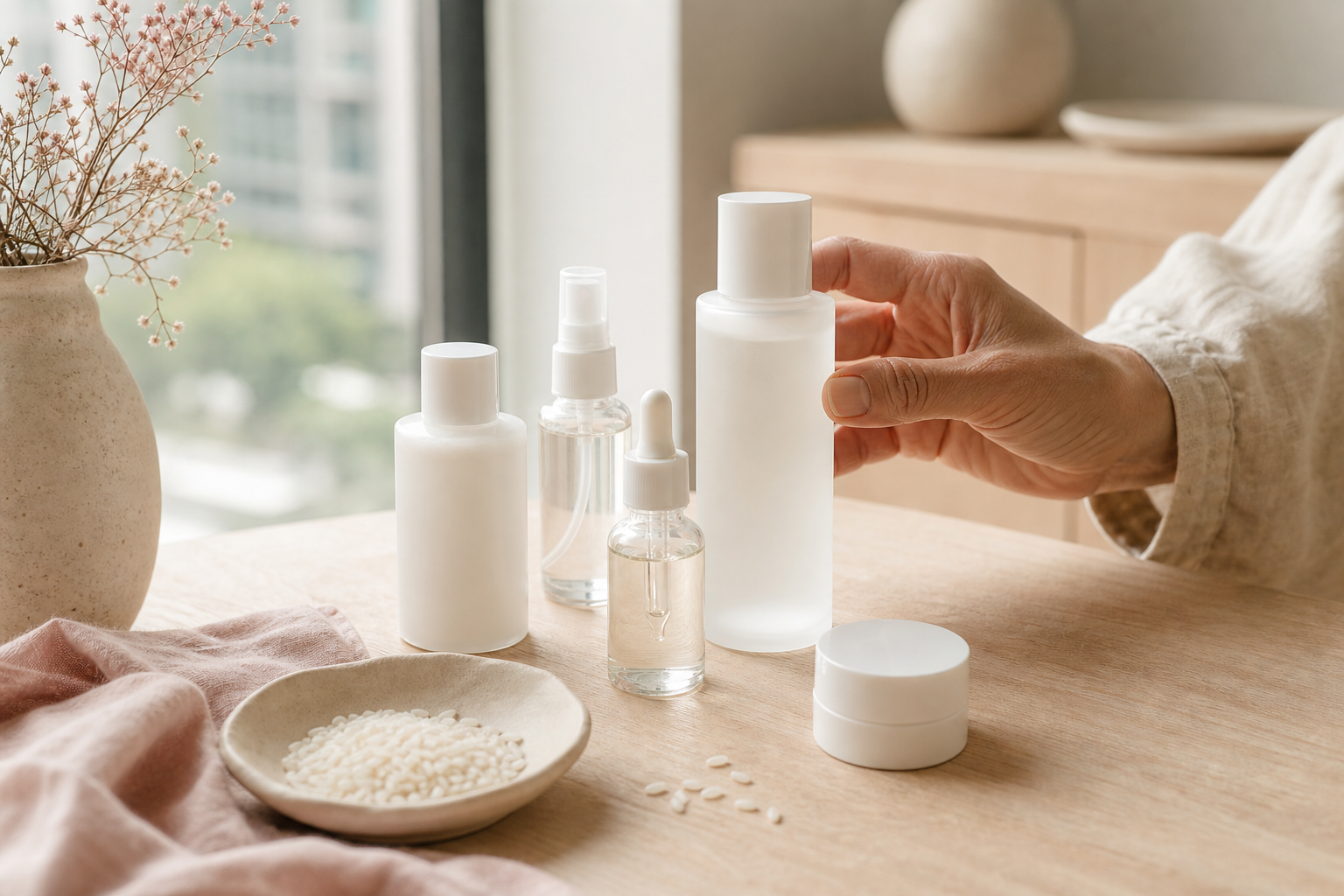
You're standing in the skincare aisle at Takashimaya, comparing two serums. One has a pastel package and a ten-step routine promise. The other has a plain white bottle, a short ingredient list, and a formulation that's been in Japanese pharmacies since before you were born.
Japanese beauty doesn't shout. It refines. While K-beauty built an empire on innovation and volume, Japanese brands spent decades in dermatology clinics and university labs, testing gentle actives on aging skin in humid climates. For readers in Singapore who want evidence over hype, that clinical heritage matters. Mature skin in tropical humidity needs formulations that respect the skin barrier, deliver actives without irritation, and work within the realities of air-conditioned offices and 80% outdoor humidity.
Why Japanese formulations suit mature skin in Singapore
Japanese skincare philosophy centres on barrier protection and long-term gentleness. Most hero products avoid high percentages of actives in favour of stable, bioavailable forms that work over weeks, not days. That approach aligns well with mature skin, which tends to have a thinner lipid barrier and recovers more slowly from irritation.
Singapore's climate adds another layer. Constant transitions between air-conditioning and outdoor heat stress the skin barrier. Japanese formulations often include humectants that pull moisture from humid air without feeling heavy, and occlusives light enough to wear in tropical heat. The textures reflect decades of refinement for Asian humidity.
The other advantage is transparency. Japanese cosmetic regulations require clear ingredient disclosure, and many brands publish stability data and pH ranges. If you're the kind of person who cross-references ingredient lists before buying, that matters.
Retinol alternatives that don't flake in humidity
Retinol is effective, but it can be unforgiving in Singapore's climate. The combination of heat, UV exposure, and rapid moisture loss often leads to flaking and sensitivity, especially for mature skin already managing dryness.
Japanese brands have leaned into retinol alternatives with gentler profiles. Retinyl palmitate and granactive retinoid appear in several pharmacy-grade lines, formulated at concentrations that stimulate collagen renewal without the aggressive peeling. These derivatives convert more slowly in the skin, which reduces irritation but requires patience.
Another route is bakuchiol, a plant-derived compound that shows similar gene expression changes to retinol in some studies, without photosensitivity. A few Japanese brands combine bakuchiol with peptides and ceramides, creating formulations that support the skin barrier while encouraging cell turnover.
If you're using any retinoid in Singapore, apply it at night after your skin has fully dried post-cleanse, and give it twenty minutes before layering occlusives. The humidity will tempt you to skip that wait. Don't.
Rice and sake ferments for barrier support
Fermented ingredients are not new, but Japanese formulations use them with uncommon precision. Sake kasu (the lees left after sake brewing) and rice bran ferment contain amino acids, peptides, and kojic acid, a gentle brightening agent that doesn't destabilize in heat. These ferments also deliver ceramides and fatty acids that mirror the skin's own lipid structure.
For mature skin managing barrier thinning, that compatibility matters. The molecules integrate into the stratum corneum rather than sitting on the surface, which means they hydrate without blocking pores or feeling occlusive in humidity.
Look for essences and lotions (in Japanese formulations, "lotion" means a hydrating toner) that list sake or rice ferment in the first five ingredients. Apply them on damp skin, immediately after cleansing, to maximize absorption. In Singapore's humidity, this step often replaces heavier creams during the day.
Vitamin C that stays stable past the first month
Vitamin C is notoriously unstable. L-ascorbic acid oxidizes in heat and light, turning yellow and losing efficacy. In Singapore's climate, a serum can degrade within weeks of opening.
Japanese formulations favour ascorbyl glucoside and magnesium ascorbyl phosphate, derivatives that remain stable at higher temperatures and neutral pH. These forms convert to active vitamin C in the skin, delivering antioxidant protection and modest brightening without the stinging or oxidation risk.
The trade-off is speed. Stable derivatives work more slowly than L-ascorbic acid, so expect results over months, not weeks. For mature skin prioritizing gentleness and consistency, that trade-off often makes sense.
Store vitamin C serums in a cool, dark drawer, not the bathroom. If you're tracking what works over time, Roona lets you log products and note when you opened them, which helps you catch oxidation before you waste weeks on a degraded formula.
Lightweight ceramides that layer under SPF
Ceramides are lipids that hold the skin barrier together. Mature skin produces fewer of them, which leads to moisture loss and increased sensitivity. The challenge in Singapore is finding ceramide formulations light enough to wear under SPF without pilling or feeling greasy.
Japanese pharmacy brands often formulate ceramides in gel-cream hybrids or essences rather than heavy creams. These products use pseudo-ceramides (synthetic lipids that mimic natural ceramides) or ceramide precursors in textures that absorb quickly and layer cleanly.
Apply ceramide products after actives and before SPF. If you're layering multiple products in humid weather, give each layer a minute to settle. Rushing the routine causes pilling and wastes product.
Tranexamic acid for persistent pigmentation
Post-inflammatory hyperpigmentation and melasma are common concerns for mature skin, especially in Singapore's high-UV environment. Tranexamic acid is a brightening agent that works by inhibiting plasmin, an enzyme involved in melanin production.
Unlike hydroquinone, tranexamic acid doesn't carry the same risk of rebound pigmentation, and it's stable in formulations that include other actives. Japanese dermatology clinics have used it for years, and it's now appearing in over-the-counter serums and essences.
Results take time. Expect to use tranexamic acid for three months before seeing noticeable fading. Pair it with diligent SPF use. Brightening agents only work if you're preventing new pigmentation from forming.
Collagen peptides in formats that penetrate
Topical collagen has been dismissed for years because whole collagen molecules are too large to penetrate the skin barrier. Japanese formulations address this with hydrolyzed collagen peptides, fragments small enough to reach the deeper epidermis.
These peptides don't rebuild collagen directly, but they signal fibroblasts to increase collagen synthesis. The effect is modest and takes months to appear, but for mature skin focused on maintenance rather than reversal, modest and cumulative is often enough.
Look for products that list hydrolyzed collagen or collagen peptides within the first seven ingredients. Apply them to damp skin in the evening, after cleansing and before heavier occlusives.
Gentle AHAs that don't strip in AC environments
Alpha hydroxy acids exfoliate by loosening the bonds between dead skin cells. In mature skin, gentle exfoliation supports cell turnover and helps other actives penetrate. The challenge in Singapore is that air-conditioned environments already dry out the skin, and aggressive AHAs can push it into chronic irritation.
Japanese formulations often use lactic acid or gluconolactone (a polyhydroxy acid) at concentrations around five percent, combined with soothing ingredients like allantoin or beta-glucan. These formulations exfoliate without compromising the barrier.
Use AHAs two to three times per week in the evening, not daily. If your skin feels tight or looks red the next morning, cut back to once per week. Exfoliation is cumulative. Overdoing it doesn't speed up results.
Niacinamide for oil control without dryness
Mature skin in Singapore often deals with a confusing combination: dryness in air-conditioning and oil production in outdoor humidity. Niacinamide addresses both. It strengthens the skin barrier (reducing transepidermal water loss) and regulates sebum production (reducing midday shine).
Japanese formulations typically use niacinamide at five to ten percent, often combined with licorice root extract or arbutin for additional brightening. These products come in light lotions or serums that layer well under SPF.
Niacinamide works with nearly every other active, so it's a flexible addition to most routines. Apply it in the morning after cleansing and before SPF. If you're using multiple serums, niacinamide can go first or last; it's stable and non-reactive.
Sunscreen formulations that don't disrupt makeup
Japanese sunscreens are a separate category. They use chemical filters (like tinosorb and uvinul) that leave no white cast, absorb instantly, and sit well under makeup. Many are formulated as milk or gel textures that feel closer to a primer than a traditional sunscreen.
For mature skin, look for formulations that include hyaluronic acid or glycerin for hydration, and avoid alcohol-heavy formulas that can dry out the skin over time. Japanese sunscreens also tend to include antioxidants like vitamin E or green tea extract, which provide additional protection against environmental stress.
Reapply every two hours if you're outdoors. If you're indoors most of the day, one morning application and one midday reapplication over makeup (using a cushion or mist format) is usually enough.
Building a routine that fits your life
Japanese beauty doesn't require ten steps. A functional mature-skin routine in Singapore might look like this: gentle cleanser, hydrating toner, one or two targeted serums (niacinamide, vitamin C, retinol alternative), a light ceramide product, and SPF in the morning. At night, swap SPF for a slightly richer moisturizer and add an AHA two to three times per week.
The key is consistency, not volume. Mature skin benefits more from using the same effective products for months than from rotating through new ones every few weeks. If you're building a routine from scratch or trying to figure out what's actually working, tracking your products and skin observations in Roona gives you a clearer picture over time than memory alone.
Japanese formulations reward patience. They're designed for long-term use, not dramatic before-and-after photos. If that aligns with how you think about skincare, the evidence is worth your attention.
Trend source: Yahoo (SG)
Keep reading
-

Barrier-First Routines for Tropical Climates: Hot, Humid Care
Barrier repair works differently in heat and humidity. Here's how to protect your skin when sweat, sun, and moisture are part of every day. 26 July 2026 -

Watsons Beautopia 2026: What the Hype Says About Malaysian Beauty
Watsons Beautopia 2026 is drawing crowds across Malaysia. Here's what the buzz tells us about ingredients, formats and routines worth watching this year. 25 July 2026 -
How to Choose a Skincare Tracking App You'll Still Open in Week Six
Most skincare trackers get abandoned by week three. Two things predict whether one actually works for you: how long a single entry takes on a bad night, and where your progress photos end up living. 28 July 2026