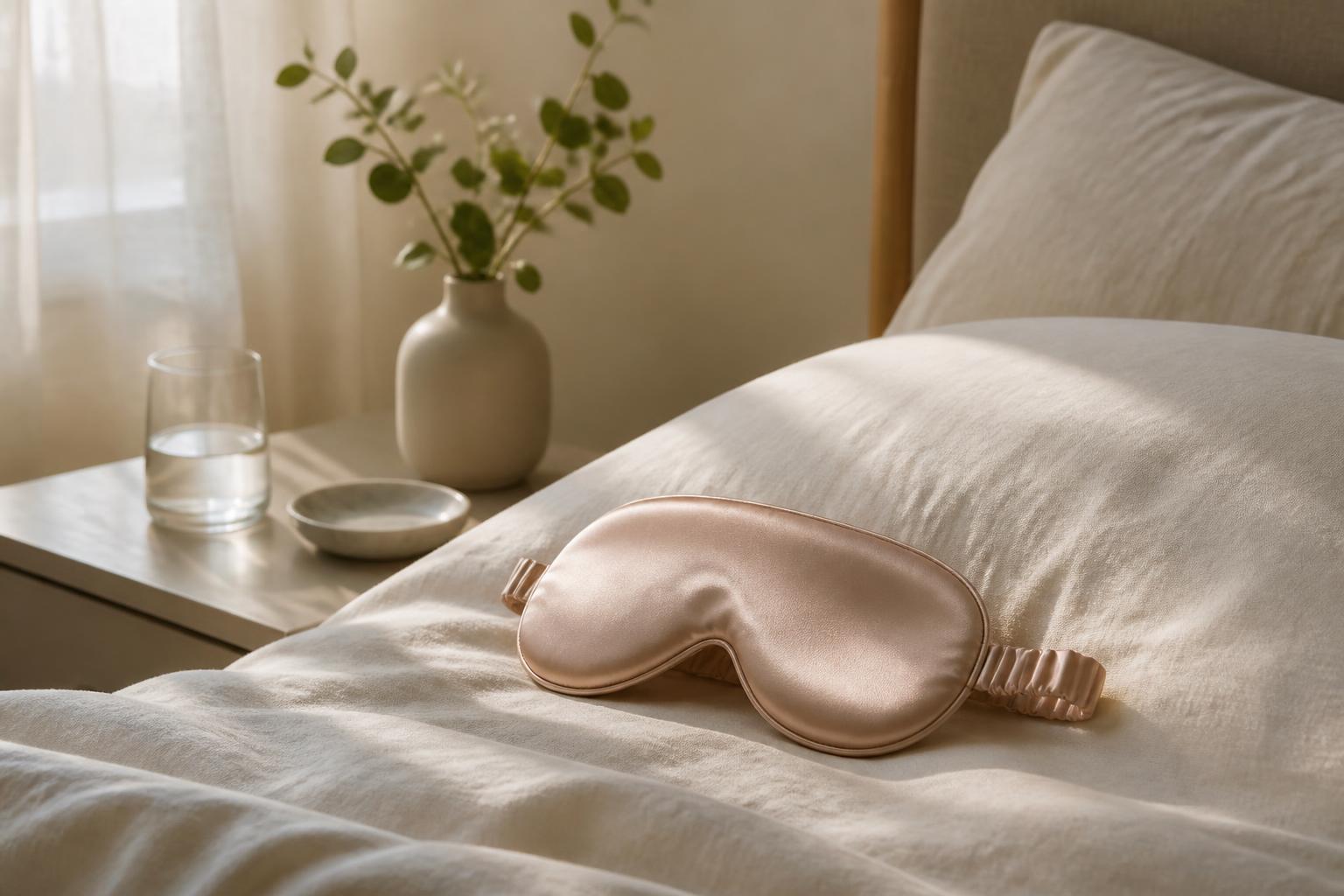
You smooth on retinol, press in peptide serum, and lock it all down with a thick night cream. Then you pull a cotton pillowcase over your face and wonder why your skin looks creased in the morning.
Sleep masks have moved from airline freebies to three-figure investments, with some styles approaching the cost of a professional facial. The pitch is consistent: protect your skincare, prevent sleep lines, wake up dewier. But separating material science from marketing requires looking at what happens to skin during seven or eight hours of pressure, friction, and occlusion.
A sleep mask creates a physical barrier between your face and your pillow. That barrier can reduce friction, which matters because repeated tugging on skin contributes to fine lines over time. It can also prevent your carefully applied skincare from transferring onto fabric instead of absorbing.
The material determines how much moisture stays on your skin. Silk and satin (whether real silk or polyester satin) are smoother and less absorbent than cotton, so they pull less product off your face. Some masks add a layer of occlusion, similar to slugging, which can help hydrating ingredients penetrate better.
What a mask cannot do: erase existing wrinkles, tighten skin, or replace active ingredients. It is a passive tool. It keeps conditions stable while your skincare works.
Not all expensive sleep masks justify their cost, but some features do require better materials and construction.
Mulberry silk (the specific grade, not just "silk blend") has a smooth protein structure that reduces friction more than polyester alternatives. It also regulates temperature better, which matters if you wake up sweaty and irritated.
Contoured designs that sit away from your eyes and lashes prevent pressure on delicate skin. Flat masks that press directly on your face can cause puffiness or, worse, transfer bacteria from the fabric into your pores overnight.
Adjustable, covered elastic prevents hair breakage and keeps the mask in place without digging into your skin. Cheap elastic frays, loses tension, or leaves marks.
Wide coverage that extends past your cheekbones protects more of the area where sleep lines form. A mask that only covers your eyes does nothing for the creases that develop along your cheeks and jaw.
If a mask has all four features, it will likely cost more than fifty dollars. Whether it costs one hundred or three hundred often comes down to brand positioning, not performance.
You can find well-constructed silk masks between sixty and one hundred dollars that deliver the same skin benefits as luxury versions. Look for 100% mulberry silk (often labeled as 6A grade), adjustable straps, and enough width to cover your entire face if you sleep on your side.
Satin (usually polyester) can be washed more frequently at higher temperatures than silk. Silk requires gentle detergent and air drying, which means you need multiple masks to rotate while one is being cleaned.
Polyester satin masks start around twenty dollars. They won't feel as cool or regulate temperature as well, but they create the same low-friction surface that protects your skincare and reduces tugging.
A sleep mask only helps if the rest of your sleep environment supports your skin. Sleeping on your back eliminates pressure entirely, which no mask can replicate. A humidifier addresses dryness better than occlusion alone. Washing your mask every few days prevents oil and bacteria buildup that can cause breakouts.
If you sleep hot, silk will feel better than satin. If you move a lot at night, a contoured mask with a wide elastic band will stay in place better than a lightweight one. If you apply heavy creams or oils, you need a mask you can wash frequently without it losing shape.
Track which products and habits actually change your skin instead of assuming the most expensive tool is the most effective one.
If you already sleep on a silk pillowcase, a mask adds redundancy unless you need full light blocking for better sleep quality. The pillowcase covers more surface area and works whether you stay still or move around.
If you don't wear skincare to bed, a mask won't do much beyond blocking light. The friction-reduction benefit only matters if you're protecting something.
If you have active breakouts or use strong actives like tretinoin, adding occlusion from a mask can increase irritation. Let your skin breathe unless your dermatologist has specifically recommended otherwise.
Start with these non-negotiables: a material that won't absorb your skincare (silk, satin, or certain synthetic blends), a contoured shape that doesn't press on your eyes, and a strap that adjusts without pulling your hair.
Try one mid-range option first. Wear it for two weeks and notice whether you wake up with fewer sleep lines, less irritation, or better product absorption. If you see a difference, the mask is doing its job. If not, the issue might be your pillow, your sleep position, or the products themselves.
Some people find that a mask helps them stick to a nighttime routine because it signals a commitment to the process. That psychological benefit is real.
A three-hundred-dollar sleep mask is not ten times better than a thirty-dollar one. But a well-made mask in the sixty-to-one-hundred-dollar range can genuinely reduce friction, protect your skincare, and prevent some of the mechanical stress that contributes to lines over time.
The return comes from consistency. If a mask helps you sleep better, stay on your back, or keep your retinol on your face instead of your pillowcase, it pays for itself faster than another serum you'll use twice and forget.
Skincare works best when you remove the obstacles between application and absorption. Sometimes that obstacle is a pillowcase. Sometimes it's worth a small investment to get it out of the way.
Trend source: The Register-Guard (US)
Keep reading
-
The aging myths dermatologists are tired of repeating
Expensive means effective. You need a separate eye cream. Anti-aging starts at 30. A look at the beliefs quietly wasting your money and your skin's time. 25 August 2026 -
Tretinoin: What It Does and What Adjusting Really Feels Like
An honest look at tretinoin: how it works, who tends to use it, what the adjustment period involves, and how to start slowly without wrecking your barrier. 20 August 2026 -
The $10 Skincare Routine That Keeps One 66-Year-Old's Skin Glowing
A beauty editor's mother proves that glowing skin in your sixties doesn't require expensive serums. Her budget routine offers lessons in consistency and simplicity. 12 August 2026