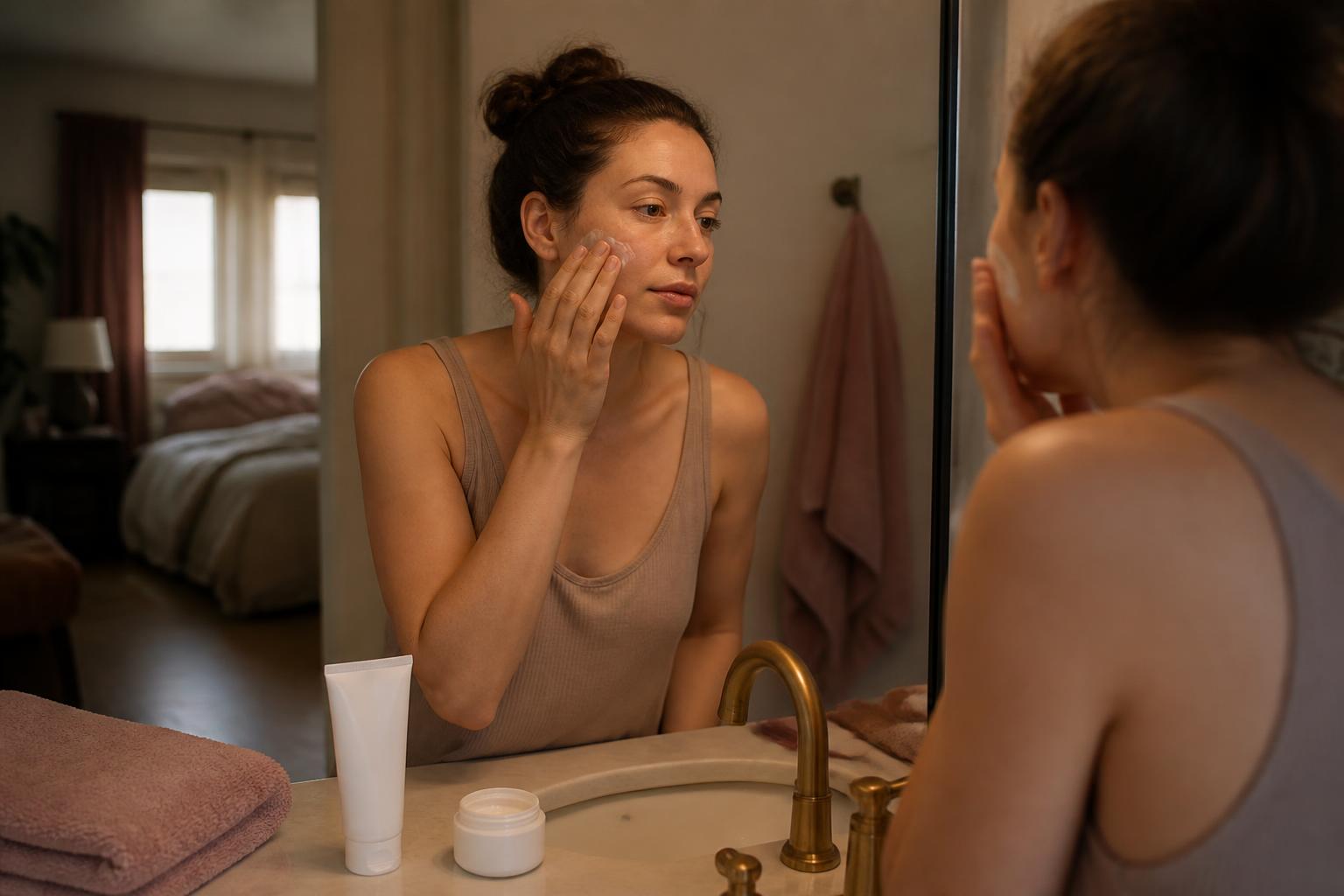
You get the prescription filled, squeeze out a pea-sized amount before bed, and for three nights nothing happens. Then week two arrives and your cheeks feel like paper. The corners of your nose start flaking mid-afternoon at work. Nobody in the TikTok tutorial mentioned that part, or if they did, it was a two-second clip captioned "purging lol" before cutting to the glowing eight-month result.
Tretinoin is one of the most studied topical ingredients in dermatology, and it has been prescribed for decades. It also has a genuine learning curve, and most of the people who quit tretinoin quit in the first six weeks, before it has had a chance to do much of anything. Understanding what happens during that window makes it far easier to stay the course, or to decide it isn't for you.
What tretinoin actually is
Tretinoin is a prescription retinoid: all-trans retinoic acid, the form of vitamin A that your skin cells can use directly. That distinction matters because it explains the whole hierarchy of retinoid products you see at Sephora and Ulta.
Over-the-counter retinol has to be converted inside the skin before it becomes retinoic acid. Retinaldehyde is one step closer. Retinyl palmitate is several steps away and correspondingly gentle. Adapalene, sold over the counter in the United States as Differin, is a synthetic retinoid that binds selectively to certain receptors, which is part of why many people find it more tolerable than tretinoin at similar strengths.
Tretinoin skips the conversion queue entirely. It is not a stronger version of retinol in the way that a higher SPF is stronger sunscreen. It's a different starting point, which is why the effects tend to show up faster and the irritation does too.
What it does to skin over time
Tretinoin speeds up how quickly skin cells turn over and influences how they behave as they mature. In practice, that shows up in a few ways that dermatologists have documented extensively:
Fewer clogged pores and blackheads, because tretinoin affects how dead cells shed inside the follicle rather than just on the surface
Smoother surface texture, often the first thing people notice
Gradual improvement in fine lines and the look of sun-related pigmentation, on a timeline measured in months rather than weeks
More even tone, especially in post-acne marks that linger after a breakout has cleared
The honest version of the timeline: texture and clogged pores often start shifting somewhere in the first couple of months. Anything to do with fine lines and pigmentation is a long game. Dermatologists routinely tell patients to give it six months before judging results, and a year is not an unreasonable horizon. This is a maintenance ingredient, not a course of treatment with an end date.
Who tends to do well with it
Tretinoin gets talked about as an anti-aging product, but it started as an acne medication and it still does that job. It suits people dealing with persistent clogged pores, closed comedones along the jaw and forehead, and the kind of breakouts that leave marks behind for months.
It also suits people who want to address early texture and tone changes and are willing to be patient and consistent about sunscreen. That second part isn't optional. Tretinoin makes skin more sensitive to UV, and photodamage undoes the thing you are paying for.
It tends to be harder going if you have rosacea, eczema, or a barrier that's already reactive, though plenty of people in those categories use it successfully at low frequency with careful buffering. Tretinoin is not used during pregnancy or breastfeeding. Because it's prescription-only in the United States, the conversation about whether it fits your skin happens with a dermatologist or through a telederm service, and that's the right place for it, not a comment section.
The adjustment period, described honestly
The term of art is retinization. It's the stretch where your skin adapts to a faster turnover rate, and it usually lands somewhere in the first two to twelve weeks depending on your starting strength and how often you apply.
Here is roughly what people report, in the order it tends to arrive:
Nothing at all for the first several nights, which lulls you into applying more than you should
Tightness and a slight sting when you apply moisturizer, usually around week one or two
Visible flaking, concentrated around the nose, chin, and the smile lines beside the mouth
A breakout wave, often in areas where you already get congestion
Redness that can look like mild windburn, more obvious on fair skin, more likely to show as dryness and ashiness on deeper skin tones
That breakout wave is the part that causes most people to bail. Purging happens because tretinoin accelerates the lifecycle of microcomedones that were already forming under the surface, so a few weeks' worth of future breakouts arrive at once. It shows up where you normally break out and it resolves. Irritation-driven breakouts, by contrast, tend to appear in new places, feel more like small angry bumps, and come with a barrier that is stinging and hot. If your skin feels raw rather than dry, you have gone too fast, and the answer is to pull back rather than push through.
Winter makes all of this worse. Dry indoor heat in a Chicago or Boston apartment in January will amplify flaking that would have been unremarkable in July. Plenty of people start in autumn thinking they'll get ahead of it and end up in the worst possible conditions. Late spring, when humidity is climbing but the sun exposure is still manageable, is a kinder time to start.
How to start without wrecking your barrier
The strategy that works is boring, and boring is the point.
Start at the lowest strength your prescriber offers and apply it twice a week, not nightly. Build up over a couple of months.
Use a pea-sized amount for the whole face. More does not accelerate results, it accelerates irritation.
Apply to completely dry skin, and skip the eyelids, the corners of the nose, and the corners of the mouth where product pools.
Buffer if you need to: moisturizer first, tretinoin on top, or tretinoin mixed into your moisturizer in the palm of your hand. This slows delivery and takes the edge off.
Cut everything else back while you adjust. No exfoliating acids, no vitamin C in the same routine, no scrubs, no cleansing brushes. A gentle cream cleanser and a bland moisturizer with ceramides or squalane is the whole supporting cast you need.
Wear sunscreen every morning, and reapply if you're outdoors. Broad-spectrum, at least SPF 30.
If a night goes badly, skip the next one. Skipping is not failure, and the cumulative frequency over months matters more than any individual application. This is exactly the kind of pattern that's easy to lose track of, which is why it helps to track your routine with Roona rather than trying to remember whether you applied it on Tuesday or the Tuesday before.
When to reconsider
Some people never fully tolerate tretinoin, and that's a reasonable outcome rather than a personal failing. Signals worth taking seriously: persistent redness that doesn't settle between applications, stinging from water, or a breakout pattern that's been getting worse for more than eight to ten weeks.
The alternatives are real. Adapalene is available without a prescription and many people find it gentler with meaningful results on congestion. Well-formulated retinaldehyde and encapsulated retinol products have improved a lot and suit reactive skin better. A lower tretinoin strength used twice a week indefinitely will do more for you over three years than a higher strength you abandon in month two.
Going back to your prescriber with specifics helps: which strength, how often, what you layered it with, when the irritation peaked. That conversation gets much easier when you have a record of what you actually did instead of a vague sense that it didn't agree with you. If you'd like somewhere calm to log the nights you applied and how your skin responded, Roona is built for exactly that kind of slow, patient tracking.
Trend source: thekit.ca (US)
Keep reading
-

After 40, This Viral Skincare Routine May Overwork Your Skin
Why the viral multi-step skincare routine can irritate skin after 40, plus a gentler Singapore routine with acids, retinoids and SPF. 5 September 2026 -

The aging myths dermatologists are tired of repeating
Expensive means effective. You need a separate eye cream. Anti-aging starts at 30. A look at the beliefs quietly wasting your money and your skin's time. 25 August 2026 -

When Skincare Became Content: The Movie Theater Moment
A creator filmed her nighttime routine mid-screening and the internet erupted. A calm look at what performed self-care costs, and how to get your routine back. 18 August 2026