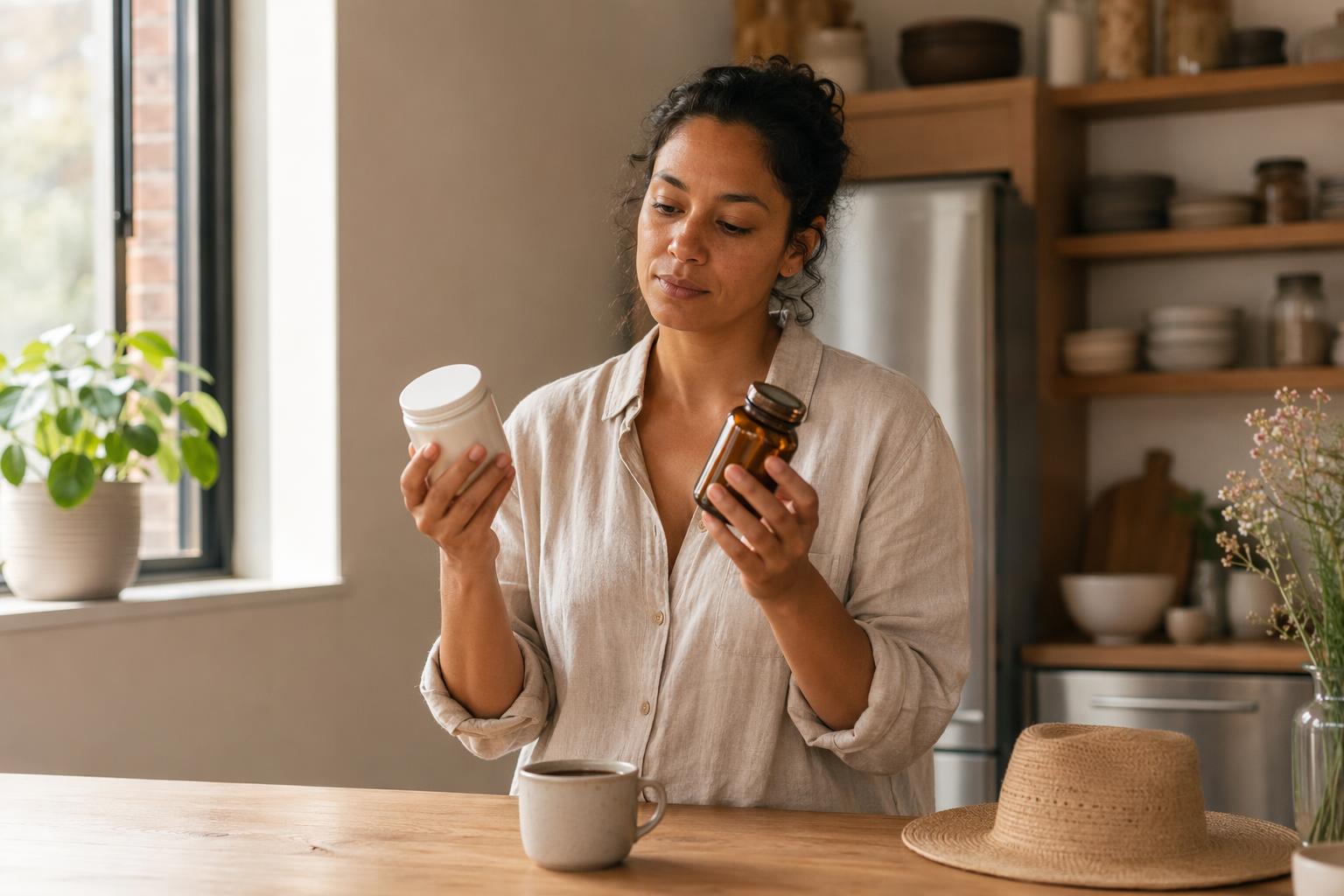
You are already running late, the car is hot, and reapplying SPF over makeup feels like a project you do not have time for. So when an ad promises sun protection you can swallow with your morning coffee, it lands. One capsule, no white cast, no greasy forehead by 2pm.
Oral sun protection supplements, often sold as "sun pills" or capsules built around polypodium leucotomos fern extract, nicotinamide, or antioxidant blends like astaxanthin and lycopene, have been circulating in beauty media and on TikTok as a shortcut. Some of the science behind the ingredients is real. The shortcut is not.
What sun pills actually contain
Most formulas in United States pharmacies and on Amazon fall into a few categories. Polypodium leucotomos, a fern extract, is the most talked about and has been studied for its effect on how skin responds to ultraviolet light. Nicotinamide, the amide form of vitamin B3, has been studied in dermatology for skin cancer risk in high-risk patients and is often recommended by dermatologists in that specific context, not as a general SPF alternative. Then there are carotenoid antioxidants: lycopene, beta-carotene, astaxanthin, usually marketed alongside vague "glow from within" language.
What these share is a mechanism that works from the inside. They are not sitting on the surface of your skin blocking or absorbing UV rays. They act more like backup, mopping up some of the free radical damage that happens after UV gets in.
That difference matters more than anything else in this conversation.
Why they cannot replace SPF
A topical sunscreen creates a physical layer. Zinc oxide and titanium dioxide scatter and absorb UV at the surface; chemical filters like avobenzone and the newer photostable filters absorb it and convert it to heat. The protection happens before the light reaches your living skin cells.
A capsule cannot do that. Nothing you swallow forms a film over your cheekbones. Which is why the Food and Drug Administration has publicly warned companies marketing pills as sunscreen substitutes: the claim overstates what the products can do, and a consumer who believes it spends more time in the sun with less protection than they think.
The practical consequence is the part worth sitting with. If you take a capsule and skip your SPF before a long August afternoon at a lake, you are not protected. You are unprotected and confident, which is worse than unprotected and cautious, because confidence changes behavior. You stay out longer. You skip the hat.
Where oral antioxidants might genuinely fit
There is a version of this that makes sense, and it is much less exciting than the marketing.
Topical sunscreen is imperfect in ordinary use. Most people apply less than the amount used in lab testing. Most people do not reapply every two hours at the beach. Sweat, water, towels, and the back of your hand all take some off. So there is a plausible role for something that helps your skin deal with the UV that gets through.
That framing changes the question from "can I stop wearing sunscreen" to "is this a reasonable addition." For some people it is:
- If you have melasma or persistent post-inflammatory pigmentation that flares in summer, oral polypodium is something dermatologists sometimes suggest alongside topical SPF, iron oxide tinted sunscreen, and shade.
- If you have a photosensitivity condition, or you are on a medication that increases sun sensitivity, it is worth raising with your dermatologist rather than self-prescribing.
- If you have a personal history of skin cancer, nicotinamide is a conversation to have with your doctor, who can tell you whether the evidence applies to your situation.
Outside of those situations, a supplement is a small optional extra on top of the things that actually do the work.
What actually moves the needle on sun protection
The unglamorous list has not changed, and it still outperforms anything in capsule form.
- A broad spectrum sunscreen you will genuinely reapply. Texture is the deciding factor, not the number on the front. If a fluid or a Japanese-style essence sunscreen feels good enough that you use it daily, it beats a heavier SPF 50 sitting unopened in your bathroom cabinet.
- A stick or a powder SPF in your bag for the 2pm top-up over makeup. Not perfect coverage, but real coverage, and far better than nothing.
- Shade and timing. UV in most of the United States peaks late morning through mid afternoon, and it is stronger at altitude in Denver or Salt Lake City than the temperature suggests.
- A hat with a real brim and UV-blocking sunglasses, which cover the areas people chronically underapply: ears, hairline, eyelids, the tops of cheekbones.
- Awareness that clouds and car windows are not full protection. Standard windshield glass filters most UVB but far less UVA, which is why drivers often show more pigmentation on the left side of the face.
If you want to know whether your routine is actually holding, watch outcomes over a season rather than a week. Pigmentation, in particular, responds slowly, and it is easy to credit a new supplement for something a change in weather explains. Logging what you use and when makes that easier to untangle; you can keep a simple record of your routine with Roona and look back at how your skin behaved across a summer instead of relying on memory.
How to read a sun pill label without getting sold
Supplements in the United States are regulated as food, not as drugs, so the burden of proof before something reaches a shelf is lower than for a sunscreen filter. That has a few practical implications.
Check whether the label names a specific standardized extract at a specific dose, or whether it lists a proprietary blend with no amounts. Blends let a brand include a trace of the studied ingredient and a lot of filler. Look for third-party testing marks like NSF or USP, which verify what is in the bottle rather than whether it works. And read the claims closely: "supports skin's resilience to environmental stress" is a very different sentence from "replaces sunscreen," and brands writing the first one are usually being more honest than the ones implying the second.
If you take medication, are pregnant, or are breastfeeding, run any new supplement past a pharmacist or your doctor. Beta-carotene in particular has cautions for people who smoke, which is the kind of detail a beauty ad will not carry.
A calmer way to hold all of this
The appeal of a sun pill is not really about UV. It is about wanting one less step, one less thing to remember, one less sticky layer in July. That is a fair thing to want.
The more useful place to put that energy is in making your topical SPF something you do not have to negotiate with every morning. A texture you like, kept somewhere you will see it, applied as the last step of your morning routine so it is not competing with anything. Habits survive on low friction, not on willpower.
If a supplement fits on top of that and your dermatologist thinks it is reasonable for your skin, take it. Just keep it in the right slot: a possible supporting player, not the lead.
If you are trying to work out what is actually helping your skin this season, you are welcome to track your routine with Roona and see what the pattern looks like over time. No rush, and no pressure to change anything today.
Trend source: NDTV (US)
Keep reading
-

Tan-Maxxing: What Skipping SPF Costs You Later
Tan-maxxing videos make skipping sunscreen look harmless. Here is what sun exposure does over time, and how to enjoy summer without wrecking your skin barrier. 28 July 2026 -
When Skincare Meets Wellness: What the Ulta x Good Day Launch Tells Us
Ulta's Good Day line blurs skincare and wellness categories. What this shift means for how we build routines that actually feel sustainable. 27 July 2026 -
How to Choose a Skincare Tracking App You'll Still Open in Week Six
Most skincare trackers get abandoned by week three. Two things predict whether one actually works for you: how long a single entry takes on a bad night, and where your progress photos end up living. 28 July 2026