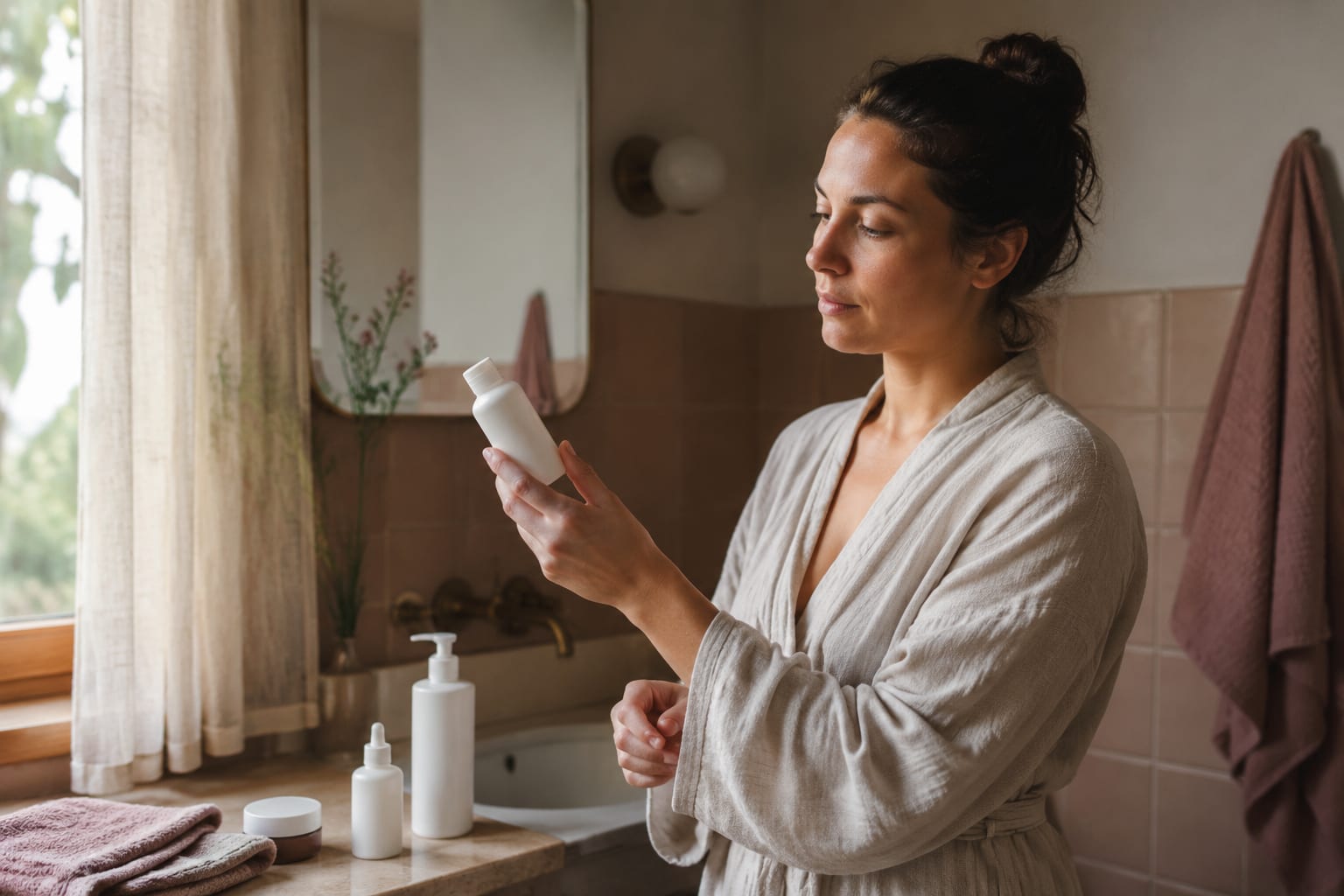
You are at the sink at eleven at night, holding a bottle you bought because a video told you your pores were packed with dirt. The label promises to draw it out. Somewhere in the back of your head sits a rule you have never questioned: steam opens pores, cold water closes them. Neither is true. The bottle still got bought.
Myths survive in skincare for a simple reason. They give you a mechanism you can picture, and a task you can do tonight. The accurate version is usually slower, less visual, and asks you to wait several weeks before deciding anything. That is a hard sell against a fifteen second clip, so the old ideas keep coming back around, dressed in newer packaging.
Pores Are Not Doors
A pore is the opening of a hair follicle, usually with an oil gland attached. There is no muscle around it, so nothing opens or shuts on command. Steam does something real, just not that: warmth and humidity soften the mix of sebum and dead skin sitting in the opening, so it clears more easily. Cold water tightens blood vessels near the surface for a while, which can calm redness after a run or a hot shower. Neither changes the diameter of the pore itself.
Pore size is largely inherited, and it tends to look more obvious where oil glands are densest: the nose, the inner cheeks, the chin. What genuinely shifts how visible pores are, over months rather than nights:
- Leave-on salicylic acid, which is oil soluble and works inside the pore lining rather than just on top of it
- A retinoid used consistently, which changes how quickly skin cells turn over and how neatly they shed
- Daily broad spectrum sunscreen, because sun damage loosens the collagen scaffolding that holds a pore opening taut
None of that photographs well on day one. That is why the steam story outlives it.
Oily Skin Still Needs Moisturizer
The logic sounds airtight. Skin is producing too much oil, so stop adding more. In practice, people acting on that logic tend to reach for a stripping foaming cleanser, an alcohol-heavy toner, and nothing after. Skin ends up tight by lunchtime and shiny by three, which reads as proof the oil was the problem all along.
Oil and water are different things. Sebum is a lipid, and it does not hydrate the upper layers of skin the way water bound into them does. You can be oily and dehydrated at the same time, which usually shows up as shine paired with a tight, slightly rough feeling, or makeup separating in patches by mid-afternoon.
A light gel-cream with glycerin, niacinamide or squalane is enough. What matters more than richness is whether you are stripping skin first.
"Natural" Is Not a Safety Category
Poison ivy is natural. So is urushiol, so is nickel, so are the citrus oils that make some people photosensitive. Plant-derived does not predict how a substance behaves on skin, and the DIY corner of the internet keeps proving it: lemon juice on dark marks, baking soda paste as an exfoliant, cinnamon masks, undiluted tea tree oil dabbed on a spot.
What predicts tolerance is concentration, formulation and pH, all of which a decent product controls and a kitchen does not. Some of the best tolerated ingredients on the shelf are the least romantic ones. Petrolatum. Glycerin. Zinc oxide. Niacinamide. They have been in drugstore formulas at Target and Walgreens for decades because they are dull and dependable, which is exactly what you want from something you apply two hundred nights a year.
If you are trying anything new, patch test it: a small amount on the inner forearm or just in front of the ear, once a day for several days, before it goes anywhere near your whole face.
Tingling Is Not a Progress Report
This one is stubborn because it borrows credibility from exercise. Effort should be felt, so a product that stings must be doing something. Often what you are feeling is menthol, camphor, denatured alcohol or fragrance, none of which are treating anything. Sometimes it is a genuine active landing on a barrier that has already been pushed too hard.
Discomfort that fades in under a minute on freshly cleansed skin, from something like a low-strength acid, is usually unremarkable. Burning that lasts, or stinging from plain water and bland moisturizer, means the barrier needs a quiet stretch: cleanser, moisturizer, sunscreen, nothing else, for a week or two.
The signals worth watching are less dramatic. Flaking easing off. Fewer days when your skin objects to a product it used to accept. Texture that looks smoother in the same bathroom light it looked rough in a month ago.
The Waiting Game Between Layers
Somewhere along the way, a piece of formulation chemistry about pH turned into a rule that you must wait twenty or thirty minutes between steps. For almost everyone, that is time spent standing around. Modern products are buffered and tested as finished formulas, not as raw acids meeting raw bases on your cheek.
A workable approach: apply thinnest to thickest, and move on once a layer has stopped feeling wet. That is thirty seconds, not thirty minutes. With prescription tretinoin, applying moisturizer before or after is fine, and buffering with moisturizer underneath is a common way to make the first few months more comfortable.
One pairing that does deserve care is layering multiple strong actives at once, like an acid exfoliant and a retinoid in the same routine. Alternate nights instead. Not because of chemistry, but because your barrier has a budget.
What Precision Skincare Actually Looks Like
Personalized skincare gets sold as a swab kit and a subscription. The version that changes outcomes is less commercial and more clerical: you become the one who knows what your skin does, because you wrote it down.
That means running one variable at a time. Introduce a single new product, give it four to eight weeks, twelve for a retinoid, and hold everything else steady while you do. Skin turns over on its own schedule and does not care that you want an answer by Sunday.
It also means noticing context. Congestion that appears every time you swap to a heavier cream. Redness that spikes in the week the heating goes on. Breakouts that track sleep more reliably than they track any product. Photos in the same spot, same light, same time of day, because memory flatters and mirrors lie. If you would rather not keep it in a notes app, you can track your routine with Roona and let the pattern show up on its own.
A Quick Filter for Any Claim You Meet
Before you add something to a cart, run it past four questions:
- Does the claim describe a mechanism that exists, or one that only sounds plausible?
- Is there a concentration or a named ingredient, or just a category like "botanical complex"?
- Is the promised timeline consistent with how skin actually renews, or does it promise overnight?
- Is the evidence about the ingredient in general, or about this formula?
Most hype fails on the last two. A claim that survives all four is usually attached to something unglamorous: a sunscreen you like enough to wear daily, a moisturizer that suits the season, an active you can tolerate long enough for it to matter.
Skincare gets calmer once you stop needing every step to be exciting. If you want a place to log what you are using and notice what your skin keeps telling you, Roona is there when you feel like it.
Trend source: FOX 2 (US)
Keep reading
-

The aging myths dermatologists are tired of repeating
Expensive means effective. You need a separate eye cream. Anti-aging starts at 30. A look at the beliefs quietly wasting your money and your skin's time. 25 August 2026 -

Why Pamela Anderson's Simple Skincare Routine Works
A four-step routine won over the skeptics. What makes a minimal skincare approach repeatable, and how to build your own version at home. 3 August 2026 -
Viral Summer Skincare Hacks: What Actually Helps
Ice rollers, fridge serums, rice water toners, sunscreen mixed into moisturizer. A calm look at which viral summer skincare hacks hold up and which don't. 3 August 2026