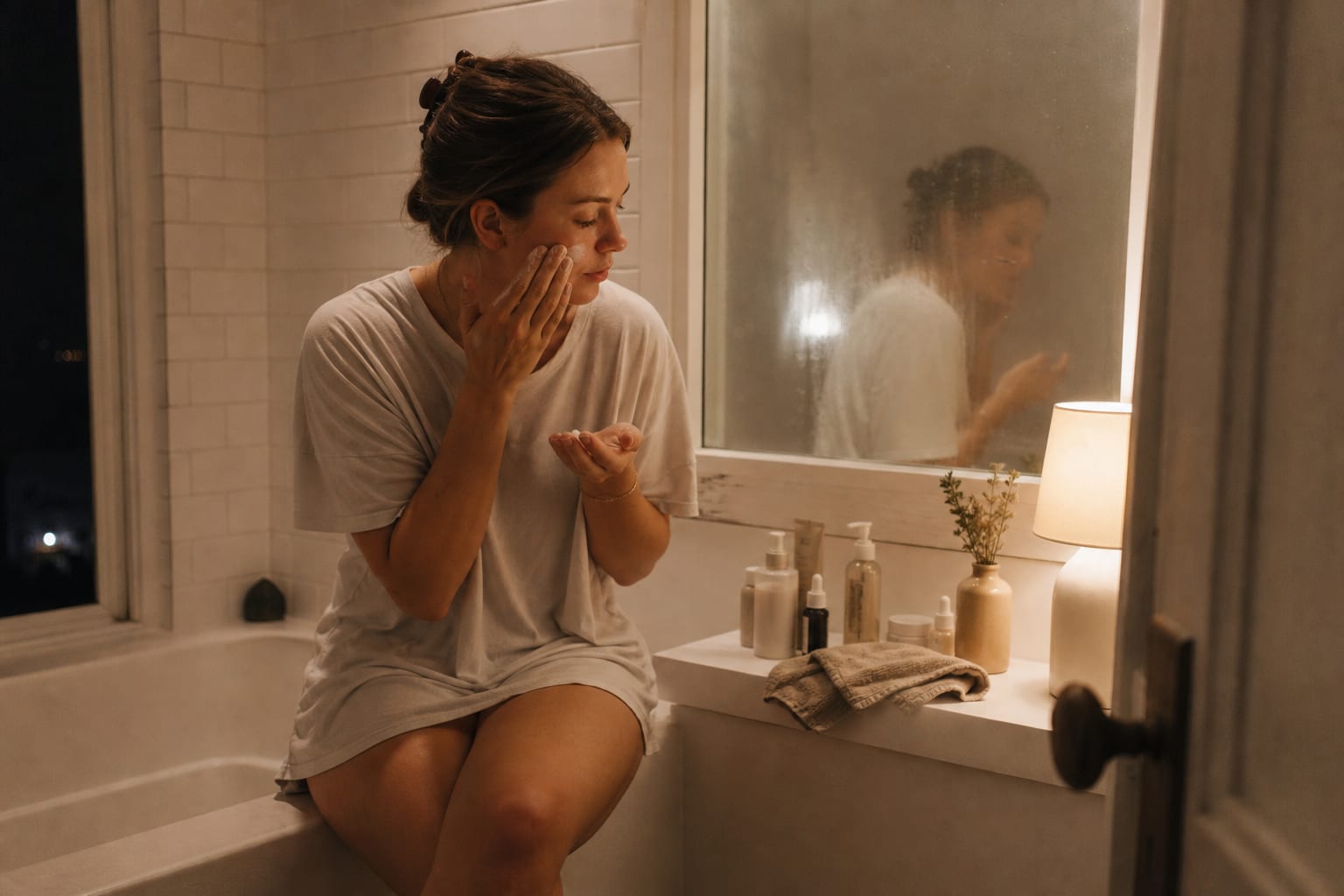
You've seen the setup even if you've never filmed one: phone propped against a stack of books, ring light angled just off-camera, a lineup of bottles arranged so the labels face forward. Cleanser, toner, serum, moisturizer, a satisfying tap-tap of fingertips. It's a genre now. And recently a creator brought that genre into a movie theater, applying products during a screening of The Odyssey while filming it, and the backlash arrived fast and loud.
The rudeness part is easy. Everyone agrees a dark theater is not a bathroom counter. What's more interesting is the question underneath: how did a private, quiet, slightly boring set of habits turn into something people perform for an audience, in public, mid-film?
Skincare stopped being a routine and became a format
There's a reason the ten-step nighttime video works so well online. It has a beginning, a middle, and an end. It has props with pretty packaging. It has textures that look good in close-up: the gel-to-milk cleanser, the slip of a hyaluronic acid serum, the thick occlusive balm that goes on last and catches the light.
That's an unusually good fit for short-form video, and the algorithm rewarded it. What followed was predictable. Routines got longer because longer routines make better content. Shelves got fuller because a full shelf reads as expertise on camera. The visual grammar of skincare, the amber dropper, the slow smoothing motion, became shorthand for taking care of yourself, whether or not any of it was doing much for the person's skin.
Somewhere in that shift, the point moved. A routine used to be measured by whether your skin felt comfortable in the morning. Now it can be measured by whether it looked like a routine.
What performance actually costs your skin
This is where the cultural question turns practical. Routines built to be watched tend to have a specific shape, and that shape has consequences.
- More steps means more actives sharing a face. Retinoids, exfoliating acids, and vitamin C stacked in the same week are a common source of stinging, tightness, and flaking, especially in dry indoor winter air.
- Constant product rotation means you never learn what works. A new serum every two weeks makes it impossible to tell which one your skin liked.
- Visual products get priority. Peel-off masks, cooling globes, and multi-step layering are photogenic. Sunscreen, applied every morning, is not, and it's the step with the strongest evidence behind it.
- Steps get performed rather than done. A ninety-second cleanse looks great on camera. A five-second swipe with a cotton pad at 1am does not, and one of those actually removes the day.
Dermatologists have been saying a version of this for a while now, and the pushback against over-layering has become its own trend. Barrier repair, minimalism, the "skin cycling" framing. Some of that is just a new content format wearing different clothes. Some of it is a genuine correction.
The theater moment as a symptom, not a scandal
Filming a routine during a movie is a boundary problem, but it's also a signal about where the boundary between doing something and documenting it has gotten thin. If the routine only counts when it's captured, then every location becomes a potential set: the airplane tray table, the office bathroom, the passenger seat, row F of a Tuesday screening.
The backlash was about etiquette. The interesting part is that plenty of people who piled on have also filmed their own routine at least once, or thought about it. The impulse is familiar. Self-care is invisible work, and invisible work is unsatisfying. Filming it makes it legible, both to other people and to yourself.
There's a gentler way to get that same legibility. Noting what you used and how your skin responded gives you the record without the audience, and it's genuinely more useful, because a log tells you things a video never will. You can track your routine with Roona and actually see which weeks your skin was calmest.
How to tell if your routine is for you or for the camera
A few honest questions, none of them about product count:
- Could you name the reason each product is in your routine? Not the marketing claim, the reason you personally added it.
- If you stopped buying anything new for two months, would your routine still function?
- Do you use sunscreen more consistently than you use whatever serum you bought most recently?
- When your skin gets irritated, do you know which product you'd remove first?
- Would you do the whole routine in a hotel bathroom with bad lighting and no shelf space?
If most of those have clear answers, your routine is yours. If several don't, some of it is probably decoration.
What a routine that isn't content looks like
It's short, and it's repetitive, and it's a bit dull. That's the whole trick.
Morning is usually a cleanse or a rinse depending on how your skin feels, a moisturizer, and sunscreen. In American cities where you're moving between heated buildings and cold January streets, or air conditioning and August humidity, the moisturizer is the part that changes seasonally. A light lotion in summer, something richer with ceramides or squalane when the radiators come on.
Evening is where actives live, and where restraint matters most. A retinoid two or three nights a week, moisturizer on the others, and the discipline to skip a night when your skin is stinging. If you're using an exfoliating acid, it doesn't need to be nightly, and it usually shouldn't share an evening with a retinoid while you're still learning how your skin handles either one.
The rest is patience. Most active ingredients take weeks before you can judge them, which is exactly the timescale that short-form video cannot represent. A twelve-week arc doesn't fit in thirty seconds. That's not a flaw in the ingredient.
Watching skincare content without letting it run your bathroom
You don't have to log off. Beauty content is fun, and some creators genuinely know their ingredients. A few filters help:
- Notice whether a creator ever says a product didn't work. If nothing ever disappoints them, you're watching an ad.
- Separate the aesthetic from the advice. You can love the way a routine looks and still not need eight steps.
- Give any new product a real trial window before you decide, and add one thing at a time so you can attribute the result.
- Be suspicious of any routine that requires a specific bathroom, a specific light, or a specific shelf.
The theater story will fade in a week, the way these things do. What it exposed is worth keeping: the gap between caring for your skin and staging the care. One of those is quiet, cheap, and mostly happens when nobody is looking.
If you want a way to keep track of what you're using and how your skin actually responds, without turning it into a production, Roona is there whenever you feel like starting.
Trend source: New York Post (US)
Keep reading
-
Glowcations: Why Seoul Is the New Skincare Getaway
Seoul's skincare travel trend blends clinic appointments, K-beauty shopping, and routine planning into a more thoughtful alternative to the spa weekend. 5 September 2026 -
Martha Stewart's 84-Year-Old Skin and What 111SKIN Can Do
Martha Stewart's 111SKIN routine raises a useful question: what can luxury skincare do for different ages, and what is worth buying? 5 September 2026 -
After 40, This Viral Skincare Routine May Overwork Your Skin
Why the viral multi-step skincare routine can irritate skin after 40, plus a gentler Singapore routine with acids, retinoids and SPF. 5 September 2026