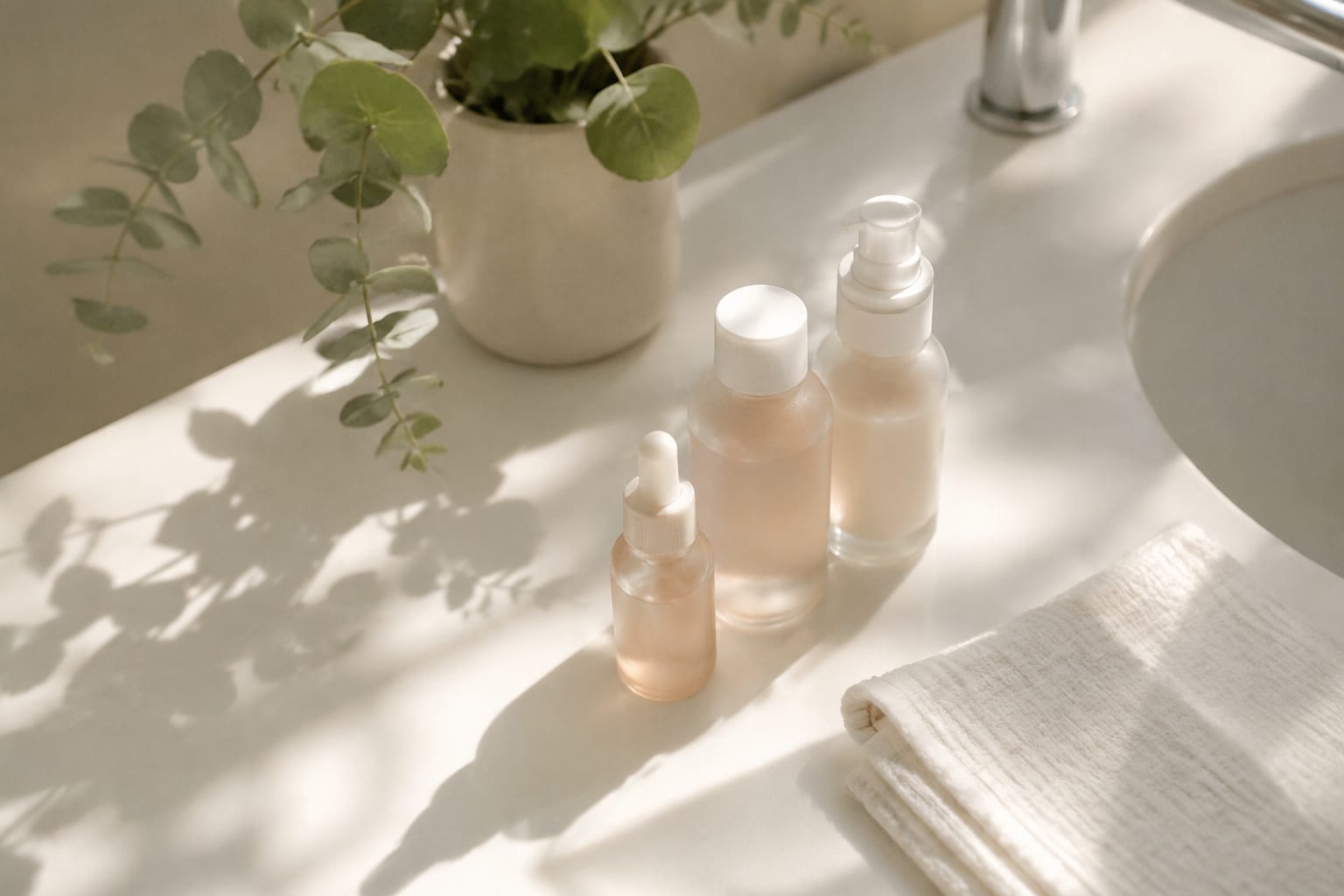
You open your medicine cabinet and count eight serums, three essences, two ampoules. Somewhere in there is a routine you meant to follow, but most mornings you reach for the same two or three things and call it done.
Australian beauty brands have been watching that math for years, and they built an entire movement around it. A-Beauty cuts steps down to what actually works, with actives strong enough to earn their place and textures light enough to survive a humid commute or a day in full sun.
What makes A-Beauty different
Australian skincare grew up under conditions that punish fussy routines. The country has the highest rate of skin cancer in the world, so sun protection is not optional, and formulas that feel heavy or greasy do not last. The result is a category of products that prioritize efficacy over ritual: fewer steps, higher concentrations of actives, and textures that layer fast and stay comfortable in heat.
Where K-beauty introduced essences and sleeping packs as discrete steps, A-Beauty collapses functions. A serum does the work of two. A moisturizer includes SPF. The goal is not to simplify for the sake of aesthetics but to make a routine sustainable when you are tired, rushed, or traveling.
Brands like Aesop, Alpha-H, and Sand & Sky export globally now, but they still reflect Australian priorities: vitamin C that does not oxidize in a hot bathroom, glycolic acid formulations strong enough to show results quickly, and reef-safe SPF that works under makeup.
Why it is resonating now
Skincare routines in the United States have trended maximalist for years. The ten-step routine became aspirational, then exhausting. Bathroom shelves filled with products that expired before they were finished, and social media amplified the cycle: new launches every week, each one promising to solve a problem you did not know you had.
A-Beauty offers a way out. It reframes fewer products as smarter, not lazy. You are not skipping steps; you are using formulas concentrated enough that you do not need to layer three serums to see a difference. The philosophy aligns with a broader shift toward intentional consumption, where people want to know what they own and why they own it.
The climate argument also travels. Humid summers in the South and Southwest make heavy creams unbearable, and anyone who has tried to reapply SPF over a full face of skincare knows the problem A-Beauty solves: lightweight layers that do not pill, sweat off, or feel like a mask by noon.
Key ingredients and how they are used
Australian brands lean on actives with decades of research behind them, not trending molecules that need a ten-slide explanation. Vitamin C, niacinamide, glycolic acid, and zinc oxide show up repeatedly, formulated at percentages high enough to work but stable enough to survive heat and light.
Alpha-H's Liquid Gold, a glycolic acid toner, became a cult product by doing one thing well: exfoliating without irritation. It does not ask you to add three prep steps or follow it with two repair serums.
Sand & Sky's Australian Pink Clay mask combines kaolin clay with vitamin C and turmeric, a formula that treats congestion and dullness in one step instead of splitting those goals across separate products. The texture is thick but rinses clean, a small thing that matters when you are washing your face in a hot shower after a long day.
Niacinamide appears in A-Beauty moisturizers and serums as a multi-tasker: it calms redness, regulates oil, and supports the skin barrier without needing a separate product for each function. Track how your skin responds to new actives with Roona, especially when you are consolidating steps and want to know what is actually making a difference.
What a minimal routine actually looks like
A-Beauty does not prescribe a fixed number of steps, but most routines land at three to five products, morning and night. The structure is familiar: cleanse, treat, protect. The difference is in how much each product does.
Morning:
- Cleanser (if needed; many A-Beauty users rinse with water in the morning)
- Vitamin C or niacinamide serum
- Moisturizer with SPF, or separate SPF if you prefer higher protection
Night:
- Oil or balm cleanser to remove SPF and makeup
- Exfoliating toner or retinoid (not both on the same night)
- Moisturizer or facial oil
That is it. No essence, no ampoule, no sheet mask as a regular step. The routine assumes your serum and moisturizer are doing enough that you do not need to add more.
If you are used to more steps, the adjustment takes a week or two. Your skin does not fall apart without seven layers; it often looks calmer. Overuse of actives is common in maximalist routines, and cutting back gives your barrier time to recover.
How to try it without starting over
You do not need to replace your entire routine to test whether a minimal approach works for you. Start by identifying overlap. If you use a hydrating toner, a hyaluronic serum, and a rich moisturizer, you are probably over-delivering hydration and under-delivering treatment.
Pick one product that does two jobs. Swap the toner and serum for a single niacinamide serum. Use a moisturizer with SPF instead of layering them separately. See if your skin feels different after two weeks. Most people find they do not miss the extra steps, and some notice their skin looks less congested without the layering.
Pay attention to how long it takes you to get ready in the morning. A-Beauty is not just about ingredient efficacy; it is about whether you can actually maintain the routine when you are running late or traveling. If you skip products more often than you use them, they are not serving you.
If you are dealing with specific concerns like acne or hyperpigmentation, a minimal routine still works, but your treatment step needs to be strong enough to carry the load. A 10% niacinamide serum or a prescription retinoid will show results; a gentle essence will not. Choose actives that have evidence behind them, and give them time to work before adding more.
Does it work for all skin types?
A-Beauty's focus on lightweight textures and high-active formulas works well for oily and combination skin, which is not a coincidence given Australia's climate. But the philosophy adapts. Dry skin still needs moisture; the question is whether you get it from three light layers or one concentrated cream.
Sensitive skin benefits from fewer products because fewer products means fewer potential irritants. A-Beauty brands often avoid fragrance and essential oils, which are common triggers, and they formulate with skin-barrier support in mind. If your skin reacts to everything, stripping your routine down to four well-chosen products often helps more than adding a calming serum on top of ten other steps.
Mature skin can use A-Beauty principles but may need richer textures or additional hydration. The minimalism is in the number of steps, not in how much moisture or treatment you deliver. A peptide serum and a nourishing night cream still count as minimal if they are the only two things you use before bed.
What this means for how we buy skincare
A-Beauty asks you to buy less, which runs counter to how the beauty industry makes money. Brands that build their model on minimalism have to deliver products that work well enough to justify the higher per-unit cost, and they have to resist the pressure to launch new SKUs every season just to stay visible.
For shoppers, the shift means thinking in terms of cost per use instead of cost per product. A $60 serum that replaces two $35 serums is not more expensive if it lasts twice as long and works better. The math only makes sense if you stop buying backup products you do not need and start finishing what you open.
This approach also changes how you evaluate new products. Instead of asking whether something sounds interesting, ask whether it does something your current routine does not. If the answer is no, you do not need it. If the answer is yes, consider what you will remove to make room for it.
Starting with what matters
A-Beauty will not work for everyone, and that is fine. Some people find joy in a longer routine, and if the ritual serves you, there is no reason to change it. But if you are spending more time managing your skincare than enjoying it, or if your bathroom counter is full of half-used bottles you feel guilty about, the Australian approach offers a way to reset.
Start with the products you reach for every day, the ones you do not skip even when you are exhausted. Those are the core of your routine. Everything else is optional, and optional means you can let it go.
Use Roona to track what you actually use, not what you think you should use, and build from there. The goal is not to have the smallest routine possible. It is to have a routine that fits your life and delivers results you can see.
Trend source: Dhaka Tribune (US)
Keep reading
-
Beauty Literacy: How to Read Skincare Claims
Beauty literacy means reading skincare claims the way you'd fact-check a headline. Here's how to decode labels, ads and advice without the overwhelm. 14 August 2026 -
Buying Skincare on Amazon: How to Shop Smarter
Counterfeit and mishandled skincare shows up on big marketplaces. Here's how to read a listing, spot red flags, and protect the products you already trust. 9 August 2026 -
Do Skincare Fridges Actually Protect Your Products?
Mini skincare fridges are trending again. What chilling actually does for your serums and sunscreen in Malaysia's heat, and when it's just decoration. 6 August 2026