You leave a vitamin C serum on the bathroom shelf in a Kuala Lumpur apartment. Two months later, the liquid that was clear or pale straw has turned a deep amber, and it smells faintly metallic. Nothing dramatic happened. The bathroom just sat at around 30°C most afternoons, the window let in light, and the product quietly aged faster than the box promised.
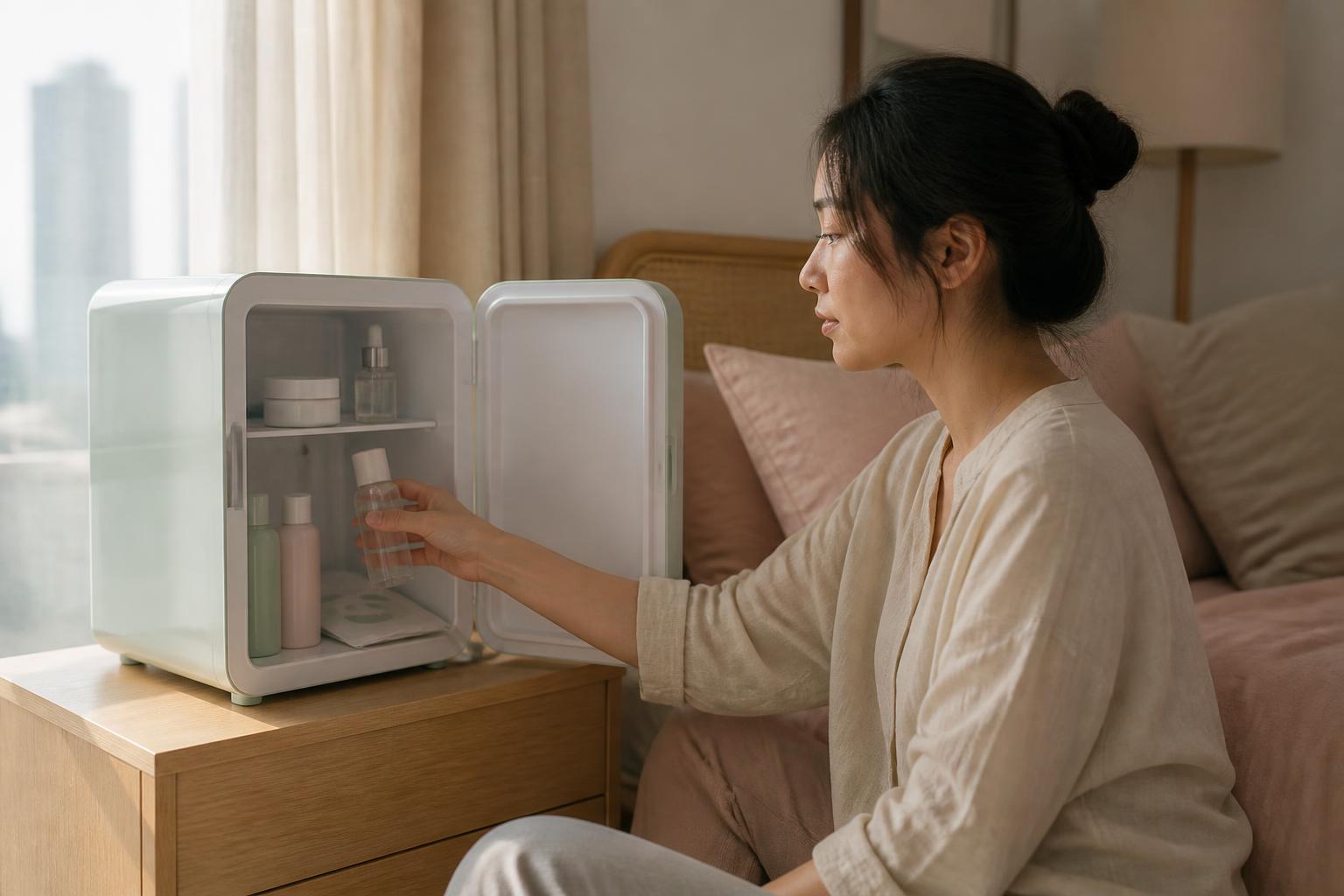
That is the real argument for a skincare fridge, and it is a narrower argument than the pastel Instagram shelfies suggest. Chilling helps some products meaningfully, does nothing for others, and can actively work against a few. Worth knowing which is which before you spend on one.
What heat actually does to a formula
Chemical reactions speed up as temperature rises. That is not a skincare-specific claim, it is basic chemistry, and it applies to the ingredients in your bottles as much as anything else. Oxidation, hydrolysis, and the slow breakdown of preservative systems all move faster in a warm cupboard than a cool one.
In practice, this shows up in a few recognisable ways:
- Ascorbic acid serums darkening from clear to yellow to brown
- Oils in a balm or facial oil going rancid, with a crayon-like or off smell
- Emulsions separating, where a lotion looks grainy or watery at the top
- Retinoids losing strength, which you notice as a product that used to sting slightly and now does nothing
Malaysian bathrooms are a hostile environment for all of this. Hot showers, no air-conditioning, humidity that never really drops. If your products live on an open shelf near the shower, they are sitting in a warm, damp box for hours a day. A bedroom drawer in an air-conditioned room is already a big improvement, and it costs nothing.
Which products genuinely benefit from being chilled
A skincare fridge typically runs cooler than room temperature but warmer than a food fridge. That range suits a specific set of products.
Pure vitamin C serums, especially L-ascorbic acid at higher concentrations, are the strongest case. They oxidise readily, and once they brown, the antioxidant activity has largely gone. Cooler storage slows that down. Derivatives like sodium ascorbyl phosphate or ethyl ascorbic acid are more stable to begin with, so the benefit is smaller.
Products with a high oil content also do better cool. Facial oils, cleansing balms, and anything built around rosehip or other unsaturated oils will go off eventually, and warmth accelerates it. If you have ever opened a jar of cleansing balm that smelled like old nuts, that was oxidation.
Sheet masks are the low-stakes win. A chilled hydrogel or cotton sheet mask on a Saturday afternoon when you have just come in from outside feels genuinely good, and cold does temporarily calm redness and reduce puffiness. That effect is real, though it fades within the hour. Eye gels and jade or metal facial tools fall into the same category: nice, immediate, not preservation.
Some natural or minimally preserved products, and anything labelled for refrigeration by the brand, should follow the label. If a Korean brand or a local Malaysian small-batch maker tells you to refrigerate after opening, that instruction exists for a reason.
What you should not put in there
Sunscreen is the main one. Malaysian UV is high year-round, and your SPF is the product doing the most work. Most sunscreens are emulsions, and repeated cooling and warming can destabilise the emulsion, causing the filters to distribute unevenly. A separated sunscreen may not deliver the protection on the label. Keep it in a cool, shaded, room-temperature spot instead. Same for the tube you carry in your handbag: out of direct sun, out of a parked car.
Thick balms, petrolatum-based occlusives and heavy shea butters get uncomfortably firm when chilled, and you end up dragging them across your skin. Clay masks can thicken and become hard to spread. Anything in a pump with a fine nozzle can clog if the formula stiffens.
And one thing to be honest about: putting a product in the fridge does not extend a period-after-opening date. The PAO symbol on the packaging, the little jar icon with a number like 6M or 12M, is about preservative performance once air and fingers have been introduced. Chilling helps with heat degradation. It does not reset that clock.
The Malaysian climate question: air-con is doing more than you think
If you live and work in air-conditioned spaces, your products may already be spending most of their life in a stable, cool environment. The problem is usually the bathroom, the car, and the commute.
A few free changes that address most of the actual risk:
- Move your active serums out of the bathroom and into a bedroom drawer
- Keep bottles in their boxes, or at least out of direct light from a window
- Never leave skincare in a parked car, where interior temperatures climb fast
- Close lids and caps properly, since air exposure matters as much as heat for oxidation
- Buy smaller sizes of vitamin C and retinoids so you finish them before they age
That last one is the ringgit-conscious version of the whole argument. A 30ml vitamin C you finish in two months is better value than a 60ml bottle you are still using at month six, regardless of where you store it.
So is it worth the money?
A mini fridge is a reasonable buy if you own several oxidation-prone actives, if your only storage space is a hot bathroom, or if you use sheet masks often enough that the chilled version becomes a real part of your routine. On Shopee and Lazada these units are inexpensive relative to a single mid-range serum, and Watsons and Guardian occasionally carry them too. If it makes you more consistent with a routine you already like, that consistency is worth something on its own.
It is not worth the money if you are buying it to make a shelf look better, or if you think it will meaningfully extend the life of a hyaluronic acid serum, a niacinamide toner, or a gentle cleanser. Those formulas are already stable at room temperature. A fridge full of things that did not need chilling is just an appliance drawing power in the corner of your room.
One practical note on the hardware: cheap thermoelectric units can run cold enough to freeze things near the back wall, and a frozen and thawed emulsion often never recovers its texture. Check yours for a few days before you trust a favourite serum to it.
A simpler way to know if it's working
The honest test is your own products. Watch for colour shifts, smell changes, texture separation, and the point at which an active stops producing the tingle or the results you were used to. If you can notice that a serum reached month four looking exactly as it did on day one, you have your answer. If you keep discovering half-used bottles that went off, storage is only part of the problem.
Writing down when you open a product and what you notice over the following weeks makes those patterns visible. You can track your routine with Roona and log what you are using, when you opened it, and how your skin responds, which turns a vague sense of "this one didn't last" into something you can actually check.
If you already have a fridge, use it for the few things that earn the space. If you don't, move your serums out of the bathroom this week and see whether that alone changes anything. Either way, there's no rush.
Trend source: metro.co.uk (MY)
Keep reading
-

Sephora Afterpay Sale Singapore: What to Buy and Skip
Make smarter Sephora Afterpay Sale purchases in Singapore with a practical guide to useful skincare, makeup and haircare deals worth skipping. 27 August 2026 -

Why Asian Skin Is Not a Monolith, Says Dr Teo Wan Lin
Dr Teo Wan Lin explains why Asian skin needs more than one beauty label, with practical formulation lessons for Malaysia's climate and routines. 27 August 2026 -
The Viral Skincare 'Dangers' You Can Safely Ignore
Not every viral skincare warning deserves your anxiety. Here's how to tell which ingredient fears are grounded in evidence and which are just noise. 10 August 2026