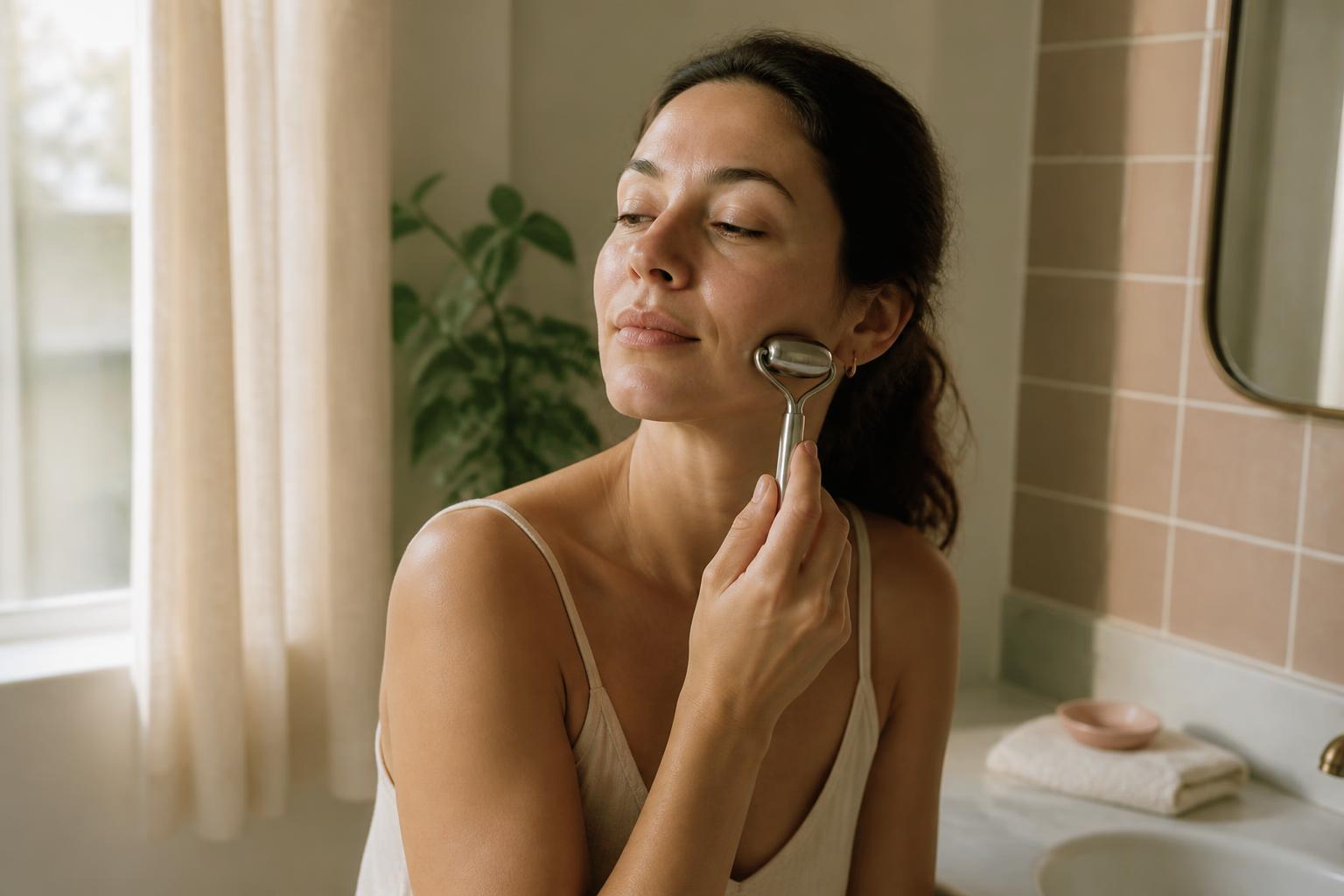
You wake up with a puffy face, open TikTok while the coffee brews, and someone is dunking their head into a bowl of ice water and calling it homemade Botox. Twenty minutes later you are watching a second video where a wooden gua sha tool gets dragged along a jawline, then a third where someone claims a drugstore face mask tightened their forehead lines in one sitting. By the time you brush your teeth, you have absorbed three different promises about your own face.
Some of what you saw does something real. None of it does what Botox does. Both halves of that sentence matter, because the useful version of these routines gets lost when they are marketed as needle replacements.
What Botox actually does, in one paragraph
Botulinum toxin injections work by interrupting the signal between a nerve and a specific muscle, so that muscle stops contracting as strongly for a period of time. That is why it is used on expression lines: the crease softens because the movement that folds the skin is reduced. It requires a licensed injector, it targets muscles you cannot reach from the outside, and it wears off. No topical product, tool, or temperature change reaches a nerve terminal. A cold bowl of water on your skin is working on blood vessels and fluid, several layers away from anything a neurotoxin touches.
So when a video labels a technique "homemade Botox", read it as a claim about how the result looks in a ten-second clip, not a claim about mechanism.
Facial icing: real, temporary, and mostly about fluid
Cold constricts blood vessels near the surface of the skin. Press an ice roller along your under-eyes and jaw and you will usually see less puffiness for a while, because you have moved fluid and calmed some flush. That is a genuine effect, and if you sleep poorly, eat late, fly a lot, or wake up looking swollen after a salty dinner, it is a pleasant way to start the morning.
What it is not doing is changing muscle activity or the structure of a line. When your skin returns to its normal temperature, the effect fades. If you have rosacea or skin that flushes hard, aggressive cold can also backfire, since the rebound dilation can leave you redder than you started.
A few things that keep icing gentle:
- Wrap ice in a soft cloth, or use a chilled roller instead of direct contact
- Keep it to a couple of minutes per area, not a held plunge
- Skip it on freshly exfoliated or actively irritated skin
- Pat dry and follow with your usual moisturizer while skin is still slightly damp
In a dry Midwestern January, icing before your moisturizer is fine. Icing instead of your moisturizer is how you end up with a tight, flaky forehead by lunchtime.
Gua sha and facial massage: lymph, not lift
Gua sha has a long history in traditional Chinese medicine, and the version circulating on American beauty TikTok is a stripped-down cosmetic adaptation of it. Used with slip from a facial oil, moving from the center of the face outward and down the neck, it encourages lymphatic drainage and eases tension in muscles that clench, particularly around the jaw and temples.
That tension release is worth taking seriously. If you grind your teeth or hold your phone between your shoulder and ear, your masseter and jaw can stay tight for hours, and softening that changes how your lower face sits. Ten minutes of massage will not reposition fat pads or tighten skin permanently. The word "lifting" in these videos is doing a lot of work it has not earned.
The risk is pressure. Dragging a hard stone across dry skin, especially over active breakouts or inflamed acne, can spread bacteria and worsen irritation. Broken capillaries and bruising happen when people press as hard as they would on a sore hamstring. Keep the stone nearly flat, use enough oil that it glides without catching, and stop before it becomes uncomfortable.
Needle-free microcurrent hacks: two different things wearing one name
The term microcurrent covers actual low-level electrical current devices, the Sephora-shelf category, and a growing pile of hacks that borrow the word without using any current at all. Real microcurrent devices deliver a weak current intended to stimulate facial muscles, and the visible effect is short-lived and dependent on regular use. People who like them treat them the way they treat the gym: a standing appointment, not a one-off.
The hacks are the part to watch. Egg white masks, aluminum-foil setups, DIY "tightening" pastes and taping the face overnight all produce a temporary drawn-tight sensation. That feeling is the mask drying and contracting on the surface of your skin, plus a bit of trapped surface moisture. It can also mean you have stripped the lipids you needed, which shows up two days later as stinging when you apply serum.
If you want to spend money in this category, spend it on the device with published instructions and a conductive gel, and skip anything that involves a home chemistry setup near your eyes.
The lines these routines actually influence
There is a category of change that consistent surface care does affect, and it gets less airtime because it is slower. Fine crepey texture, dullness, and the shallow lines that look worse when your barrier is dehydrated all respond to boring maintenance. When the top layers hold water properly, light bounces differently and skin reads smoother. That is not a trick, it is hydration doing what hydration does.
The ingredients with the strongest evidence behind long-term texture and line improvement are still the ones you have heard about a hundred times: a broad-spectrum SPF worn daily, a retinoid used at whatever frequency your skin tolerates, and vitamin C in the morning if you like it. Niacinamide and ceramides support the barrier while the retinoid does its work. None of these will freeze a muscle, and none of them need a viral name.
Seasonality matters in the United States more than most routine advice admits. Indoor heating from November through March pulls moisture out of the air, so the same routine that felt rich in Atlanta in August may feel inadequate in Chicago in February. Adjusting the moisturizer rather than adding four new actives is usually the move.
How to try a trend without paying for it later
Most of the harm from viral face hacks does not come from the hack itself. It comes from stacking it on top of three other new things and losing track of which one caused the reaction.
- Add one new thing at a time and give it two to four weeks
- Keep your cleanse, moisturize and SPF steps constant while you test
- Write down the date you started, so you are not reconstructing it from memory later
- Note what your skin does on day three, not just day one, since irritation lags
- Drop anything that stings on application every single time
This is exactly where a log earns its place. If you track your routine with Roona, you can see whether that morning ice roller lines up with the mornings your face looked less puffy, or whether the change actually tracked with better sleep. Patterns in your own skin are more useful than any creator's before-and-after lighting.
What to take from the trend
Icing reduces puffiness for a while. Gua sha eases tension and moves fluid, and feels good doing it. Microcurrent devices give a short-term effect if you use them consistently. All three are reasonable additions to a routine you already like. None of them are injections, and treating them as substitutes sets you up to feel let down by techniques that were never going to deliver that.
If you enjoy the ritual, keep it. Five quiet minutes with a cold roller and an oil is a decent way to be gentle with yourself before a long day. If you are hoping to soften a specific expression line, that is a conversation with a board-certified dermatologist, and there is no shame in asking what your options are.
Whenever you want a calmer way to see what your skin is actually responding to, Roona is here to keep the notes for you.
Trend source: WWD (US)
Keep reading
-

After 40, This Viral Skincare Routine May Overwork Your Skin
Why the viral multi-step skincare routine can irritate skin after 40, plus a gentler Singapore routine with acids, retinoids and SPF. 5 September 2026 -
Tretinoin: What It Does and What Adjusting Really Feels Like
An honest look at tretinoin: how it works, who tends to use it, what the adjustment period involves, and how to start slowly without wrecking your barrier. 20 August 2026 -

When Skincare Became Content: The Movie Theater Moment
A creator filmed her nighttime routine mid-screening and the internet erupted. A calm look at what performed self-care costs, and how to get your routine back. 18 August 2026