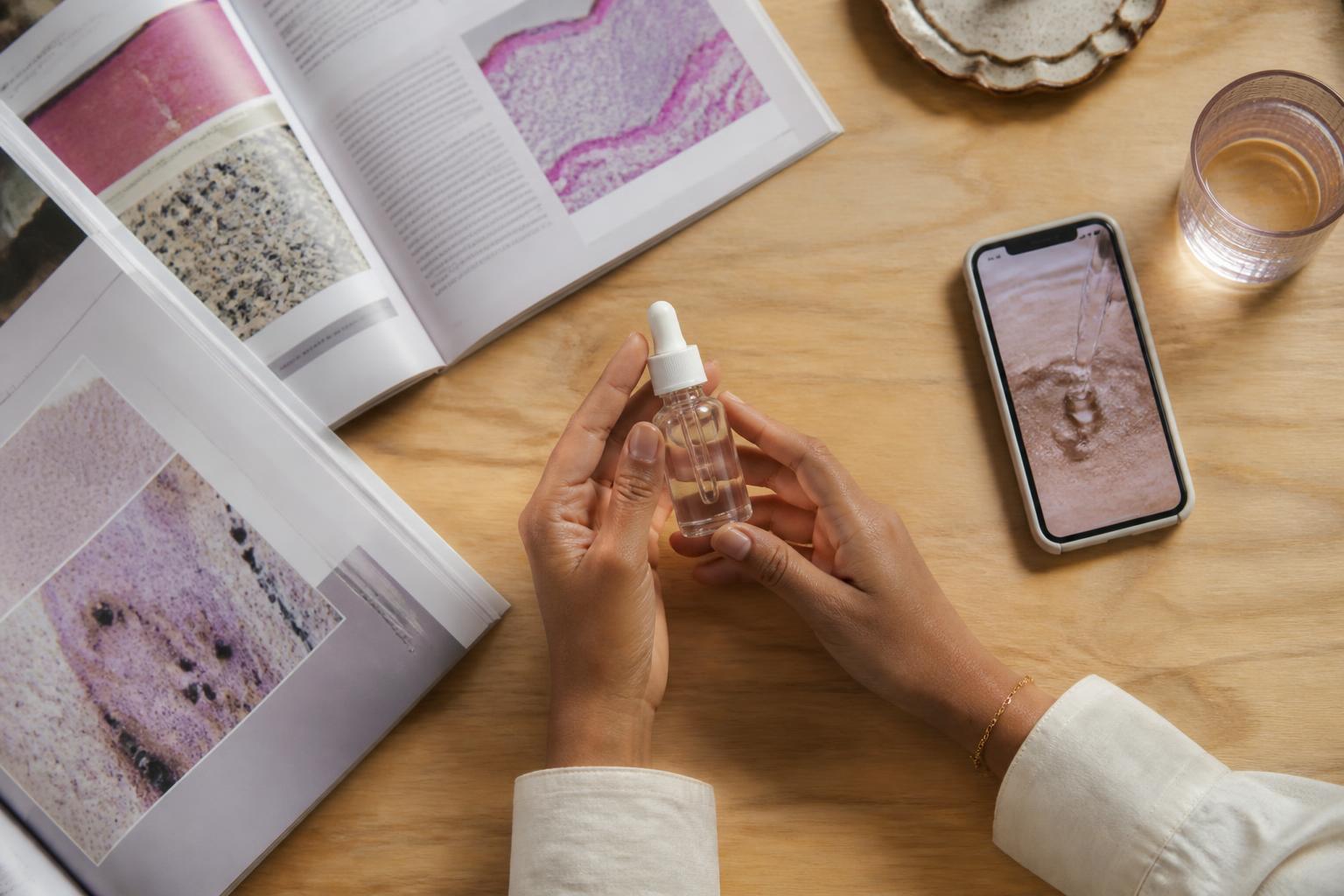
You see the TikTok. A dermatologist holds up a serum and calls one ingredient the thing your routine has been missing. Two days later, three versions of that product are sold out at Ulta, and your algorithm is wall-to-wall before-and-afters. A week after that, another dermatologist posts a video with the caption: "Let's talk about why that ingredient is overhyped."
This cycle repeats every few weeks with a new name. The question is not whether the ingredient is legitimate, but whether the specific claim being made about it matches what the research actually supports.
The Anatomy of Ingredient Hype
Most viral ingredient moments follow a template. A study gets published, often in a niche dermatology journal. A brand reformulates an existing product to feature that ingredient higher on the label. A few influencers post about it. Then someone with credentials weighs in, the algorithm picks it up, and suddenly the ingredient is everywhere.
The ingredient itself may be decades old. Niacinamide has been studied since the 1970s. Azelaic acid has been used for rosacea since the 1980s. What changes is the marketing narrative, not the science. A ingredient that was previously positioned as a supporting player in anti-aging suddenly becomes the star of a pore-minimizing routine. Same molecule, different story.
The problem is not that brands are lying. The problem is that a single true thing about an ingredient can be turned into a dozen implications that sound true but are not supported by the same evidence. An ingredient that improves skin texture in one study becomes "pore-erasing" in a caption. An ingredient that reduces hyperpigmentation over 12 weeks becomes a "dark spot eraser" in three days of posts.
What to Check Before You Buy
You do not need to become a chemist to navigate this. You need a few reliable checks.
Look for the concentration range. Most active ingredients only work within a specific percentage range. Niacinamide is effective between 2% and 10%. Azelaic acid typically needs to be at least 10% for significant results. If a product does not list the percentage and the ingredient is buried halfway down the ingredient list, it may be there for label appeal, not efficacy. INCI order matters: ingredients are listed by descending concentration until you hit the 1% threshold, after which order becomes less predictable.
Separate the ingredient from the product. An ingredient can have strong evidence while a specific product contains too little of it to matter, pairs it with ingredients that destabilize it, or skips the delivery system that made it work in studies. Retinol is effective, but retinol in a jar exposed to light and air degrades quickly. Vitamin C works, but L-ascorbic acid requires a low pH and an airless pump to stay stable. The ingredient's reputation does not transfer automatically to every product that lists it.
Check what the ingredient is actually proven to do. Most ingredients have one or two well-supported uses and a handful of things they might help with under specific conditions. Tranexamic acid has solid evidence for melasma. It may help with post-inflammatory hyperpigmentation, but the studies are smaller and the results are more variable. If someone is selling it as a universal brightening solution, that is a reach. When tracking your routine with Roona, pay attention to what you are actually trying to address. An ingredient with strong evidence for one concern may do very little for another.
Notice the timeline. Most active ingredients take weeks to show results. Niacinamide may calm redness within days, but its effects on hyperpigmentation take four to eight weeks. Retinoids often require three months. Azelaic acid sits somewhere in between. If a product promises visible change overnight, it is probably relying on silicones, temporary plumping from hydration, or a subtle tint, not the active ingredient doing its job.
The Comparison Problem
When an ingredient goes viral, the comparison game starts immediately. Is it better than retinol? Can it replace vitamin C? Should you use it instead of niacinamide?
These questions assume that ingredients are interchangeable based on results, but they are not. Retinoids increase cell turnover. Vitamin C is an antioxidant. Niacinamide strengthens the skin barrier and regulates oil. Azelaic acid is antimicrobial and exfoliating. They do different things through different mechanisms, and many of them work better together than alone.
The "better than" framing is marketing strategy, not science. What matters is whether the ingredient addresses your specific concern through a mechanism that makes sense for your skin. Azelaic acid is a strong option for rosacea because it reduces inflammation and targets the bacteria associated with rosacea. That does not make it better or worse than niacinamide in general. It makes it better for rosacea specifically.
How to Test Without Getting Swept Up
If you want to try a viral ingredient, test it like you would test anything else. Introduce one product at a time. Keep the rest of your routine stable so you know what is actually causing any change you see.
Document what you are tracking. Take photos in the same light at the same time of day. Write down what you are hoping to improve. After the appropriate timeline, compare. Did the thing you wanted to address actually improve, or did you just get used to the product being in your routine?
If it worked, keep it. If it did not, you have information. Maybe the percentage was too low. Maybe your skin does not respond to that particular mechanism. Maybe the concern you were targeting needs a different approach entirely. That is useful, not a failure.
When the Hype is Not Wrong
Some viral moments are justified. When azelaic acid started gaining traction a few years ago, it was overdue. The ingredient has decades of research supporting its use for rosacea, acne, and hyperpigmentation, but it was undersold in the United States compared to Europe. The hype caught up to the evidence.
The problem is not that effective ingredients get attention. The problem is that the attention often outlasts the nuance. Azelaic acid works, but it does not work for everyone, it can be irritating during the adjustment period, and it requires consistency. Those details get lost when the focus is on before-and-after posts and sold-out product links.
You can benefit from viral ingredients without getting caught in the cycle. Use the attention as a signal to investigate, not a directive to buy. Read the studies if you can access them. Check multiple dermatologist sources, not just the ones that went viral. Look at how the ingredient is formulated in the product you are considering, not just whether it is listed.
The next viral ingredient is already in development. Someone is drafting the post. The product is being reformulated. When it arrives, you will have a framework. Not because you have become skeptical of everything, but because you know what questions to ask before the algorithm makes the decision for you.
If this resonates, Roona helps you track what you are actually using and what you are actually seeing, so the next time an ingredient goes viral, you will know whether your skin already has what it needs.
Trend source: Charlotte Observer (US)
Keep reading
-
Japanese Beauty for Mature Skin: 9 Evidence-Backed Picks
K-beauty dominates, but Japanese formulations have quietly perfected mature skincare. What works for Singapore's climate and why the science holds up. 26 July 2026 -

Honey in skincare: what it really does and when it works
Honey is trending in skincare, but raw honey, honey extract, and medical-grade honey serve different purposes. Learn what each one does. 10 October 2026 -
What Longevity Science in Skincare Really Delivers
Darkfin Labs' Ulta launch brings longevity skincare to a wider audience. Learn what the science can support, where claims stretch, and what to use. 8 October 2026