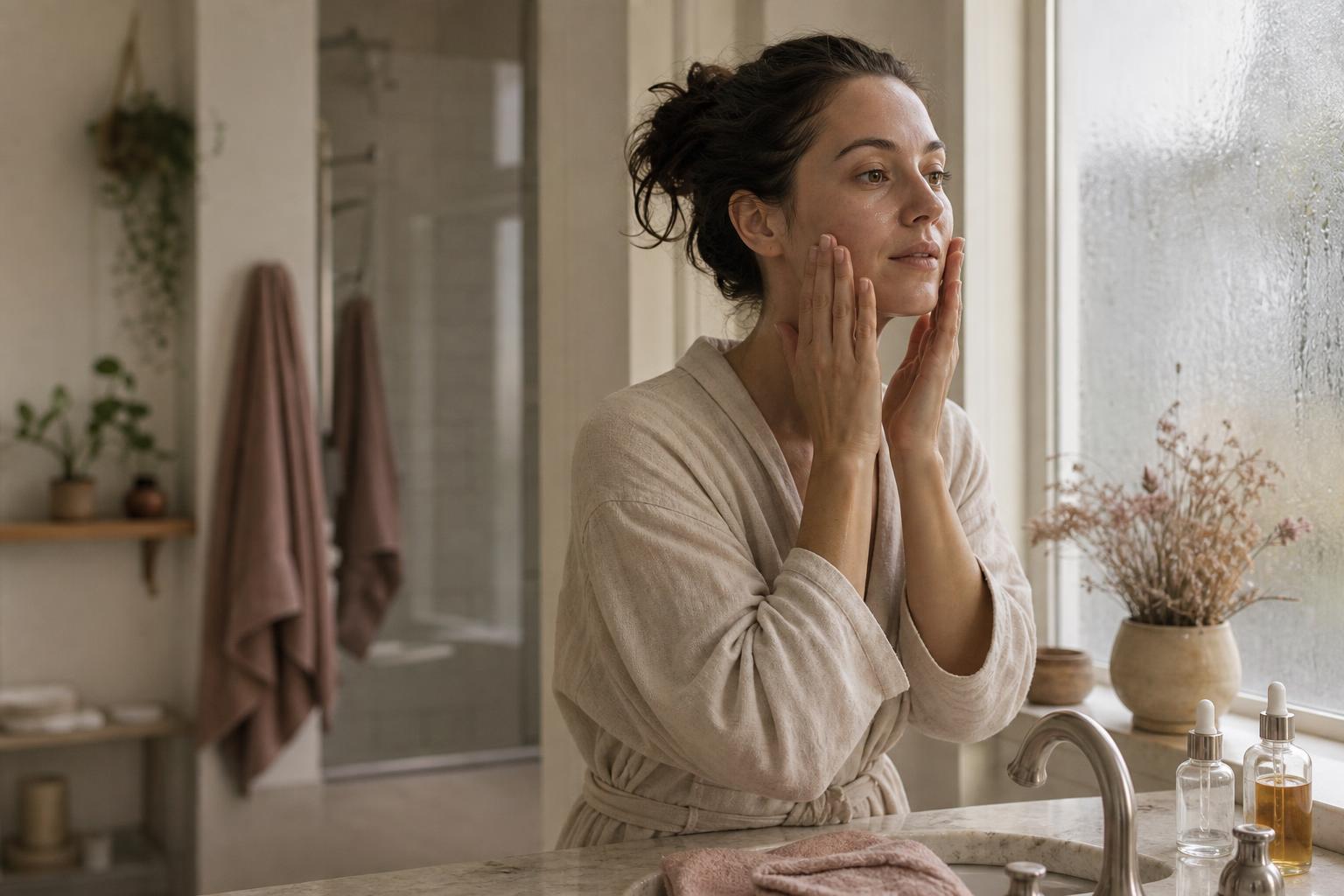
You splash your face, pat on a hyaluronic acid serum while your skin is still wet, follow it with an essence, then a cream, and for about twenty minutes your cheeks look plumped and glassy. By mid-afternoon, with the radiator running, they feel tighter than before you started. That gap between the immediate result and the four-hour result is the whole story of skin flooding.
The technique has picked up momentum as a cold-weather fix, and the name does a lot of the marketing. Flooding sounds generous. It sounds like the answer to a face that stings when you walk from a heated apartment into January wind. Some of it holds up. Some of it depends entirely on what you put on last.
What skin flooding actually means
Skin flooding is a layering sequence, not a product. You cleanse, or just rinse with lukewarm water, and leave your face damp. You press in a hydrating toner, essence, or a few spritzes of water-based mist, then apply a humectant serum, usually hyaluronic acid or glycerin, while skin is still wet. Add a second thin hydrating layer if your skin drinks the first one up, then seal everything with a moisturizer, ideally one containing occlusive ingredients.
The damp-skin step is the part people fixate on, and it does matter. Humectants pull water toward themselves. Applied to a dry face in a dry room, they have to source that water from somewhere, and the nearest reservoir is your own skin. Applied to damp skin and then covered, they hold surface water where you want it.
So the method is a reasonable interpretation of how humectants behave. The trouble is that people treat the flooding part as the active step and the moisturizer as an afterthought.
Why hyaluronic acid alone struggles in dry air
Hyaluronic acid is a humectant. Its job is attracting and binding water, and it does that well. What it does not do is stop water from leaving. Nothing about a hyaluronic acid serum slows transepidermal water loss, which is the ordinary process of moisture evaporating from your skin into the air around it.
In a humid summer, that process is slow, because the air is already carrying a lot of water. Central heating in winter changes the math. Warm indoor air holds more moisture capacity while the actual moisture content stays low, so it pulls harder at anything wet, including your face. A layer of hyaluronic acid sitting uncovered in that environment is a sponge in a wind tunnel.
This is the mechanism behind the complaint you see every winter: someone adds a hyaluronic acid serum, uses it faithfully, and their skin feels drier and more reactive than it did in November. The serum did not damage anything. It just was not asked to do the part that mattered.
Does flooding beat a regular moisturizer?
On its own, no. Layered under a good moisturizer, it can add something, mostly comfort and that soft, cushioned surface feel that makes makeup sit better.
A moisturizer worth using in winter does three jobs at once. It carries humectants like glycerin or hyaluronic acid to attract water. It carries emollients like squalane, ceramides, or fatty acids to smooth the spaces between skin cells. And it carries occlusives like petrolatum, shea butter, or dimethicone to slow evaporation. A single well-formulated cream covers all three, which is why the honest answer to "flooding or moisturizer" is that the moisturizer is doing most of the work.
Flooding earns its place on skin that feels tight within minutes of cleansing, before you have applied anything, and in very dry indoor air, the kind where you wake up with a dry throat. It also helps during weeks when you are using a retinoid or an exfoliating acid and want extra cushioning, and on makeup days, when a hydrated base genuinely photographs better.
Where it tends to disappoint: oily and congestion-prone skin in a warm apartment, where four damp layers under a heavy cream can leave you shiny and clogged rather than dewy. And any routine where the last step is a lightweight gel. A gel-cream in a Chicago February is not sealing much of anything.
A winter layering routine that holds up
Here is a version that keeps the useful parts and drops the theater. Evening, since that is when most of the repair work happens and when you are not rushing.
- Cleanse with something non-stripping. Cream, milk, or a gentle gel. If your face feels squeaky after, the cleanser is the problem and no amount of layering will out-run it.
- Do not towel dry completely. Blot, leave skin visibly damp.
- Press in one hydrating layer: a glycerin-heavy toner or essence works as well as anything marketed for flooding.
- Apply your humectant serum. One layer is usually enough. Two if your skin is genuinely parched.
- Follow with a cream containing ceramides and an occlusive. This is the step that determines whether any of the previous steps last.
- On the driest nights, tap a thin layer of an occlusive balm over the top, concentrating on cheeks and around the nose. Skip the eye area if you tend to puff.
Mornings, compress this. Damp skin, one hydrating layer, moisturizer, then broad-spectrum SPF 30 or higher. Winter sun in the United States still reaches you, and it reflects off snow with real intensity, which is why skiers burn under their chins.
How to tell if it is working for you
The immediate feel of skin flooding is not the test. Everything feels plumped when it is wet. What matters is how your face feels four hours later, and how it feels first thing in the morning.
Over two to three weeks, watch whether the tight feeling after cleansing shortens or disappears, whether flaking around the nose and mouth settles, and whether foundation stops clinging to dry patches by lunchtime. Watch too for anything new appearing along the jaw or hairline, which suggests too many layers.
Change one variable at a time. If you add a hydrating essence, a new serum, and a richer cream in the same week and your skin reacts, you have no way to know which one did it. Keeping a simple record of what you used and how your skin felt the next morning turns guesswork into something you can actually read, and it is exactly what logging your routine with Roona is built for.
The unglamorous winter variables
Layering is only one input. A humidifier in the bedroom does more for morning tightness than a fourth serum, because it changes the air your skin sits in for eight hours. Shorter, cooler showers matter, since hot water strips the lipids that hold moisture in. A scarf pulled over your cheeks on a windy walk is genuinely protective.
And sometimes the answer is subtraction. Dryness that arrives suddenly in winter is often a barrier that has been sanded down by too-frequent exfoliation, a strong retinoid used on a schedule that made sense in September, or a foaming cleanser used twice a day. Flooding on top of that treats the symptom while the cause keeps working.
If your skin is cracking, weeping, or persistently stinging, that is worth a conversation with a dermatologist rather than another product.
Where that leaves skin flooding
It is a decent technique with an oversized reputation. Applying humectants to damp skin and sealing them in is sound practice, and the sequence gives people a clear reason to stop using hyaluronic acid as a standalone step, which was always the mistake. Just do not expect the layers themselves to carry winter. The cream on top does that.
If you try it, give it a few weeks and pay attention to the boring measurements: how your face feels when you wake up, whether the tightness fades. Roona is here whenever you want somewhere to keep track of what your skin is telling you.
Trend source: Medianet News Hub (US)
Keep reading
-

In-flight skincare kits: what to buy before you board
Airport skincare kits promise relief from dry cabin air. Learn which ingredients and travel-size products are worth packing before your flight. 27 September 2026 -

Why Pamela Anderson's Simple Skincare Routine Works
A four-step routine won over the skeptics. What makes a minimal skincare approach repeatable, and how to build your own version at home. 3 August 2026 -

Honey in skincare: what it really does and when it works
Honey is trending in skincare, but raw honey, honey extract, and medical-grade honey serve different purposes. Learn what each one does. 10 October 2026