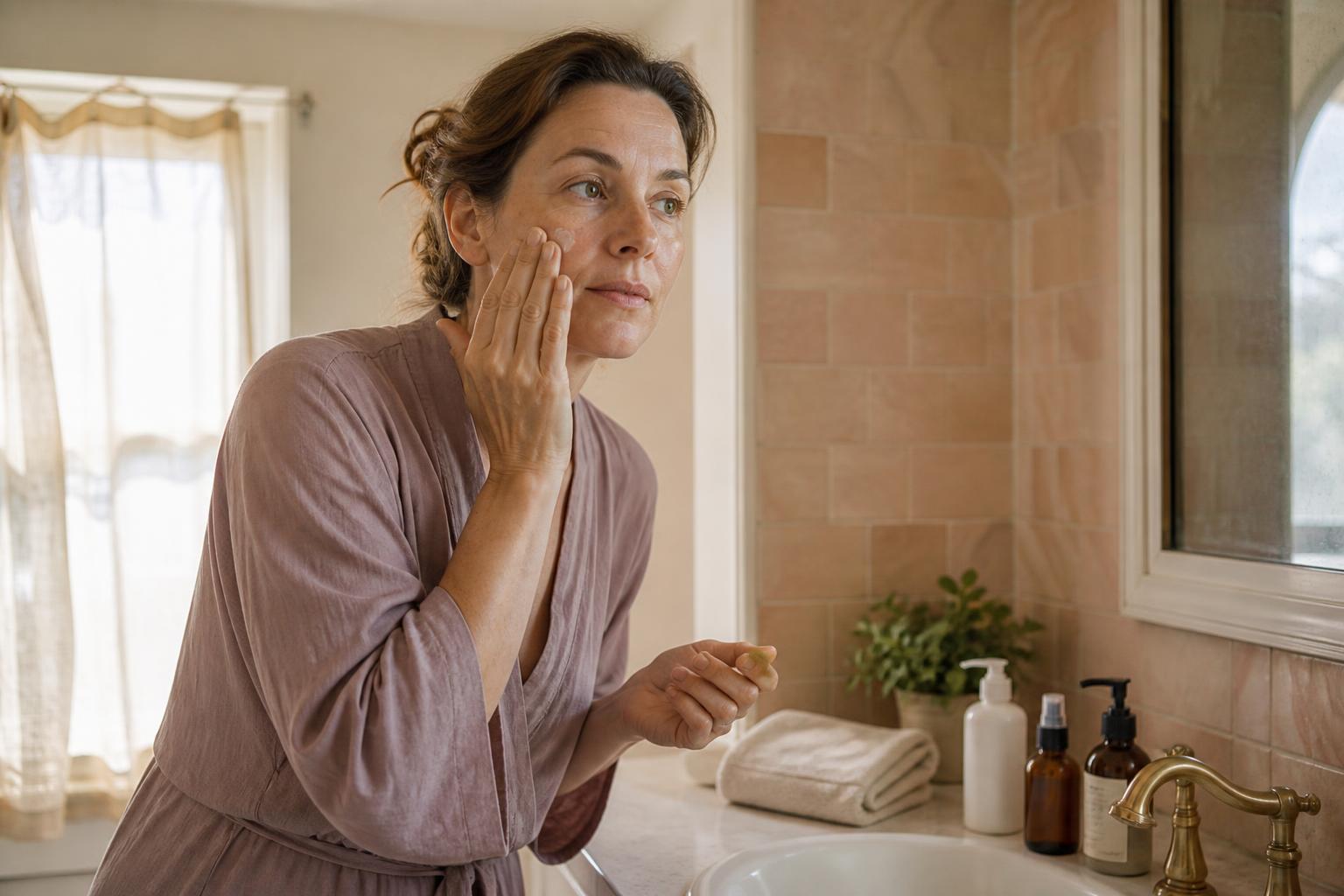
You stand at the bathroom sink at 11pm with eight bottles in front of you and pick three of them, mostly by mood. The essence you bought in July is still three quarters full. The retinol is somewhere behind the sunscreen. You have no idea which of these is actually doing anything, and you are too tired tonight to find out.
That pile is the reason Pamela Anderson's pared-back approach has been getting attention. She has been public about going makeup-free at events where nobody goes makeup-free, and about keeping her skincare short. Four steps, roughly. No twelve-part evening ritual. For a reader who has been told for years that more products equal more results, that lands differently than another celebrity routine with fourteen line items.
What is worth unpacking is not her specific shelf. It is the structure underneath it, because that structure is the part you can copy.
What a four-step routine actually covers
Strip almost any dermatologist-recommended routine down to its load-bearing parts and you get the same short list:
- A gentle cleanser, used at night and rinsed with lukewarm water
- A hydrating layer, usually a serum or essence with humectants like glycerin or hyaluronic acid
- A moisturizer with something occlusive or emollient in it, so the water you just added stays put
- Broad-spectrum SPF 30 or higher, every morning you will see daylight
That is the whole architecture. Everything else, the exfoliating acids, the retinoids, the vitamin C, the azelaic acid, sits on top of it as a targeted addition for a specific concern. Useful additions, often. But they are the second floor, not the foundation.
Most overstuffed routines fail because they have three second floors and no foundation. Six actives, no consistent moisturizer, sunscreen only on beach days.
Fewer products means fewer suspects
Here is the practical advantage that gets lost in the conversation about minimalism as an aesthetic. When you use four products, and your cheeks start stinging on a Tuesday, you have four suspects. When you use eleven, you have a research project.
Irritation is the most common way American skincare routines quietly go sideways. Not one dramatic reaction, just a slow creep: a little tightness after cleansing, some flaking around the nose, a patch near the jaw that stays pink. It builds over weeks from a glycolic toner plus a retinol plus a physical scrub plus a foaming cleanser with a high pH, none of which would have caused trouble alone.
A short routine makes that easier to catch, and much easier to fix. You drop one thing, wait two weeks, see what happens.
The makeup-free part is not incidental
Anderson's decision to skip makeup at public events is often framed as a confidence story. It also has a boring mechanical effect on skin: less to remove at night.
Heavy makeup removal is where a lot of over-cleansing lives. Oil cleanser, then a foaming cleanser, then a micellar pass with a cotton pad because you saw a smudge, then a toner to get rid of any residue. Four rounds of surfactant and friction on the same face. Skin that gets that treatment nightly often responds by feeling tight and looking dull, which people then read as a hydration problem and treat with more product.
You do not have to give up makeup to get the benefit. Wearing less of it on ordinary days, or skipping it on a weekend, gives you a genuinely gentler evening: one cleanse, one moisturizer, done.
Where a minimal routine falls short
A four-step routine handles hydration, barrier support and sun protection. It does not treat everything, and pretending otherwise is how minimalism turns into its own kind of overpromise.
If you are dealing with persistent acne, melasma, rosacea or texture that has not budged in a year of consistency, the four steps are your base, not your answer. That is the point at which a targeted active or a visit to a dermatologist does more than another moisturizer will. Insurance and access being what they are in the United States, telederm services and drugstore-tier options with proven ingredients, adapalene for acne, azelaic acid for redness and tone, are worth knowing about.
The honest version of the minimal-routine argument: it makes a reliable floor, and it makes any active you do add easier to tolerate.
Building your own four steps
Start from what your skin does in the environment you actually live in, not what looks good on a shelf.
- If winter indoor heating leaves your face tight by mid-January, weight your routine toward the moisturizer. A thicker cream at night, ceramides or squalane in the ingredient list, and a humidifier in the bedroom do more than any serum.
- If you are somewhere humid most of the year, Houston, Miami, most of the Southeast in August, a gel-cream and a fluid or gel sunscreen will feel wearable enough that you keep using them. Wearability is not a small thing. The SPF you tolerate beats the SPF you own.
- If you are oily and breakout-prone, keep the four steps and make the hydrating layer lightweight. Skipping moisturizer to control shine usually backfires.
- If your skin is reactive, cut fragrance and essential oils from all four products before you change anything else.
Buy in that order too. Cleanser and moisturizer are where consistency pays off, and both are areas where a well-formulated drugstore option holds up fine against the Sephora shelf. Save the budget for the one active that addresses your actual concern.
Consistency is the variable nobody markets
The reason a four-step routine outperforms a twelve-step routine for most people has nothing to do with the products. It is that you will still be doing the four-step version in March.
Skin changes slowly. Barrier repair takes weeks. Pigment shifts take months, and only with daily sunscreen. Almost nothing you do tonight shows up tomorrow morning, which makes it very hard to tell whether something is working, and very easy to abandon it early for whatever is trending. That gap between effort and visible change is where most routines die.
Writing down what you used and how your skin felt closes that gap a little. Patterns that are invisible day to day, the way your skin reacts three days after you introduce a new serum, or how it behaves in the week you travel, get obvious once they are on a timeline. If you want something built for that, you can track your routine with Roona and let the record do the remembering instead of your memory.
What to take from it
The useful lesson from any celebrity routine is never the shopping list. It is the shape. Cleanse gently, add water, seal it in, protect it from the sun, then add one targeted product if you have a specific concern and give it a real trial period.
That is a routine you can do at 11pm when you are tired, in a hotel bathroom, in February when your face is tight and in July when it is not. It survives contact with a normal life, which is most of what a skincare routine has to do.
If you want to see how your own four steps are actually landing, start a simple routine log with Roona and check back in a month. No overhaul required. Just a clearer picture of what your skin is responding to.
Trend source: People.com (US)
Keep reading
-

In-flight skincare kits: what to buy before you board
Airport skincare kits promise relief from dry cabin air. Learn which ingredients and travel-size products are worth packing before your flight. 27 September 2026 -

The Skincare Routine Athletes Actually Need
Sweat, sunscreen reapplication, and locker-room compromises. Here's how to build a routine that survives an active lifestyle without overcomplicating it. 8 August 2026 -
The Skincare Myths That Won't Die (and What Replaces Them)
Steam doesn't open pores and tingling isn't progress. A calm look at the skincare myths that keep circulating, and the less dramatic advice that works better. 4 August 2026