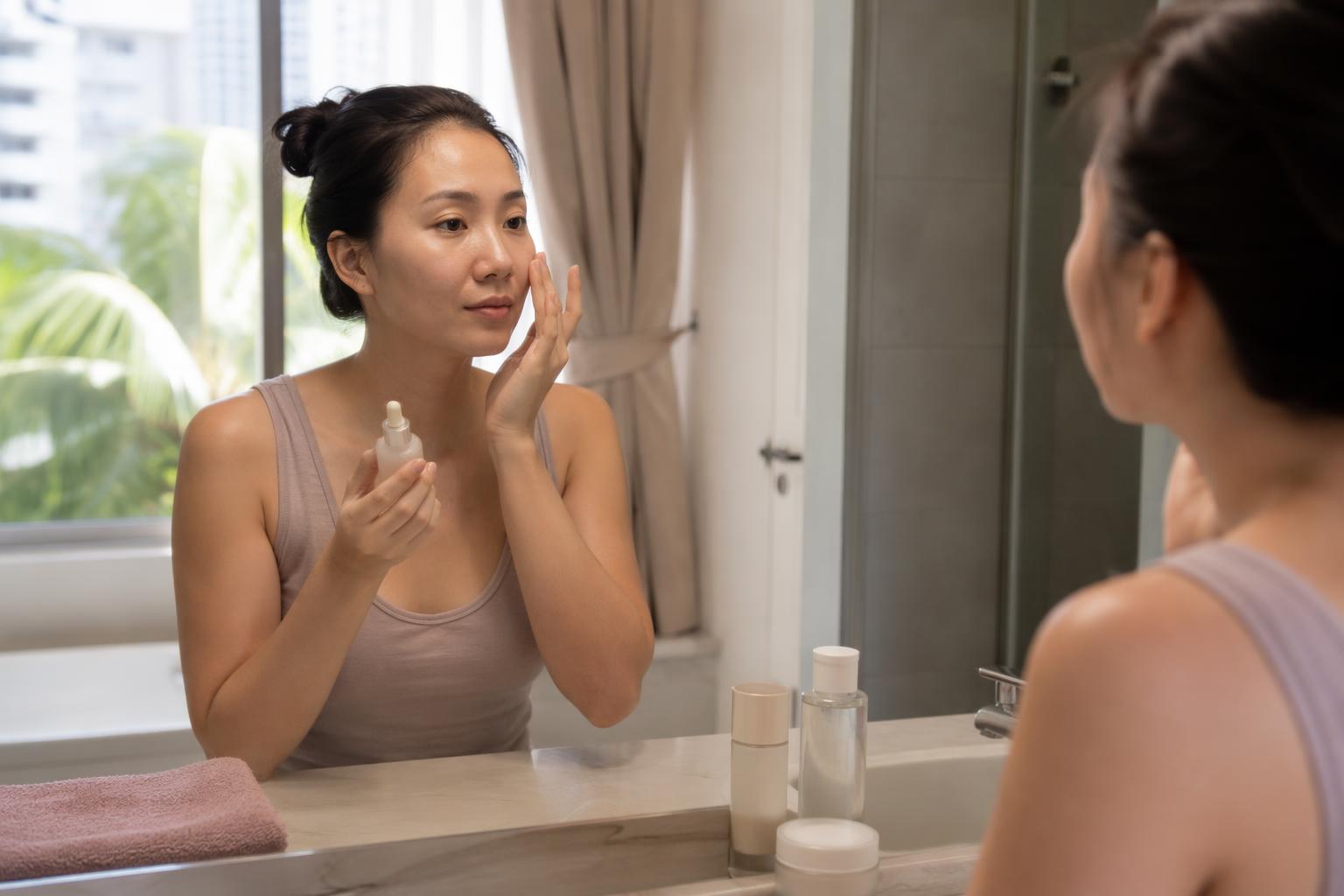
You apply a thin layer of a new serum, wait about a minute, and your cheeks start to prickle. Not stinging, not burning, just a persistent itch that makes you want to scratch along your jaw. That sensation is the entire selling point of spicules, and it is also the reason people either love them or quietly retire the bottle after one use.
Spicules have been circulating in Korean skincare for a while, and they show up regularly in Singapore now: in ampoules on Shopee, in "needle" serums on Sephora's K-beauty shelves, in the kind of clinic-adjacent brands that sit beside prescription retinoids on a dermatologist's counter. The pitch is consistent. Better penetration, faster turnover, visible smoothing in days rather than weeks. Worth understanding before you add one to a routine that already has to survive an MRT platform at 8am and an office at 22 degrees.
What spicules actually are
Spicules are microscopic needle-shaped structures made largely of silica, harvested from freshwater sponges. Under a microscope they look like tiny glass splinters. In a product, they are suspended in a serum, gel or loose powder, and when you press the formula into skin, thousands of them lodge in the upper layers of the stratum corneum.
That is the mechanism. Not a chemical action, a physical one. The spicules create temporary micro-channels through the outermost layer of skin, and anything dissolved alongside them, niacinamide, peptides, hyaluronic acid, centella extract, has an easier route in. The itching you feel is the spicules embedding. It usually peaks within the first few minutes and fades over the following hour or so.
Think of it as the at-home cousin of microneedling, operating at a much shallower depth. A clinic roller or pen is aiming for the dermis. Spicules are working at the surface, well above that.
What the tingling is telling you
The sensation is not evidence that the product is working harder. It is evidence that the spicules are in your skin. Those two things overlap, but they are not the same claim, and this is where a lot of the marketing gets loose.
A few things follow from the mechanism:
- Whatever active sits in the formula gets a shortcut past your barrier, so its effect is amplified rather than replaced
- Your skin is briefly more permeable, which also means more open to irritants applied straight afterwards
- Physical exfoliation happens as a side effect, which is why skin often feels smoother the next morning
- The effect is temporary; the micro-channels close as the barrier repairs itself
That second point is the one most people skip. If you follow a spicule serum with a strong acid toner or a fragranced essence, you have effectively increased the dose of everything, including the parts you did not want.
Whether it earns a place in a Singapore routine
Humidity changes the calculation. In a climate where skin rarely struggles to hold water, the main reason people reach for penetration-enhancing tech is not hydration. It is texture: closed comedones along the jaw, congestion around the nose that persists no matter how many BHA toners you cycle through, the slightly rough feel that comes from sebum mixing with sunscreen and sitting there for eleven hours.
Spicules do help with that surface roughness, in the same way a well-formulated physical exfoliant does, with the added benefit of delivering an active while they are at it. If your concern is congestion and unevenness, there is a reasonable case for trying one.
If your concern is barrier sensitivity, and in Singapore that often means skin caught between outdoor sweat and indoor aircon dryness, the case is much weaker. Skin that already flushes easily, or that reacts to your tretinoin nights, does not need extra permeability. There are gentler routes to smoother texture: mandelic acid, low-strength lactic acid, a well-formulated PHA toner, or simply a consistent nightly retinoid at a strength your skin tolerates without peeling.
And if you are currently using prescription-strength actives, layering spicules on top is not a small adjustment. Speak to your dermatologist first rather than experimenting on your own face.
How to use spicules without wrecking your barrier
Most of the bad experiences come from application, not the ingredient. The instructions on the box are usually brief, and the details matter.
- Start at once a week, at night. Not daily, whatever the packaging suggests as a maximum.
- Apply to clean, completely dry skin. Water and residual toner dilute the formula and blunt the effect, which pushes people to over-apply.
- Press and pat rather than rub. Rubbing drags the spicules sideways and increases the chance of visible irritation.
- Wait for the sensation to settle before anything else goes on. Ten to fifteen minutes is a reasonable pause.
- Follow with something plain: a ceramide moisturiser, a simple squalane cream, nothing fragranced or acidic.
- Skip your exfoliant and your retinoid that night entirely.
- Sunscreen the next morning is non-negotiable. Freshly exfoliated skin under Singapore's UV index is a bad combination.
One more practical note. Spicule powders and ampoules can leave a faint gritty residue if you use too much. If you are seeing that, you are using more than you need.
Reading the label properly
Singaporean shoppers tend to read ingredient lists closely, which works in your favour here. Look for the sponge-derived component listed by name, often as a Spongilla or Hymeniacidon extract, or described as silica microneedles. Then look at what is riding along with it, because that is where the actual benefit lives.
A spicule serum paired with niacinamide and panthenol is a different product from one paired with a high concentration of acid. The first is aiming at texture and tone with some barrier support built in. The second is stacking two irritation mechanisms in one bottle, which some skin handles fine and some does not. Fragrance and essential oils in a spicule formula deserve a second look for the same reason: you are delivering them past the barrier more efficiently than usual.
Check the concentration if the brand discloses it. Many do not, and that is worth noting rather than assuming the formula is mild.
What to expect, and when to stop
Smoother texture within a few uses is realistic. Softer-looking congestion over several weeks is realistic. Anything framed as a transformation is marketing, and anything framed as treating a skin condition is a claim a serum cannot make.
Stop if you see any of these: prolonged redness that does not settle within a day, new stinging when you apply products that never stung before, small flakes appearing along the cheeks or nose, or a general tightness that persists after moisturising. Those are barrier signals. Give it two to three weeks of gentle cleansing, a plain moisturiser and diligent sunscreen before you reintroduce anything active.
Because the effects are cumulative and the sensation makes it easy to over-use, this is a good ingredient to log rather than guess at. Note the date, how much you used, and how your skin felt the following morning. Patterns show up quickly. You can track your routine with Roona and see how a weekly spicule night sits alongside your retinoid nights, which is usually the question that decides whether it stays in the rotation.
A calmer way to try it
Spicules are a real delivery mechanism with a real physical effect, not a myth, and not a shortcut past the work of a consistent routine. They suit skin that is already stable and wants help with texture. They do not suit skin that is currently reactive, and no amount of tingling changes that.
If you are curious, buy the smallest size, use it once a week for a month, and pay attention to how your skin behaves the morning after rather than the minute after. If you would like a gentler place to start, our notes on building a barrier-friendly routine with Roona might be a better first step. Either way, you have plenty of time to decide.
Trend source: Harper's Bazaar India (SG)
Keep reading
-
What's Actually Worth It in the Medicube Range?
An honest look at Medicube's viral lineup: which products earn a place in your routine, which are optional, and how to test them without wasting money. 27 July 2026 -

Barrier-First Routines for Tropical Climates: Hot, Humid Care
Barrier repair works differently in heat and humidity. Here's how to protect your skin when sweat, sun, and moisture are part of every day. 26 July 2026 -

Watsons Beautopia 2026: What the Hype Says About Malaysian Beauty
Watsons Beautopia 2026 is drawing crowds across Malaysia. Here's what the buzz tells us about ingredients, formats and routines worth watching this year. 25 July 2026