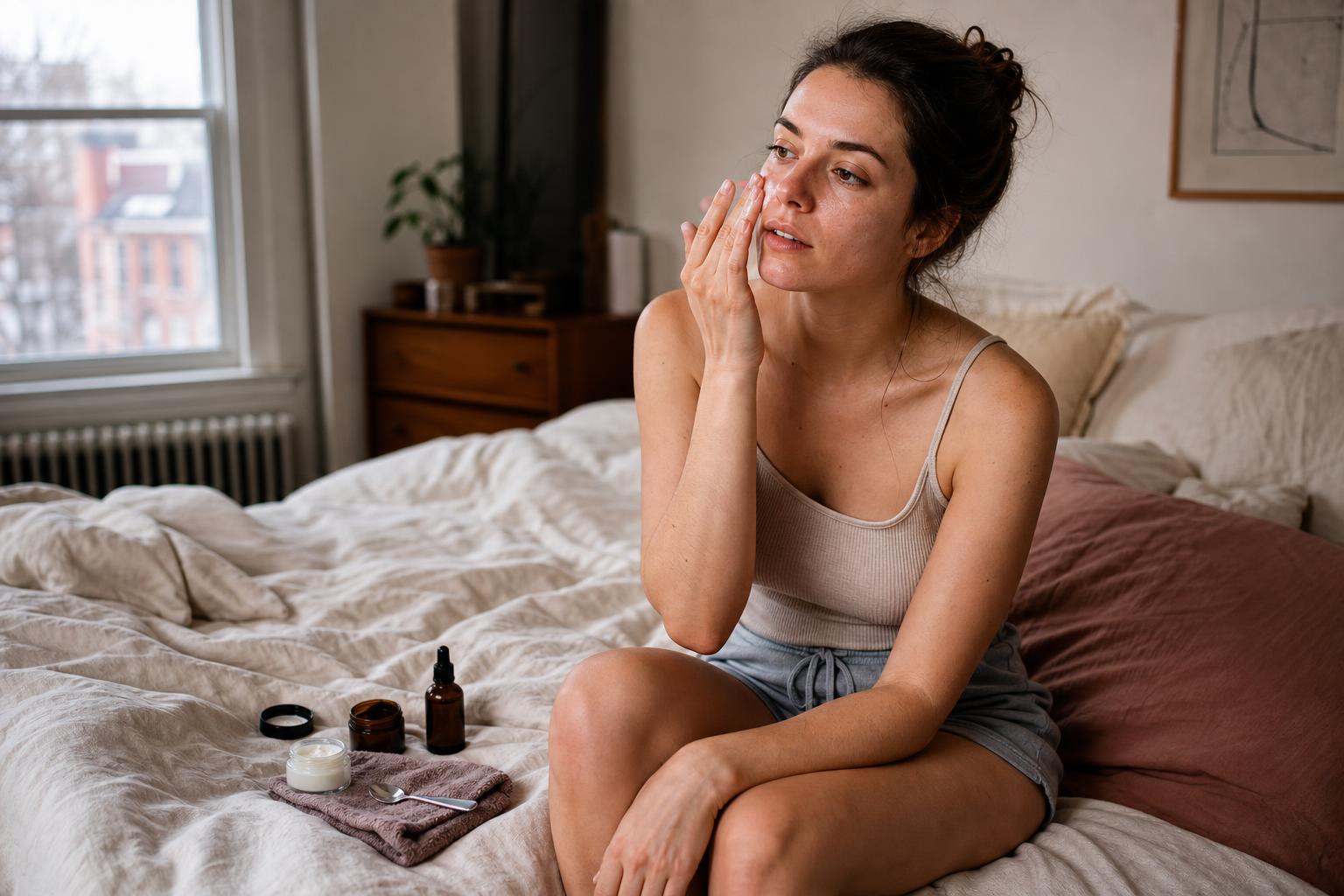
You've seen the clip: someone runs a chilled metal spoon along their cheekbone, tilts toward the window, and the light catches their skin like wet glass. It looks incredible. It also looks like something you could do in ninety seconds with something already in your kitchen drawer, which is exactly why it keeps circulating.
Glass skin has been trending in some form since Korean beauty first landed in Sephora aisles, and every few months a fresh crop of hacks resurfaces on TikTok. Some of them are doing real work on your skin barrier. Some are doing real work on the video. Worth knowing which is which before you rearrange your evenings around a spoon.
What actually makes skin look like glass
Before sorting the hacks, it helps to know what you're aiming at. Skin looks dewy and light-reflective for a handful of mechanical reasons:
- The surface is smooth, so light bounces off in one direction instead of scattering. Rough, flaky texture scatters light and reads matte or dull.
- The stratum corneum, your outermost layer, is well hydrated, so the individual cells sit plump and flat rather than curling at the edges.
- There's a thin occlusive or emollient film on top, which fills in micro-texture the way a coat of wax fills grain in wood.
- Nothing is actively inflamed. Redness and irritation change how light reads on skin no matter how much serum you layer.
That's the whole mechanism. Smooth, hydrated, calm, lightly sealed. Anything that supports one of those four things has a shot at working. Anything that doesn't is theater, and some of it is theater that costs you barrier function.
The hacks that hold up
Sealing water in with an occlusive
Slugging, the practice of finishing your evening routine with a thin layer of petrolatum-based balm, is the most reliably effective thing on the viral list. Petrolatum reduces water loss through the skin's surface dramatically, which is why it's a fixture in dermatology offices and diaper cream alike. Wake up, rinse, and skin genuinely looks smoother because it spent eight hours not losing moisture to your bedroom air.
This matters most in a dry-heat winter. If you're running forced-air heating in Chicago or Denver from November through March, indoor humidity drops low enough that skin loses water steadily overnight. An occlusive interrupts that.
A caveat worth taking seriously: petrolatum traps whatever is underneath it. If you're acne-prone, especially along the jaw and forehead, slugging over a full routine can push congestion. Try it on cheeks only, or on nights when you've used nothing but a plain moisturizer.
Cold, applied briefly
The spoon works, sort of, and not for the reason the caption says. Cold causes short-term vasoconstriction, so puffiness around the eyes and cheeks visibly reduces for a while. That's a real effect. It's also a temporary one, on the order of an hour or two, and it does nothing for texture or hydration.
Use it the way you'd use a cold compress: morning, before an event, when you slept badly. Skip the version where people press ice directly onto skin for several minutes. Prolonged direct ice contact can irritate, and irritation is the opposite of what you want.
Layering humectants under a moisturizer
Glycerin, hyaluronic acid and panthenol pull and hold water in the upper layers of skin. Applied to damp skin and then covered with a moisturizer, they leave the surface plumper and smoother than a moisturizer alone. This is the quiet engine behind most glass-skin routines, whatever the video credits.
The order matters more than the number of products. Damp skin, then the watery humectant layer, then something with lipids on top. Three well-chosen steps outperform seven random ones.
Gentle chemical exfoliation, on a schedule
Smoothness is half the mechanism, and dead surface cells that don't shed evenly are what make skin scatter light. A low-strength lactic or mandelic acid a couple of nights a week keeps the surface even. Polyhydroxy acids like gluconolactone are worth knowing if your skin runs sensitive; they're larger molecules and tend to be better tolerated.
The failure mode here is enthusiasm. Daily acids, then an acid toner, then a scrub, and skin turns shiny in a tight, uncomfortable way that people mistake for glass. That's a compromised barrier, and it's the single most common way glass-skin chasing backfires. If your skin stings when you apply moisturizer, you've gone too far. Pull back to plain cleanser and moisturizer for a week or two.
The hacks that don't do much
Sleeping in a sheet mask
This one keeps coming back and it's worth being clear about. Sheet masks work while the essence in them is wet, roughly fifteen to twenty minutes. Once the sheet dries, it starts pulling moisture off your skin instead of putting it in. You wake up with a stiff sheet on your pillow and skin that's no better than if you'd used a moisturizer.
If you love sheet masks, use them as designed and follow with something occlusive. That's the version that actually delivers.
Rice water
Rinsing with the cloudy water left from rinsing rice is old, widespread and mostly benign. It's largely starch and a little water-soluble protein. It leaves a faint film that can look nice briefly. There's nothing in it that outperforms a basic glycerin-based product, and homemade rice water sitting on your counter is a bacterial growth medium. If you're drawn to it because it's cheap and low-effort, the honest alternative is a plain drugstore humectant serum.
Facial taping and extended tool sessions
Taping skin overnight to smooth expression lines does nothing lasting to the skin itself, and repeatedly pulling adhesive off your face can leave it red and reactive. Long gua sha or roller sessions in pursuit of "lifting" have the same problem in a milder form: pleasant, relaxing, sometimes genuinely helpful for morning puffiness, but firm dragging over inflamed or acne-prone areas can spread irritation. If you enjoy the ritual, keep the pressure light and keep it short.
How to build a glass-skin routine you'll actually keep
The reason viral hacks appeal is that they're single, dramatic actions. Skin responds to repetition instead, which is much less filmable.
A version that holds up through a dry winter:
- Evening: gentle cleanser, humectant serum on damp skin, moisturizer with ceramides or fatty alcohols, and an occlusive balm on the driest areas.
- Two or three nights a week: swap the serum step for a low-strength lactic or PHA product, then moisturize as usual.
- Morning: rinse or a light cleanse, moisturizer, broad-spectrum SPF 30 or higher. Sun exposure drives the uneven tone and texture that make skin scatter light, so this step does more for glassiness over years than any single hack.
- When you're puffy: something cold, briefly.
Give any change six to eight weeks before deciding. That's roughly how long it takes to see a real difference in surface texture, and it's why so many people cycle through hacks without ever finding out whether one worked. Keeping a simple log helps here more than you'd expect; you can track your routine with Roona and see whether the dewy weeks line up with anything you did on purpose.
What to watch for as you experiment
Skin that's genuinely well hydrated feels comfortable. Skin that's been over-exfoliated in pursuit of shine feels tight, stings with products it used to tolerate, and flushes easily. Those two states can look similar in good lighting, which is part of why glass-skin content is so easy to get wrong.
If you notice the second set of signs, the move is subtraction: fewer actives, more moisturizer, and time. Barrier recovery is unglamorous and it works.
And if something in your skin is persistent, painful, or spreading, that's a conversation with a dermatologist rather than a routine adjustment.
If you want to test one hack at a time and see what your own skin actually responds to, Roona is built for exactly that kind of patient noticing. No pressure to overhaul anything. Start with one change and see what the next month tells you.
Trend source: femina.in (US)
Keep reading
-
Spicules: The K-Beauty Tech, Explained Honestly
Sponge spicules promise deeper delivery and faster results. What they actually do to skin, who they suit, and how to use them in humid Singapore. 28 July 2026 -
What's Actually Worth It in the Medicube Range?
An honest look at Medicube's viral lineup: which products earn a place in your routine, which are optional, and how to test them without wasting money. 27 July 2026 -
Glowcations: Why Seoul Is the New Skincare Getaway
Seoul's skincare travel trend blends clinic appointments, K-beauty shopping, and routine planning into a more thoughtful alternative to the spa weekend. 5 September 2026