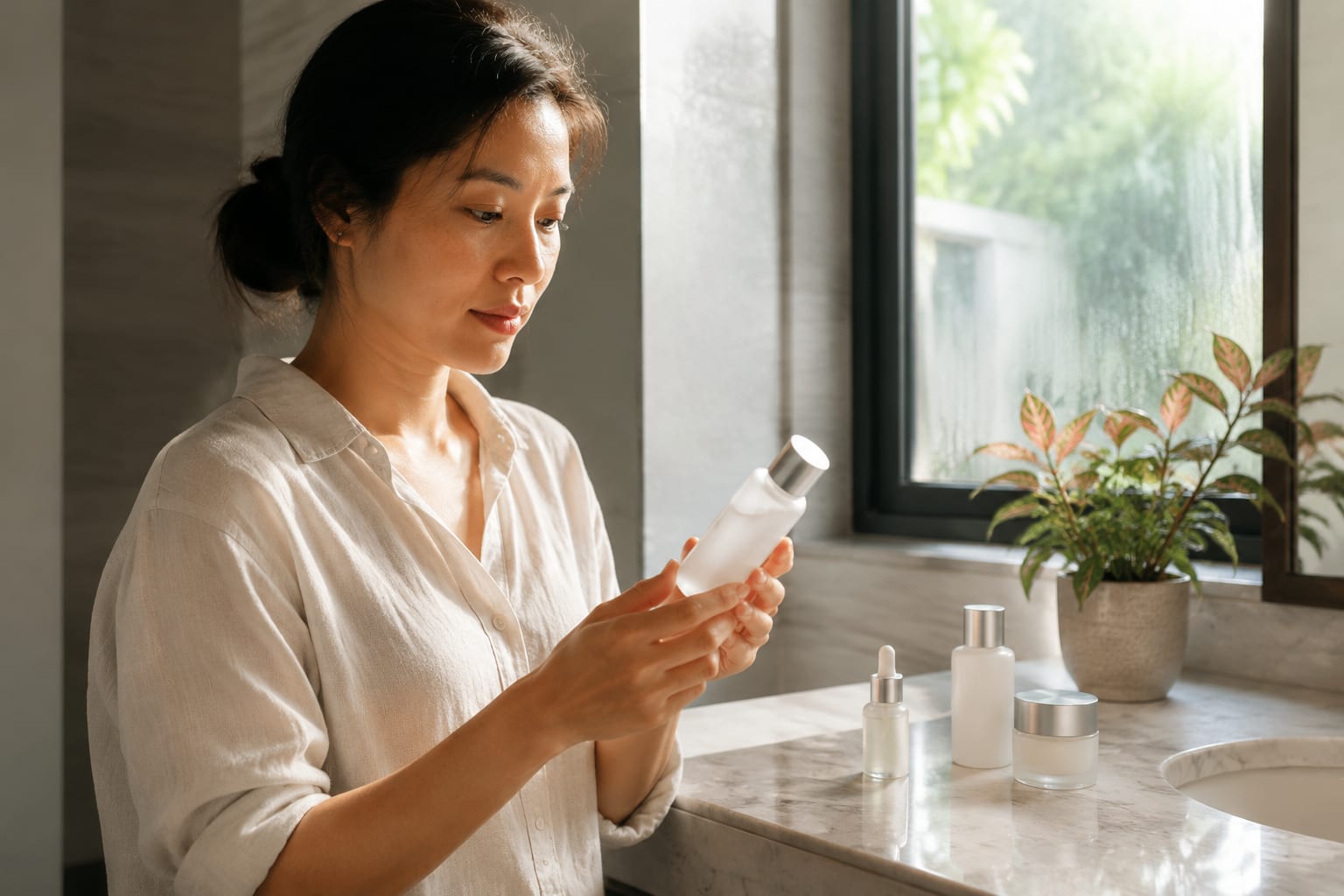
You're standing in Sephora at Ion Orchard with your phone out, comparing the ingredient lists on two vitamin C serums. One costs several times the other. Both have been called derm-approved somewhere: a box, a shelf card, a review you scrolled on the MRT over.
The phrase does mean something. It just means less than the packaging implies, and something more useful than most people expect.
What derm-approved actually signals
No regulator in Singapore issues a derm-approved certification. There is no body checking that claim before it goes on a carton. When the phrase is doing real work, it points at four things: the formula uses actives with a long research history, at concentrations that have actually been studied, at a pH the active can survive, in packaging that keeps it stable.
That is a formulation standard, not a strength standard. A well-made 0.3% retinol from a retail brand and a prescription tretinoin cream are not the same product doing the same job at different price points. The retail one works slowly and forgives you when you overdo it. Anything that promises the second while behaving like the first is overselling.
So the useful filter is boring: ingredients with a track record, at doses that have been tested, in a texture you will still want to apply in April when it's 32 degrees and you're already sticky. Niacinamide, azelaic acid, salicylic acid, benzoyl peroxide, retinaldehyde, zinc oxide, ceramides, hyaluronic acid, panthenol. None of these are new. That is the point.
The pharmacy shelf carries more weight than the beauty hall
Before Sephora, walk into Watsons or Guardian. The brands that get recommended most often in a clinic waiting room live there, not in a beauty hall: La Roche-Posay, CeraVe, Cetaphil, Avene, Bioderma, Eucerin.
They earn that placement by doing dull things well. Fragrance-free cleansers. Ceramide-based moisturisers. Zinc-based sunscreens that are actually sold in cosmetic textures. La Roche-Posay's Effaclar line built its following on salicylic acid and niacinamide for congestion rather than on scent or packaging. CeraVe's hydrating cleanser is a low-foam formula with ceramides that leaves a compromised barrier alone, which matters more than you think when you cleanse twice a day in this climate.
Buy your cleanser, your basic moisturiser and most of your sunscreen here. Then spend at Sephora on the one or two things you actually want to be nicer.
The Sephora brands worth the shelf space
What separates the good ones is disclosure. They tell you the concentration, they keep the ingredient list short enough to read, and they do not bury a single active under eleven botanical extracts.
- Paula's Choice, for single-purpose actives with the percentage on the front. The 2% BHA liquid is the reference point for salicylic acid, and their azelaic acid booster is one of the easier ways to try azelaic acid without a prescription.
- The Ordinary, for cheap experiments. Niacinamide with zinc, lactic acid, alpha arbutin. If you want to find out whether an ingredient suits you before committing, this is the least expensive way to be wrong.
- Drunk Elephant, for actives without added fragrance or essential oils, which makes a reaction easier to trace back to a specific ingredient.
- Sunday Riley, for lactic acid done gently. Good Genes is an exfoliant you can use on skin that flinches at glycolic.
- Dr. Jart+, for centella-based creams when your face is red from too much of something else last week.
- Tatcha and Farmacy, for cleansing oils and balms that remove sunscreen properly without stripping. Double cleansing matters more in Singapore than almost anywhere, because you are wearing water-resistant SPF over sweat over sebum by 7pm.
- SkinCeuticals, if you want a stable vitamin C with published formulation logic behind it. It sits in clinics and aesthetic practices here more than in beauty halls, and it is expensive enough that it should be your third purchase, not your first.
Missing from that list: anything sold mainly on a story about a rare botanical. A fermented extract can be a perfectly nice ingredient. It is not evidence.
Sunscreen is where Singapore money goes furthest
Singapore has one genuine advantage over the United States market: filter access. Formulas here can use modern UVA filters that American brands cannot, which is why Japanese, Korean and European sunscreens feel so much lighter than what your American friends complain about. Anthelios, Biore's Aqua Rich range, Shiseido's Anessa, Sunplay. You can find a sunscreen you will wear daily without negotiating with yourself about it.
The part nobody wants to hear: one morning application does not last through an outdoor lunch in Raffles Place. Reapplication is the whole game, and it only happens if the product is convenient. Sticks and cushion compacts survive in a bag and go on over makeup. A 50ml bottle in your desk drawer works too. Pick the format you will actually reach for at 1pm.
Humidity changes texture, not ingredients
Your skin here deals with two climates a day: wet heat outside, dry recycled air in the office and the MRT. Sebum production goes up in the humidity, water loss goes up in the aircon, and plenty of people read the resulting mix as oily when the barrier is the thing struggling.
What that means at the shelf:
- Gel-creams and lotions for daytime, since a rich cream under humidity mostly sits there and slides.
- Something heavier at night, when you are asleep under aircon for seven hours. A ceramide cream or a light occlusive on top does real work then.
- Fewer layers than the Korean routines suggest. Three well-chosen steps beat seven in this weather.
- Retinoids at night only, two or three nights a week to start, with moisturiser on top.
One more thing about this climate: reactions are harder to attribute, because the aircon, the sun and the new serum all arrived in the same week. Logging what you applied and how skin looked the next morning is the only way to untangle it. That is most of why we built Roona, so you can track what you actually used and when rather than reconstructing it from memory.
The two-minute label check, on the shop floor
- Find the active and its percentage. If neither is stated anywhere on the box or the brand's site, treat the product as a moisturiser with good marketing.
- Check where fragrance sits in the list. High up, on a product staying on your face all day, is a reason to hesitate if you react easily.
- Look at the packaging for anything unstable. Vitamin C, retinol and benzoyl peroxide in a clear open-mouth jar will degrade. Opaque tubes and pumps are the sign the formulator was paying attention.
- Count actives across your whole basket, not per product. Two exfoliants and a retinoid bought on the same day is how a barrier gets wrecked.
What to buy less of
Sheet masks are a nice twenty minutes and a poor daily habit. Physical scrubs with hard particles do nothing that a 2% BHA does not do more evenly. Alcohol-heavy toners strip skin that is already losing water to the aircon. And a seven-step routine bought in one Sephora trip guarantees you will never know which step helped.
Give one new product six to eight weeks before deciding. Cell turnover and pigment changes work on that timescale, no matter how the launch was described. If you like keeping notes, Roona will hold the timeline for you so you can look back and see whether that serum earned its place.
Next time you're in the Guardian at Raffles City, or wandering Sephora with no particular plan, you have a filter: named ingredient, stated concentration, a texture you'll wear in this heat. Take your time with it. There's no rush.
Trend source: instyle.com (SG)
Keep reading
-
After 40, This Viral Skincare Routine May Overwork Your Skin
Why the viral multi-step skincare routine can irritate skin after 40, plus a gentler Singapore routine with acids, retinoids and SPF. 5 September 2026 -
Olive Young lands in Sephora: what it means here
Olive Young is bringing curated K-beauty into Sephora in the US. What actually changes for Singapore shoppers who already buy this way. 26 August 2026 -
Postbiotics in Skincare: What They Are, and Why They Matter Here
Postbiotics are the newest microbiome buzzword on Malaysian shelves. What they are, how they differ from probiotics, and how to use them in humid weather. 21 August 2026