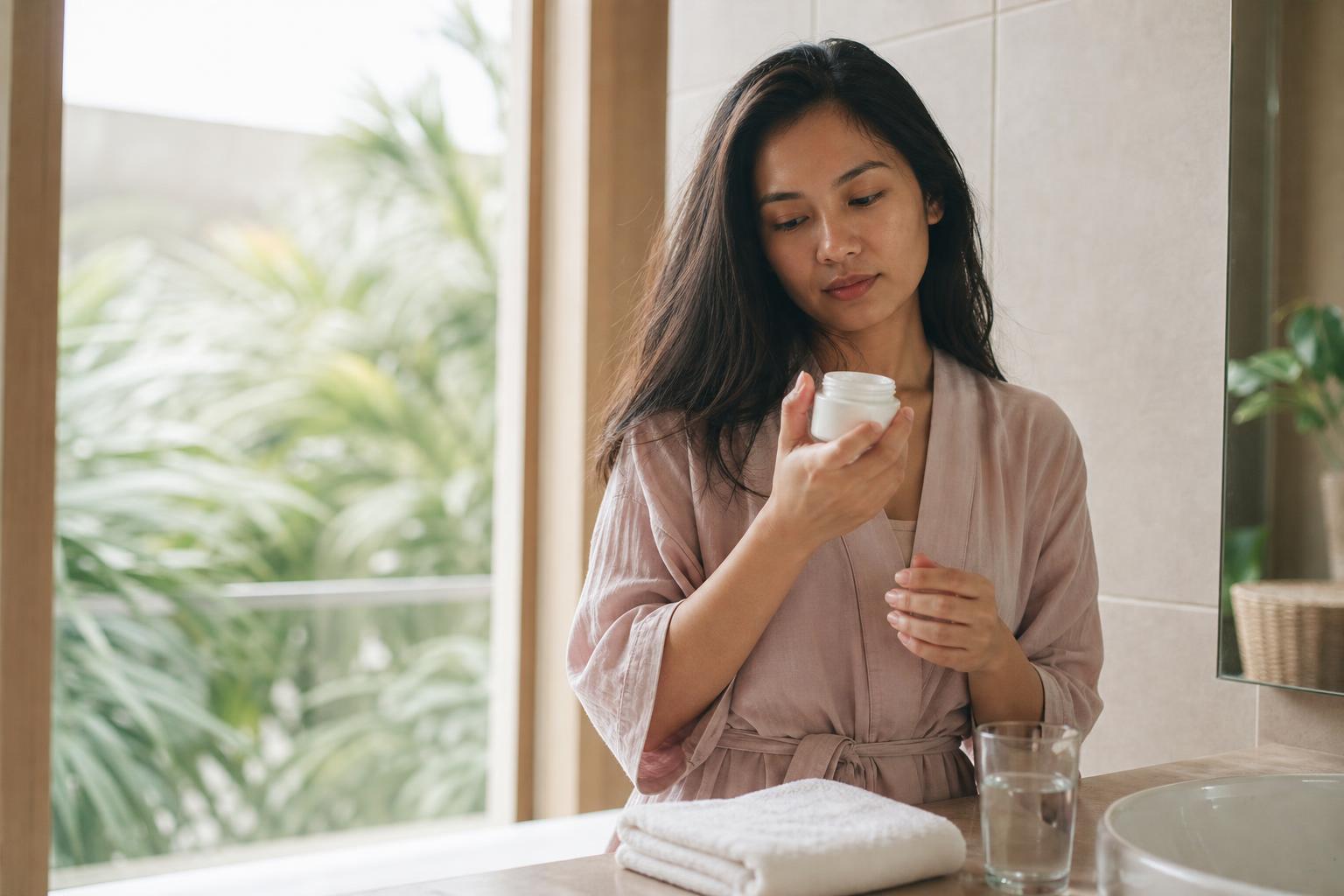
You pick up a moisturiser at Watsons, flip it over, and somewhere between the niacinamide and the panthenol there's a word you don't recognise: postbiotic. Or ferment filtrate. Or lysate. The front of the box says something about the skin microbiome. You put it back, buy the one you already know, and wonder later whether you missed something.
The microbiome conversation has been building in skincare for years, and postbiotics are the part of it that finally makes practical sense for a bathroom shelf in Kuala Lumpur. Malaysian research groups have been working on locally developed postbiotic ingredient platforms, which is a genuinely interesting development for a market that usually imports its actives. Before you decide whether it belongs in your routine, it helps to know what the word actually means.
Probiotics, prebiotics, postbiotics: three different things
These three get used interchangeably in marketing copy, and they are not interchangeable.
- Probiotics are live microorganisms. In food, think of the live cultures in yoghurt or a bottle of cultured milk drink. In skincare, keeping bacteria alive inside a preserved cosmetic product is difficult, which is why most "probiotic" creams do not contain living organisms at all.
- Prebiotics are the food those microorganisms feed on. In skincare these are often sugars like inulin or alpha-glucan oligosaccharide, included to support the bacteria already living on your skin.
- Postbiotics are what's left after the microorganisms have done their work: the fermentation by-products, cell wall fragments, peptides and metabolites. The bacteria themselves are inactivated. What remains are the compounds they produced.
On an ingredient list, postbiotics rarely say "postbiotic." You'll see names like lactobacillus ferment lysate, bifida ferment lysate, saccharomyces ferment filtrate, or lactococcus ferment lysate. Japanese and Korean brands have used ferment filtrates for a long time, which is why the concept feels familiar even if the terminology is new.
Why postbiotics suit a cosmetic product better than probiotics
Stability is the practical argument. A jar of cream sitting in a bathroom in Petaling Jaya, opened daily, exposed to humidity and warm air, is a hostile environment for live bacteria. It also has to contain preservatives, which exist specifically to kill microorganisms. Live cultures and cosmetic preservation work against each other.
Postbiotics sidestep the problem entirely. Since nothing needs to stay alive, the ingredient is more stable through manufacturing, shipping in a hot container, and months on a shelf. That matters in Malaysia, where a product might travel through unairconditioned warehouses before it reaches you.
There's a supply chain angle too. Ferment-based ingredients can be produced locally from local microbial strains and agricultural inputs, which is part of why homegrown postbiotic development is getting attention here. A locally made active is easier to certify halal, easier to register, and less exposed to currency swings than an imported one.
What the skin microbiome actually is
Your skin surface hosts a community of bacteria, fungi and other microorganisms. Staphylococcus epidermidis and Cutibacterium acnes are two of the more commonly discussed residents. They live alongside your skin barrier: the lipids, the acid mantle, the outer layer of cells.
Skincare that damages the barrier tends to disturb that community as well. A foaming cleanser that leaves your face tight and squeaky, used twice daily because you feel oily by noon, strips both lipids and surface microbes. So does over-exfoliating, which is easy to do when you're chasing a shine-free look in this weather.
Microbiome-focused skincare is largely about not doing that. The ingredients help, but the bigger factor is what you stop doing.
The Malaysian climate context
Here, skin faces a specific combination. Humidity outside sits high most of the year, so you sweat through your makeup on the walk from the car park. Then you spend eight hours in an office cooled to something close to chilly, where the air is dry and your skin quietly loses water. Then back out into the heat.
That cycle does a few things worth naming:
- Sweat and sebum sit on the skin longer in humid air, which encourages more aggressive cleansing than the skin needs.
- Air-conditioning pulls moisture out of the stratum corneum, so oily-feeling skin can be dehydrated at the same time.
- Anyone wearing a hijab, a helmet, or a face mask for long stretches deals with occlusion: warmth and moisture trapped against the skin along the hairline, forehead and jaw.
- High UV year-round means sunscreen is non-negotiable, and sunscreen needs to be removed properly, which loops back to cleansing.
Postbiotic ingredients tend to show up in lightweight moisturisers, essences and toners, which fits this climate better than the heavy balms these ingredients often appear in overseas. If you're deciding between two gel-cream moisturisers at Guardian and one has a ferment lysate high on the list, that's a reasonable tiebreaker. It is not a reason to abandon a moisturiser that's already working for you.
How to actually try a postbiotic product
If you want to test one, keep it boring and controlled.
- Choose one product, not three. An essence or a lightweight moisturiser is the easiest slot, since those go on most days regardless.
- Give it around four to six weeks before judging. Skin turnover is slow, and one week tells you almost nothing except whether it irritates.
- Change nothing else in that window. New cleanser plus new serum plus new sunscreen means you learn nothing about any of them.
- Patch test along the jaw or behind the ear for a few days first, especially if you react easily.
- Check for NPRA notification on the packaging, and look for halal certification if that matters for your household. Both are easy to verify on Malaysian retail listings, and worth doing before you buy from a Shopee or Lazada seller you don't recognise.
Keeping a simple record of what you started and when makes this far less guesswork. You can track your routine with Roona and note how your skin responds over the weeks, which is more reliable than trying to remember in March what you started in January.
Where postbiotics fit against the basics
A postbiotic ingredient is a refinement, not a foundation. If your cleanser leaves your skin feeling tight, if you're skipping moisturiser because you're oily, or if sunscreen only happens on days you go to the beach, those cost you far more than the absence of a ferment lysate.
The order that helps most people here looks like this: a gentle cleanser that doesn't strip, a moisturiser suited to humid weather, and daily sunscreen reapplied when you're outdoors for long stretches. Once those are steady for a couple of months, adding a postbiotic essence or a barrier-supporting moisturiser is a sensible next step rather than a shot in the dark.
What to be sceptical about
Microbiome claims are easy to write and hard to verify. A few things worth holding lightly:
Products advertised as "probiotic" that contain no live organisms are usually postbiotic or prebiotic, and the label language is loose rather than dishonest. Claims about "rebalancing" or "restoring" the microbiome go further than the ingredient list can support on its own. And a ferment ingredient sitting at the bottom of an INCI list, below the fragrance, is probably there for the box copy more than for your skin.
None of that makes the category empty. Ferment-derived ingredients have been in Japanese and Korean formulations for decades and many people get on well with them. It just means the word on the front of the bottle is not proof of anything by itself.
A reasonable place to land
Postbiotics are a real and sensibly designed category, more stable than live cultures and more specific than a vague prebiotic sugar. The fact that Malaysian labs are developing their own platforms is good news for local availability and for pricing over time.
If you're curious, pick one product, one slot in your routine, and enough weeks to actually see something. If your barrier is already comfortable and your skin is calm, there's no urgency. Roona is here whenever you want a quieter way to keep track of what you're using and how it's going.
Trend source: NST Online (MY)
Keep reading
-
What derm-approved really means at Sephora in Singapore
A practical look at the brands worth your money at Sephora, Watsons and Guardian in Singapore, what derm-approved actually signals, and how to read a label fast. 26 August 2026 -

When a Celebrity's Cheap Cream Sells Out: What It Really Means
Georgina Rodriguez's affordable moisturiser went viral and sold out. Here's how to read a celebrity skincare recommendation without wasting money. 19 August 2026 -

Ceramides Explained: Barrier Care in Malaysia's Heat and AC
Moving between humid Malaysian air and cold office AC can leave skin tight and reactive. What ceramides do and how to use them in a simple routine. 10 August 2026