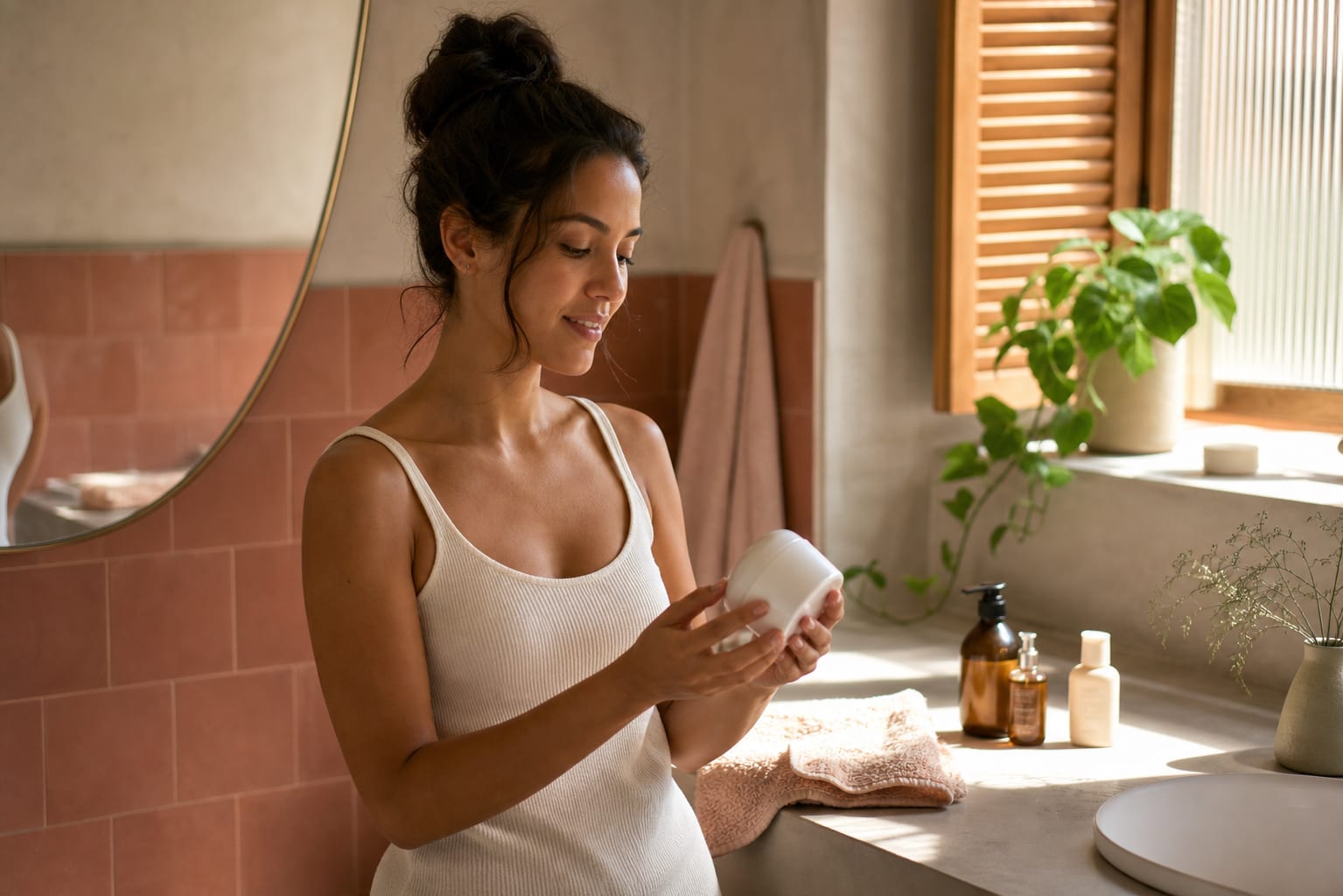
You see the screenshot on a Sunday night: a famous face, a small white tub, a price low enough that you actually consider it. By Monday the product is out of stock at Beleza na Web, and someone in a Facebook group is asking whether the version sold on Mercado Livre is the real thing. Georgina Rodriguez mentioning an affordable cream did exactly this, and the shelves emptied across Europe and here in Brazil.
That pattern repeats every few months with a different name attached. Understanding why it happens makes it much easier to decide whether the product deserves a place on your bathroom shelf, or whether you already own something that does the same job.
Why the price tag is doing most of the work
A celebrity recommending a luxury serum reads as a different species of information. Of course she uses it, you think, and you scroll on. A celebrity recommending something that costs roughly what a decent drugstore moisturiser costs in Brazil feels like a secret being shared sideways, from someone who could afford anything to someone counting reais at the pharmacy counter.
That gap between expected price and actual price is the engine. It flatters the buyer twice: you get the association with the famous person and the sense of having made a smart, unsnobbish choice. Brands know this, which is why the affordable hero product has become a standard marketing shape rather than a happy accident.
Worth remembering: a viral cream and a good cream are two separate assessments. Sometimes they overlap. The virality tells you nothing about whether the overlap happened this time.
What a moisturiser can actually do for you
Strip away the story and most of these viral products are moisturisers. A moisturiser has a genuinely useful job. It reduces water loss from the surface of the skin, softens the feel of the top layer, and supports the barrier that keeps your skin comfortable through heat, air conditioning, and the salt-and-chlorine cycle of a Brazilian summer.
The ingredients doing that work are familiar and widely available:
- Glycerin, which draws water into the upper layers and appears in almost every formula at every price point
- Hyaluronic acid, another humectant, well suited to humid climates where there is moisture in the air to hold onto
- Ceramides and cholesterol, which help rebuild the lipid structure of the barrier
- Squalane, light enough for most skin types and stable in heat
- Panthenol, which many people find calming when skin feels tight or reactive
None of these are rare. A cream from Cerave, Neutrogena, Sallve, Principia or Adcos sitting in a Brazilian pharmacy will contain some combination of them, often at a price that never trends on Instagram.
Texture matters more than the label in this climate
Here is where a European viral product can genuinely fall short for a Brazilian reader. A rich, occlusive cream designed for a dry Lisbon winter behaves differently in Recife in February. Heat and humidity change how a formula sits on skin. What feels nourishing at 12 degrees can feel like a film at 32 degrees with 80 percent humidity.
If you live somewhere hot and humid, prioritise:
- Gel-cream and lotion textures over heavy balms for daytime
- Formulas that absorb quickly enough to layer under sunscreen without pilling
- Fragrance-free options if you tend to get irritation after sweating
- Lighter facial textures paired with something richer for body, especially post-beach
A cream that a European influencer loves may still be excellent for you at night, or in the drier months in the South, or on your hands. Context is not a small detail here. It is most of the answer.
Read the ingredient list before you read the caption
When a product goes viral, turn the tub around. The ingredient list, in descending order of concentration until the one percent mark, tells you more in ten seconds than any endorsement.
Check three things. First, whether the actives you actually want appear near the top rather than trailing behind the fragrance. Second, whether anything on the list has caused you trouble before, which for many people means added fragrance or specific essential oils. Third, whether the product carries ANVISA registration, which is the baseline regulatory signal for anything sold legitimately in Brazil.
That last point matters more than usual with viral products. When official stock runs out, grey-market listings appear fast on marketplaces, and a discounted imported tub with no Portuguese labelling is a gamble on storage conditions and authenticity both.
Whether a viral product is worth buying, honestly
Sometimes yes. A well-formulated affordable moisturiser is a genuinely good thing, and mass attention occasionally lands on one. The question is not whether the product is good in the abstract. It is whether it does something your current routine does not.
Ask yourself:
- What is the gap I am trying to fill? Dryness, tightness, sensitivity after acids, flaking under sunscreen?
- Do I already own something with the same core ingredients that I stopped using for no particular reason?
- Am I buying this because my skin needs it, or because the buying itself feels good?
That third question is not a scolding. Enjoying skincare is legitimate. Just name it accurately, because a product bought for pleasure and a product bought to solve a problem should be judged by different standards.
The thing that actually changes your skin
Consistency beats novelty, and it is not close. Skin responds to what you do most days over months, not to what you tried once in March. A cheap moisturiser used every morning and night will do more for your barrier than a rotating cast of viral tubs each abandoned after two weeks.
This is also why the constant churn of viral products can quietly work against you. Every new introduction resets your ability to tell what is helping. If you started a new cleanser, a new cream and a new serum in the same week and your skin got irritated, you have no idea which one to blame.
Introduce one product at a time. Give it a few weeks. Keep some record of what you used and how your skin felt, because memory is unreliable about exactly this. If you want that record to be effortless rather than another chore, you can track your routine with Roona and see the pattern build up over time instead of guessing.
A calmer way to handle the next viral product
There will be another one. A different famous person, a different tub, another Monday morning of sold-out listings. When it arrives, you can hold it lightly.
Look at what it contains. Compare it to what you already have. Consider whether the texture suits the climate you actually live in, not the one in the campaign photos. Check that it is properly registered and properly sold. If it clears all of that and fills a real gap, buy it without guilt. If it does not, you have lost nothing except a purchase you would have half-regretted.
Georgina Rodriguez using an affordable cream is a reasonable piece of trivia and a poor prescription. Your skin has its own conditions: your humidity, your sun exposure, your history with fragrance, your budget in reais. Those are the variables that matter.
If you are curious about which of your products are actually earning their place, logging what you use with Roona is a quiet way to find out. No rush, and no need to change anything today.
Trend source: TVI (BR)
Keep reading
-
What derm-approved really means at Sephora in Singapore
A practical look at the brands worth your money at Sephora, Watsons and Guardian in Singapore, what derm-approved actually signals, and how to read a label fast. 26 August 2026 -
Postbiotics in Skincare: What They Are, and Why They Matter Here
Postbiotics are the newest microbiome buzzword on Malaysian shelves. What they are, how they differ from probiotics, and how to use them in humid weather. 21 August 2026 -

Ceramides Explained: Barrier Care in Malaysia's Heat and AC
Moving between humid Malaysian air and cold office AC can leave skin tight and reactive. What ceramides do and how to use them in a simple routine. 10 August 2026