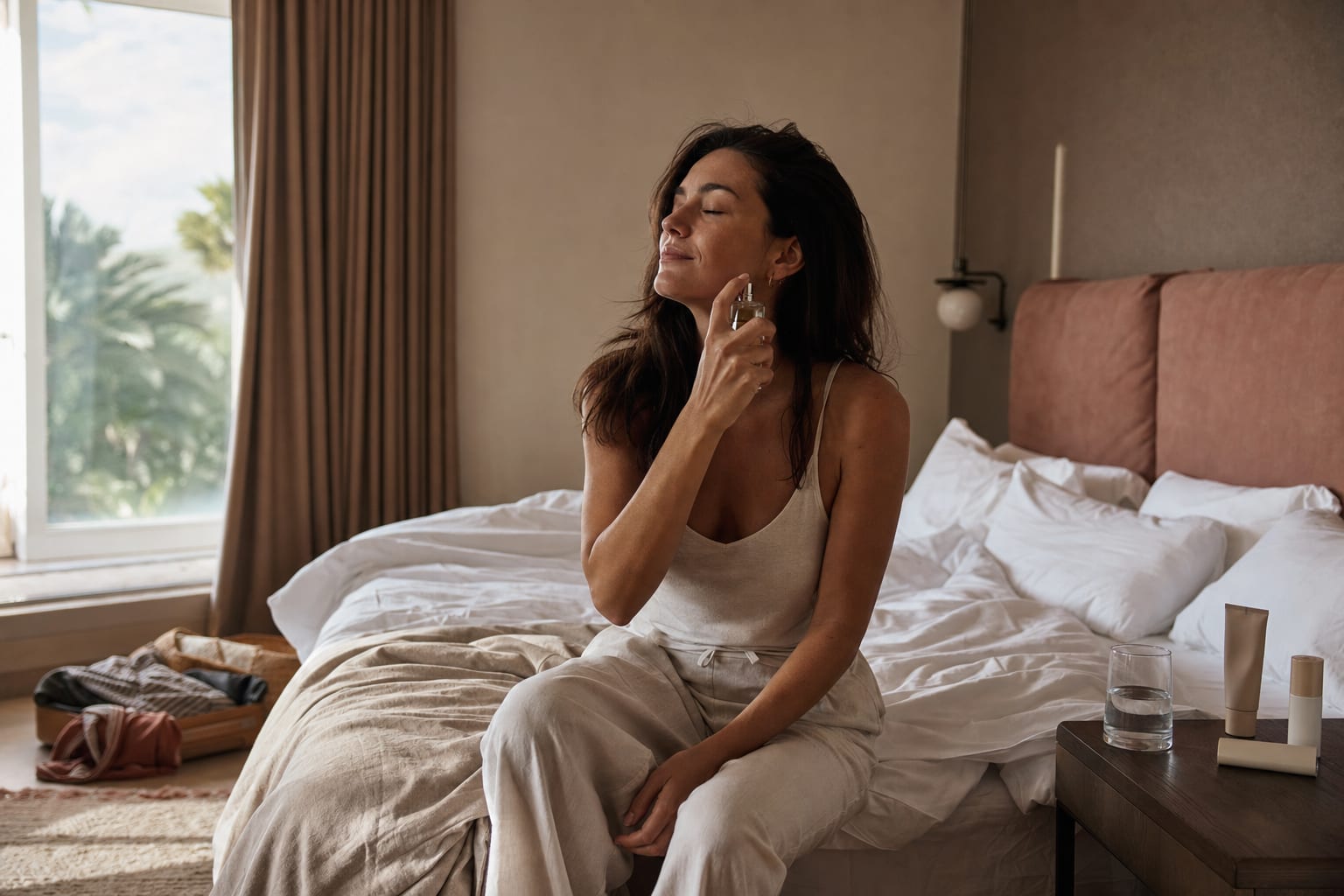
You get off a five-hour flight, walk out of a cold airport into August air, and your face feels like it has been sitting under a lamp. Tight along the cheeks, hot across the forehead, slightly swollen around the eyes. So you reach for the little mist you packed, spray twice, and feel better for about ninety seconds.
That ninety seconds is worth understanding, because it explains most of the cooling skincare on shelves right now. Some of these formulas do real work for overheated skin. Others deliver a sensation and evaporate. Both can be pleasant. Only one is worth space in a carry-on quart bag.
What "cooling" usually means on a label
There are three different things happening under that word, and they behave very differently on skin.
The first is physical temperature. A product stored in a hotel mini fridge is genuinely colder than your skin, so it pulls heat away on contact. This effect is real and short. Once the product warms to skin temperature, it stops.
The second is evaporation. Water, alcohol and volatile solvents cool as they leave the surface. This is why a spritz of thermal water feels immediate and why the feeling fades so fast. If the mist is mostly water with no humectant or occlusive behind it, evaporation can leave the surface slightly drier than before, which reads as tightness an hour later.
The third is chemical. Menthol, methyl lactate and their relatives activate TRPM8, a cold-sensing receptor in your nerve endings. Your brain registers cold. Your skin temperature has not moved. On calm skin that is a nice trick. On skin that is already flushed, stinging, or recovering from too much sun, menthol is a common source of irritation and can make a compromised barrier feel worse a few hours after the pleasant part wears off.
So when a sunscreen advertises a cooling finish, check whether that comes from a lightweight aqueous base or from added menthol. The first travels well. The second is a coin flip depending on your skin.
What genuinely helps overheated skin
Hot, traveling skin is usually dealing with a combination of things: dehydration from cabin air, more sun exposure than usual, sweat and sunscreen sitting on the surface for hours, and friction from touching your face more than you do at home. The formulas that help are the ones addressing those, not the ones with the biggest chill.
- Humectant-forward gels with glycerin, hyaluronic acid or panthenol. They hold water at the surface so the cooling sensation is not just evaporation leaving.
- Niacinamide, which supports barrier function and is well tolerated in most routines at everyday concentrations.
- Centella asiatica extract and madecassoside, staples in the K-beauty gel-creams that fill Ulta and Sephora shelves each summer, popular specifically because they sit well on reactive skin.
- Aloe vera in a formula with actual moisturizing agents, not the neon green gel that is mostly alcohol and dries down sticky.
- Oat extract or colloidal oatmeal, which is why so many drugstore body lotions get recommended after sun exposure.
- Mineral sunscreens with zinc oxide if chemical filters sting on hot skin, though a well-formulated chemical filter you will actually reapply beats a mineral one you skip.
Notice what is missing: fragrance, high concentrations of alcohol denat, essential oils, and menthol. On a normal day those are minor considerations. On skin that is hot and slightly compromised, they are the most likely reason your face is stinging.
The fridge question
Storing skincare cold is genuinely useful for one thing: reducing the feeling of heat and puffiness, quickly. A chilled gel mask after a beach day feels better than a room-temperature one, and there is nothing wrong with using that. Cold also feels good on eyes that have been open since a 5 a.m. flight.
What cold does not do is make a product work better. Refrigeration will not improve absorption or make an active more effective, and some formulas do worse in the cold. Thick creams with high oil content can go grainy. Emulsions can separate. Retinoid and vitamin C formulas are usually more stable somewhere cool and dark than somewhere cold and repeatedly warmed, because it is the temperature swings that stress a formula, not the average.
For travel, this matters practically. A mini fridge in a hotel room is fine for two nights. A cooler bag in a hot car is not, since the product spends the day cycling between cold and very warm. If you want the sensation without the storage problem, a clean stainless steel spoon pressed under the eyes for thirty seconds does the same job.
Building a travel routine that survives the heat
The goal on the road is fewer products doing steadier work, not a scaled-down version of a ten-step routine.
- Morning: gentle cleanser or just water if your skin runs dry, a humectant serum while skin is still damp, a light gel moisturizer, then sunscreen as the last step. Give the sunscreen a minute before you touch it.
- Midday: reapply sunscreen every couple of hours if you are outside. A stick over makeup, or a lightweight fluid if you can wash your hands.
- Evening: cleanse properly. A full day of sweat plus sunscreen is the one time a second cleanse is genuinely useful.
- Evening, after cleansing: a barrier-supporting moisturizer. Ceramides, cholesterol and fatty acids if your skin feels stripped.
- Skip the strong actives for a few days. High-strength exfoliating acids, retinoids and aggressive vitamin C are the things most likely to turn a sunburn into peeling.
That last point deserves a little more space. A lot of people arrive somewhere sunny and hold onto their nightly retinoid because they do not want to lose progress. A few nights off will not undo months of use, and continuing through a burn frequently means a week of flaking that sets you back further. If you are keeping notes on how your skin responds across a trip, track your routine with Roona makes it easier to see whether the pause actually cost you anything, or whether the summer flare-ups line up with something else entirely.
Reading a cooling product before you buy it
The cooling category is genuinely crowded now, and a lot of it is repackaged basics with a blue cap. A few things to check in the store:
- Where menthol or peppermint oil sits in the ingredient list. Near the end is a sensory touch. Near the top is the main event.
- Whether a mist has anything in it besides water and a preservative. Thermal spring water alone is comforting but not moisturizing.
- Whether the gel-cream includes any lipids at all. Pure gels feel wonderful in humidity and can feel insufficient in dry mountain or desert air, which matters if your summer trip is Arizona rather than Florida.
- The SPF number and whether it says broad spectrum. Cooling has no bearing on protection.
- Packaging you can actually reapply from. A wide-mouth jar in a beach bag becomes a sand jar.
One more thing worth naming: if your skin is hot and red and it does not settle after a few hours out of the sun, cooling products are not the answer. Persistent burning, blistering, chills or swelling are reasons to talk to a clinician, not to layer on another gel.
When the sensation is the point
There is a version of this where cooling skincare is simply nice, and that is a legitimate reason to use it. A cold mist on a train platform in July, a chilled sheet mask after a long drive, the two minutes you spend patting a gel-cream in with the air conditioning going. Those moments make it easier to keep doing the routine at all, which matters more than the ingredient list on any single product.
Just separate the two jobs in your head. Comfort comes from temperature and texture. Recovery comes from hydration, barrier support and sun protection you reapply. A product can do both. Most only do the first, and now you can tell which one you are holding.
If you want to see how your skin actually behaves across a hot week away from home, Roona is a quiet place to keep those notes. No pressure either way.
Trend source: Vogue Arabia (US)
Keep reading
-

Sephora's Tween Skincare Lawsuit: What Parents Need to Know
A clear guide for Singapore parents on the Sephora youth skincare lawsuit, ingredient labels, age-appropriate routines, and safer shopping decisions. 8 October 2026 -
In-flight skincare kits: what to buy before you board
Airport skincare kits promise relief from dry cabin air. Learn which ingredients and travel-size products are worth packing before your flight. 27 September 2026 -
Glowcations: Why Seoul Is the New Skincare Getaway
Seoul's skincare travel trend blends clinic appointments, K-beauty shopping, and routine planning into a more thoughtful alternative to the spa weekend. 5 September 2026