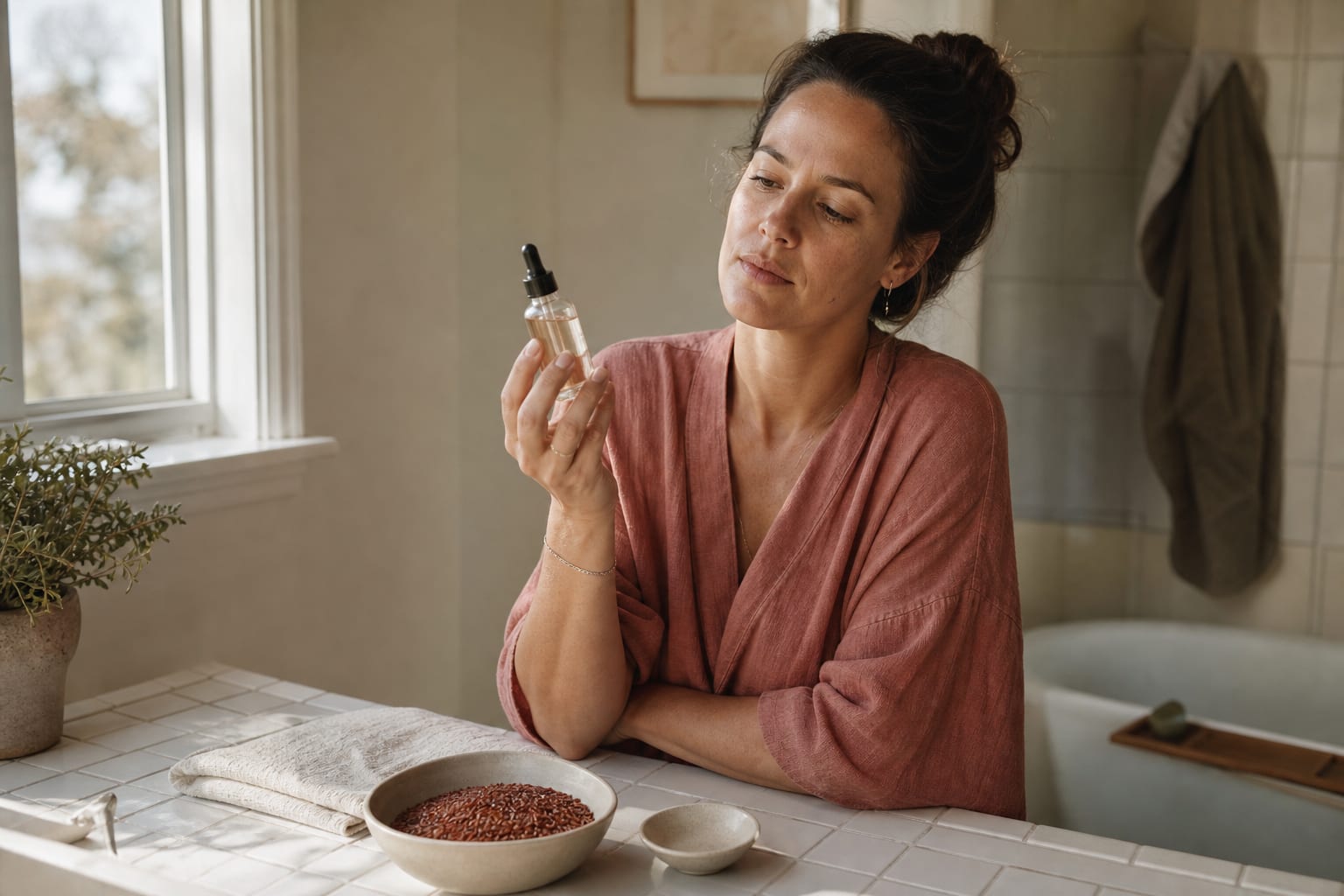
You pick up a serum at Sephora, turn the bottle over, and somewhere in the top five ingredients sits something like "Monascus/Rice Ferment Filtrate." It sounds like a supplement aisle escapee. In a way, it is: red yeast rice has been sold as a wellness ingredient in the United States for decades, and it has a much longer history in Chinese and Japanese food traditions than it does in cosmetics.
Now it's migrating into skincare, and it's worth understanding what's actually happening in that bottle before you decide whether it belongs on your shelf.
What red rice ferment actually is
Red yeast rice is made by inoculating cooked rice with a mold called Monascus purpureus. The mold grows through the grain over several days and turns it a deep brick red. In cooking, it's what gives some Chinese roast pork its color and certain rice wines their tint.
In skincare, brands use the liquid that comes off that process, usually labeled as a ferment filtrate or ferment extract. The rice itself is largely gone. What remains is the soup of small molecules the microbes produced and left behind while they worked.
That distinction matters when you're reading a label. "Oryza Sativa (Rice) Extract" and "Rice Ferment Filtrate" are not the same thing. One is rice. The other is what happened to rice.
What fermentation changes
Fermentation is essentially outsourced digestion. Microbes break large, unwieldy plant molecules into smaller ones, and along the way they secrete their own compounds into the mix.
Three things tend to come out of that process in ways that interest formulators:
- Smaller molecules. Starches and proteins get cleaved into simpler sugars, peptides and amino acids. Smaller molecules are generally easier to work into a formula and, in some cases, easier for skin to interact with at the surface.
- New byproducts. Microbes produce organic acids, enzymes and other metabolites that weren't in the raw material at all.
- Different antioxidant profiles. Fermentation can shift which polyphenols and related compounds are present and how available they are.
None of this is magic, and none of it means a fermented version of an ingredient automatically outperforms the unfermented one. It means the resulting material is chemically different, and brands are formulating around those differences.
What red rice ferment is offered for
In products currently on shelves, red rice ferment tends to show up in three contexts.
Hydration and skin feel. Ferment filtrates are often rich in amino acids and simple sugars, both of which behave as humectants. That's why so many ferment-forward essences feel slippery and sink in fast rather than sitting on top. If you've used a first-essence-style product from a Korean brand, you already know the texture.
Antioxidant support. Red yeast rice contains pigments and polyphenolic compounds, and antioxidant activity is one of the more common claims attached to the ingredient. Antioxidants in topical products are best understood as environmental support: they help skin deal with daily oxidative stress from UV exposure and pollution. They do not replace sunscreen.
Brightness and evenness. This is the marketing hook you'll see most often, usually phrased around "radiance" or "glow." Some of that is genuine: better-hydrated skin reflects light more evenly, and antioxidant support over months can help with the dullness that accumulates from sun exposure. Some of it is the ingredient's color doing rhetorical work. Red rice looks like it should brighten things.
Be skeptical of anything promising to erase dark spots. If discoloration is your main concern, ingredients with a longer research history, tretinoin from a dermatologist, azelaic acid, vitamin C, or a well-formulated niacinamide product, are still the more reliable path. Red rice ferment can sit alongside those. It isn't a substitute for them.
One thing worth knowing about monacolin K
Red yeast rice supplements have been a regulatory sticking point in the United States for years, because some strains produce monacolin K, a compound chemically identical to the prescription statin lovastatin. That's why oral red yeast rice supplements have drawn FDA attention.
This is a supplement issue, not a topical one. Cosmetic ferment filtrates are a different material, produced and processed differently, and applied to skin rather than swallowed. But it's the reason the ingredient carries a slightly odd reputation if you've encountered it before in a health food store. If you're taking red yeast rice orally, that's a conversation with a doctor or pharmacist, not something to sort out from a skincare blog.
How to work it into a routine
Red rice ferment is usually a supporting ingredient rather than the star, which makes it fairly easy to place.
- Essences and lightweight serums. This is where you'll find it most often. Apply to damp skin after cleansing, before heavier serums.
- Moisturizers. Here it's contributing hydration and antioxidant support rather than doing anything dramatic on its own.
- Sheet masks and overnight masks. Ferment filtrates are common in this category because they feel good and layer well.
It plays nicely with most things. There's no known conflict with retinoids, vitamin C, exfoliating acids or niacinamide. If your skin is reactive, the usual approach applies: introduce one new product at a time, give it two weeks, and pay attention to how your skin looks by the end of a normal week rather than the morning after.
A note on fragrance. Ferment filtrates can have a distinctly yeasty, sake-like smell, which is why many products containing them are heavily fragranced to cover it. If fragrance sensitivity is a concern for you, that's often the thing to watch on the label, not the ferment itself.
Whether it's worth your money
Honest answer: it depends on what the rest of the formula is doing.
A ferment filtrate high in the ingredient list of a well-built hydrating essence is a reasonable thing to buy. A ferment filtrate at the very bottom of a long list, below the preservatives, in a product priced as a hero treatment, is mostly a label decision.
The broader ferment trend has been running long enough now that plenty of brands are adding a ferment somewhere in the formula for the ingredient list rather than for the performance. That doesn't make the category worthless. It means the ingredient name alone tells you less than you'd like.
What tells you more is your own experience with it over time. Ferment-heavy essences are one of those categories where the difference shows up in skin comfort and texture over weeks, not in an immediate visible change, which makes it genuinely hard to evaluate from memory. If you're trying a new one, it helps to note when you started and how your skin felt at the two-week and six-week marks. You can track your routine with Roona and see whether a new product actually correlates with the change you think you're seeing, or whether it's the humidifier you started running in January doing the work.
The short version
Red rice ferment is a legitimate cosmetic ingredient with plausible hydrating and antioxidant contributions. It's not a breakthrough, and it's not a gimmick. It sits in the large middle category of ingredients that are pleasant, well tolerated, and meaningful mostly in the context of a formula that's already good.
If your current routine is working, there's no urgency here. If you're curious, a lightweight essence is the lowest-stakes place to try it, and logging what you use will tell you more in six weeks than any ingredient list can tell you today.
Trend source: Trend Hunter (US)
Keep reading
-

7 Viral Glass-Skin Hacks: What Actually Works
Spoon massages, overnight sheet masks, slugging and more: a calm look at which viral glass-skin hacks affect your skin and which are just satisfying to film. 31 July 2026 -
What Longevity Science in Skincare Really Delivers
Darkfin Labs' Ulta launch brings longevity skincare to a wider audience. Learn what the science can support, where claims stretch, and what to use. 8 October 2026 -
Glowcations: Why Seoul Is the New Skincare Getaway
Seoul's skincare travel trend blends clinic appointments, K-beauty shopping, and routine planning into a more thoughtful alternative to the spa weekend. 5 September 2026