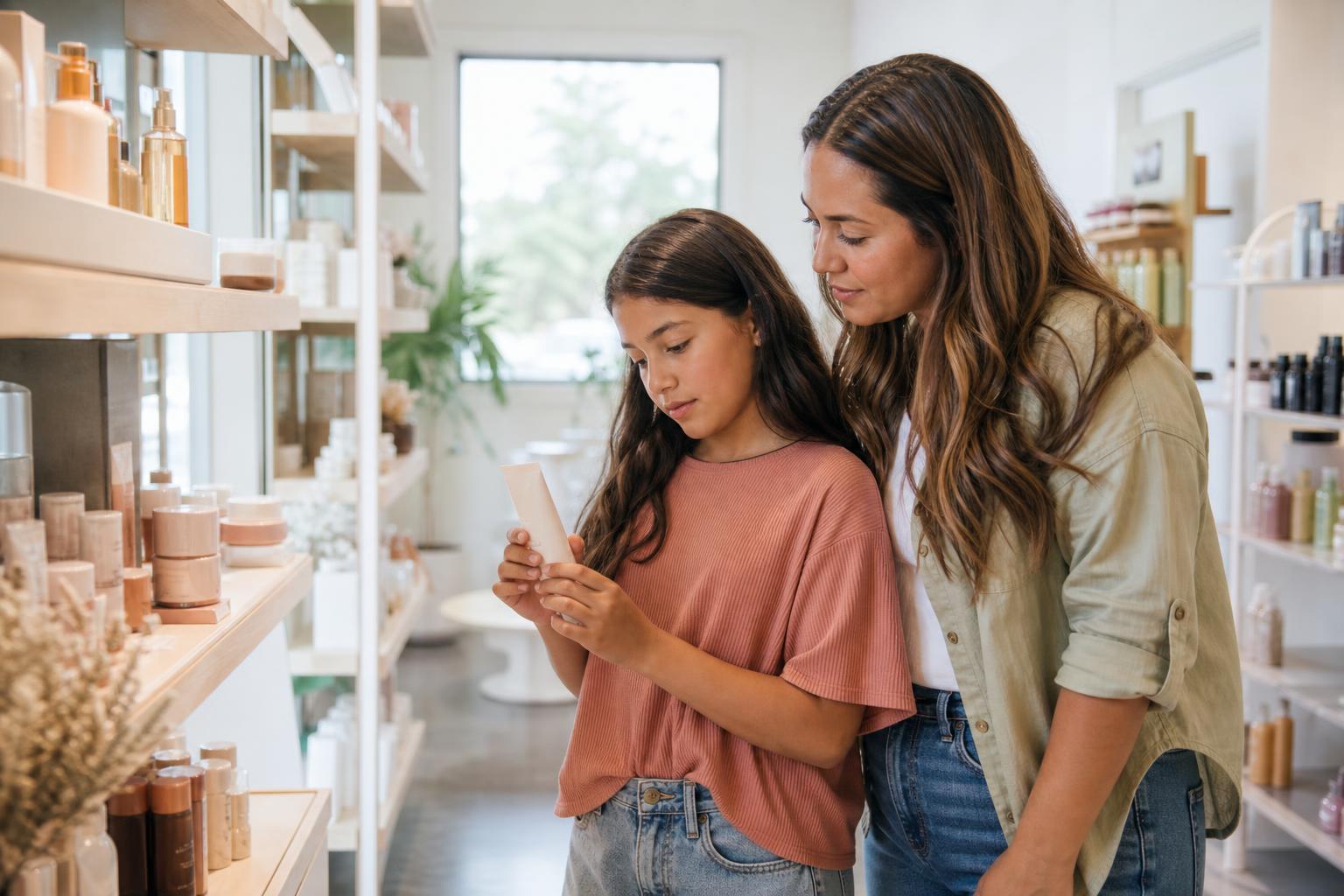
A fifth grader stands in front of the serum wall at Ulta, phone in hand, reading a label out loud to her friend. She's checking whether the moisturizer has fragrance in it. She's ten. Her mom is two aisles over, and neither of them thinks this is unusual anymore.
This scene has become common enough that store staff have opinions about it, brands have strategy decks about it, and dermatologists have started making videos specifically for pre-teens. Something real is happening, and it deserves a more careful look than either the panic takes or the brand-friendly takes are giving it.
What Gen Alpha actually knows
The striking part isn't that kids want skincare. Kids have always wanted the things adults have. What's different is the fluency.
A lot of these kids can tell you that niacinamide is for oil and redness, that hyaluronic acid pulls water into the skin, that ceramides are part of the barrier. They know the difference between a chemical and a mineral sunscreen. They know which brands have TikTok reputations for being drying. Some of them know more product vocabulary than adults who have been buying moisturizer for twenty years.
They picked this up the way they pick up everything: from short videos, from friends, from older siblings, from creators who explain ingredients in sixty seconds. The information is often accurate. The context around it usually isn't.
That gap between vocabulary and judgment is where the real issue sits. Knowing what retinol does is not the same as knowing whether a twelve-year-old's skin needs it. Knowing that an acid exfoliates is not the same as knowing that stacking three of them in one evening will leave you stinging by morning.
The routines that cause problems
Most of what young skin needs is genuinely simple. A gentle cleanser, a moisturizer, sunscreen in the morning. That's a complete routine for a healthy pre-teen face, and for most kids it's the whole story.
The trouble starts when a ten-step routine designed for a forty-year-old gets copied onto skin that has none of the concerns it was built for. The most common patterns worth watching:
- Retinol and retinoid serums used on skin with no signs of aging, which is essentially all pre-teen skin
- Multiple exfoliating acids layered in the same session, often glycolic in the morning and salicylic at night
- Heavy anti-aging creams that are too occlusive for young, oil-producing skin
- Vitamin C serums at high concentrations, which sting on skin that isn't used to them
- Strong actives applied around the eyes because the tutorial did it
The consequence is usually a compromised skin barrier: tightness, flaking, stinging when anything is applied, new sensitivity to products that used to be fine. Sometimes it's a rash of small bumps. Sometimes it's redness that lingers for weeks. It's rarely permanent, but it's uncomfortable, and it can take a couple of months of doing almost nothing to recover.
There's also the money. A pre-teen's skincare shelf can quietly outspend the adult's in the same house, funded by allowance and birthday cash, on products that address problems the kid doesn't have.
Why brands moved so fast
The industry didn't create this trend, but it noticed it quickly and adjusted. You can see it in the packaging: pastel palettes, rounded fonts, textures that feel more like a treat than a treatment. You can see it in pricing, with more products landing in the range a kid can reach without asking a parent. You can see it in the influencer rosters.
There are brands doing this responsibly, formulating gentle cleansers and simple moisturizers for young skin and saying clearly that actives aren't part of the plan. There are also brands selling products with grown-up actives in packaging that a fourth grader would put on a birthday list.
Retailers are in a genuinely awkward position. Ulta and Sephora are open to everyone, staff aren't trained to gatekeep by age, and the fastest-growing customer segment is the one least equipped to evaluate what it's buying.
What actually helps a young face
If you're a parent, an older sibling, or the adult a kid asks about this stuff, the useful move is not confiscation. It's substitution. Kids who are interested in skincare stay interested. What you can change is what they're interested in.
A workable starting point for most pre-teens and early teens:
- A non-stripping cleanser, used at night, and often just water in the morning
- A basic moisturizer, applied while skin is still slightly damp
- Broad-spectrum SPF 30 or higher every morning, especially for kids who play outdoor sports
- One targeted product at most, and only if there's a real concern, such as a benzoyl peroxide or salicylic acid product for acne
- Nothing new added for at least two weeks after starting something, so it's clear what's causing what
Acne is the one place where more than the basics genuinely helps, and it's worth taking seriously rather than treating as a phase to endure. If over-the-counter options aren't working after a couple of months, a dermatologist visit is a reasonable step, not an escalation.
Sun protection is the highest-value habit in the entire list, and it's the least glamorous. Sunscreen worn consistently from age ten does more for skin over a lifetime than any serum a kid could buy. If a young person is going to develop one non-negotiable habit from all this cultural noise, that's the one worth reinforcing.
Ingredient literacy isn't the problem
There's a version of this conversation that treats Gen Alpha's product knowledge as the thing to worry about. It isn't. A generation that reads ingredient lists, asks whether something is fragrance-free, and understands that sunscreen matters is better informed than the generations before it.
What's missing is the part that comes after the vocabulary: knowing when to do nothing. Skincare culture rewards addition. New product, new step, new routine. The skill that actually protects skin is restraint, and it's the hardest thing to communicate in a sixty-second video, because it doesn't look like anything.
That skill is learnable, and it's easier to learn with a record. Paying attention to what you used and how your skin responded over a few weeks teaches the lesson faster than any explainer. If you or someone in your house is building that habit, you can track your routine with Roona and see the pattern instead of guessing at it.
What this generation might carry forward
The kids in the Sephora aisle now will be adults in a decade. Some of them will have spent those years with irritated, over-treated skin and a complicated relationship with their reflection. Others will have grown up understanding sunscreen, reading labels, and recognizing when their skin is asking for less.
Which outcome dominates depends less on the kids and more on what the adults around them model. If the message is that skin is a problem to be corrected, that's what gets absorbed. If the message is that skin is something you look after, in the way you look after teeth or sleep, that's what gets absorbed instead.
The curiosity is a gift. It just needs somewhere sensible to go.
If you're rethinking your own routine, or helping someone younger build theirs, Roona is here whenever you want a calmer way to keep track.
Trend source: Whalesbook (US)
Keep reading
-

Sephora's Tween Skincare Lawsuit: What Parents Need to Know
A clear guide for Singapore parents on the Sephora youth skincare lawsuit, ingredient labels, age-appropriate routines, and safer shopping decisions. 8 October 2026 -
From Viral Skincare to Evidence-Based Dermocosmetics
Skincare in Mexico is shifting from TikTok trends to ingredient-backed dermocosmetics. Here is what to look for, and how to build a routine that lasts. 20 August 2026 -
Tretinoin: What It Does and What Adjusting Really Feels Like
An honest look at tretinoin: how it works, who tends to use it, what the adjustment period involves, and how to start slowly without wrecking your barrier. 20 August 2026