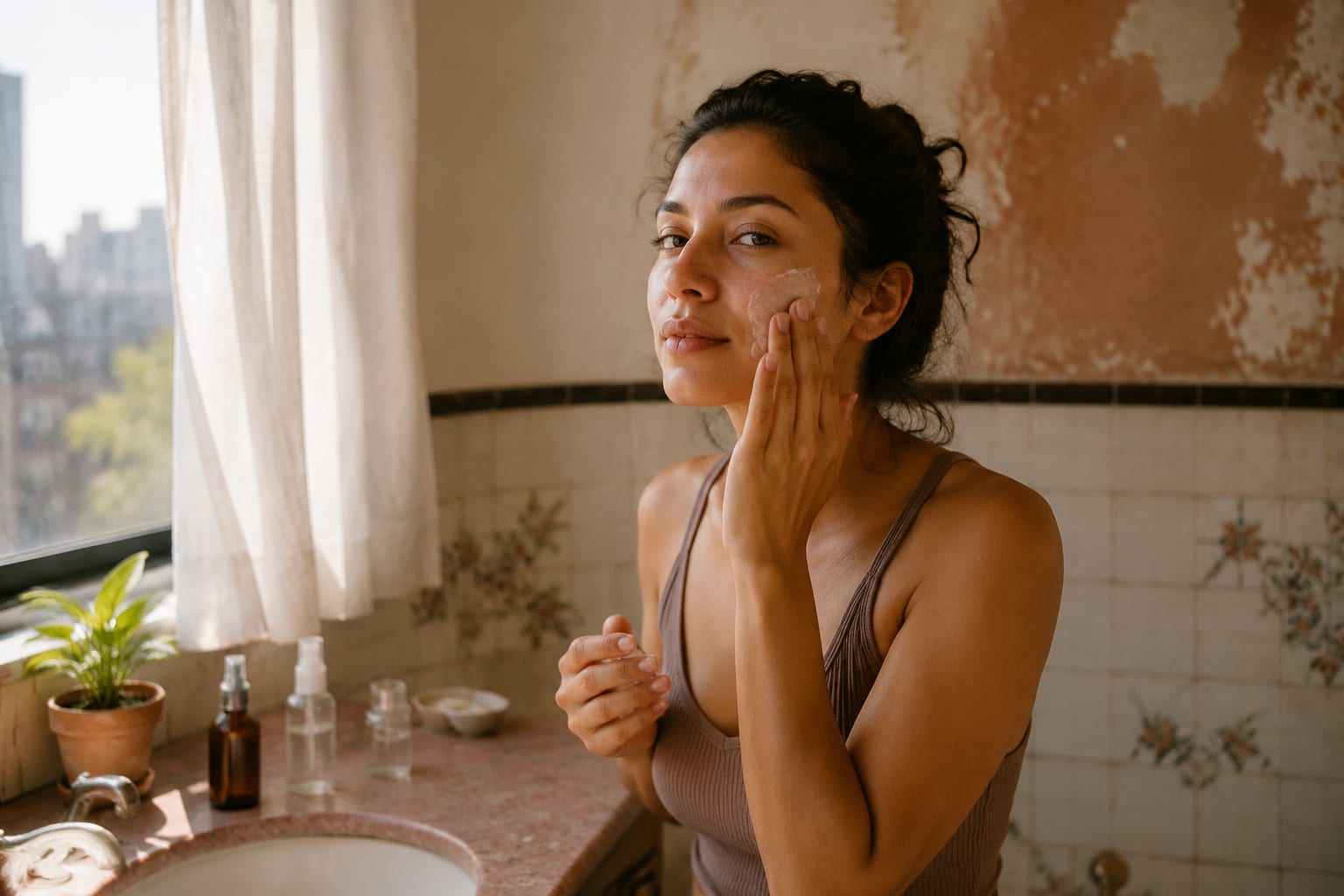
A snail mucin essence sitting on a shelf in Farmacias del Ahorro, next to a Pond's cold cream that has been in Mexican bathrooms for generations. Five years ago that shelf looked different. Korean skincare arrived here through Mercado Libre listings with three-week shipping and a lot of guesswork about whether the box was genuine. Now it has a physical aisle, a Sephora México endcap, and a TikTok Shop checkout button.
That shift is worth understanding, not because trends are interesting on their own, but because it changes what you can realistically buy, what it costs, and whether the routine you saw in a Seoul-filmed video will behave the same way on your face in Guadalajara.
Why Latin America became the growth story
K-beauty's first international wave went to China, then to the United States and Europe. Those markets are now crowded. Mexico and Brazil offer something different: large populations, a deeply established beauty habit, and a consumer who already treats skincare as routine rather than luxury.
Mexico in particular has a long relationship with multi-step care. Jafra and Avon consultants have been selling layered routines door to door for decades. Cicatricure and Pond's built a category around creams with a specific job. The idea that you use a toner and then a serum and then a cream is not a foreign import here. It is a familiar structure with new ingredients poured into it.
What Korean brands brought was texture and ingredient literacy. Lightweight essences, gel-creams, cushion-style sunscreens, and a vocabulary of centella asiatica, niacinamide and hyaluronic acid that spread quickly through Spanish-language beauty content. The format felt new. The ritual did not.
The climate problem nobody mentions in the tutorials
Here is where imported routines run into trouble. Mexico is not one skincare climate. It is several, and they contradict each other.
Mexico City sits high, dry, and under intense ultraviolet exposure. Thin air at that altitude means less atmospheric filtering, so sun protection matters year-round even when the day feels cool. The dry season strips moisture from skin fast, and a rich occlusive layer that would suffocate someone in Cancún makes perfect sense in Coyoacán in February.
The coasts flip the equation. Veracruz, Mérida, Acapulco: humidity keeps skin damp, sweat interferes with sunscreen, and heavy creams sit on the surface instead of absorbing. A gel moisturizer that felt like nothing in the capital may feel like exactly the right amount on the Yucatán peninsula.
The central plateau, Monterrey, the north: dry heat, sharp temperature swings between day and night, air conditioning working against you indoors.
So when a Korean brand promotes a ten-step routine designed for Seoul's humid summers and brutally dry winters, the translation is not automatic. Some practical adjustments:
- In high-altitude and dry regions, prioritize a proper moisturizer over stacking multiple watery layers that evaporate before they do much.
- On humid coasts, lean into essences and gel textures, and consider a sunscreen labeled for water resistance if you sweat through the morning.
- Reapply sunscreen midday if you are outdoors, particularly in Mexico City where UV stays high even in winter.
- Treat the rainy season and dry season as two different routines rather than one routine you force year-round.
If you are trying to work out which products belong in which season, logging what you use and how your skin responds is more useful than guessing from memory. You can track your routine with Roona and start noticing which formulas hold up in April versus August.
How brands are actually adapting
Adaptation shows up in a few places. Texture is the obvious one: lighter emulsions and gel formats travel better into humid markets than the thick sleeping masks that anchor a Korean winter routine.
Sun care is the other. Korean sunscreens built a reputation on cosmetically elegant finishes, no white cast on lighter skin, no heavy grease. In a country with a wide range of skin tones, that promise gets tested. Formulas that leave a grey cast on medium and deep skin lose customers quickly, and Spanish-language reviewers have been vocal about it. Chemical filter blends and tinted options have gained ground here for exactly that reason.
Distribution is the third adaptation, and possibly the most important one. A brand that only exists on Mercado Libre with unclear import paperwork has a ceiling. Getting into Liverpool, Sephora México or a pharmacy chain like Benavides means dealing with COFEPRIS, Mexico's health regulator, which registers cosmetics sold through formal retail. That registration is not a quality guarantee, but it is a real signal about the supply chain: a product that cleared it went through an importer with a paper trail, not a suitcase.
Price sensitivity shapes everything
Mexican shoppers compare aggressively, and there is a wide gap between a Korean serum bought through official retail and the same bottle on a marketplace listing. That gap creates a counterfeit problem. Popular sunscreens and essences are among the most faked skincare products in the region, and a fake sunscreen is genuinely risky because you have no idea what protection you are actually getting.
A few habits that reduce the risk:
- Buy sun protection from a pharmacy, department store or the brand's official Mercado Libre store rather than a third-party seller with no history.
- Check the packaging for Spanish-language importer information, which formal imports carry.
- Be skeptical of a price far below every other listing for the same size.
- If a product's texture, smell or color differs sharply from what you bought last time, stop using it.
Price pressure also explains why K-beauty here competes less with luxury and more with the drugstore aisle. A Korean cleansing oil is not being weighed against a department store counter brand. It is being weighed against what a shopper already trusts at Farmacias del Ahorro, and it has to justify the switch.
What this means for your own routine
More choice is genuinely useful. It also makes it easier to build a routine out of things you saw rather than things you need.
The useful core has not changed. A cleanser that does not leave your skin tight. A moisturizer matched to your region and season. Sunscreen every morning, applied in enough quantity, reapplied when you are outside. Everything past that is optional, and worth adding one product at a time so you can tell what is doing the work.
Korean formulas are often strong on the gentle end of the spectrum: centella and panthenol for skin that feels reactive, low-percentage niacinamide, cleansing oils that remove sunscreen without scrubbing. If your skin has been irritated by aggressive exfoliation, that end of the shelf is a reasonable place to look. If you are chasing a specific concern, a dermatologist is still a better guide than a fifteen-second video.
The influencer layer in Mexico is fast and persuasive, and TikTok Shop compresses the gap between seeing a product and owning it to about eight seconds. Slowing that down is worth something. Give a new product three or four weeks before you judge it, and change one variable at a time.
Watching the next chapter
Brazil is following a similar curve with its own particulars: different regulatory body, different retail structure, an even more established local beauty industry to compete with. Together the two markets give Korean brands a reason to formulate for heat, humidity, high UV and a broad range of skin tones, which eventually benefits everyone buying those products anywhere.
For now, the practical takeaway is smaller and closer to home. The products are easier to get, easier to verify, and easier to return. Your routine still has to answer to your climate, your budget and your skin.
If you want a calmer way to keep track of what you are using and how it is going, Roona is there when you want it.
Trend source: El Cronista (MX)
Keep reading
-
Olive Young lands in Sephora: what it means here
Olive Young is bringing curated K-beauty into Sephora in the US. What actually changes for Singapore shoppers who already buy this way. 26 August 2026 -
Sephora's Tween Skincare Lawsuit: What Parents Need to Know
A clear guide for Singapore parents on the Sephora youth skincare lawsuit, ingredient labels, age-appropriate routines, and safer shopping decisions. 8 October 2026 -

In-flight skincare kits: what to buy before you board
Airport skincare kits promise relief from dry cabin air. Learn which ingredients and travel-size products are worth packing before your flight. 27 September 2026