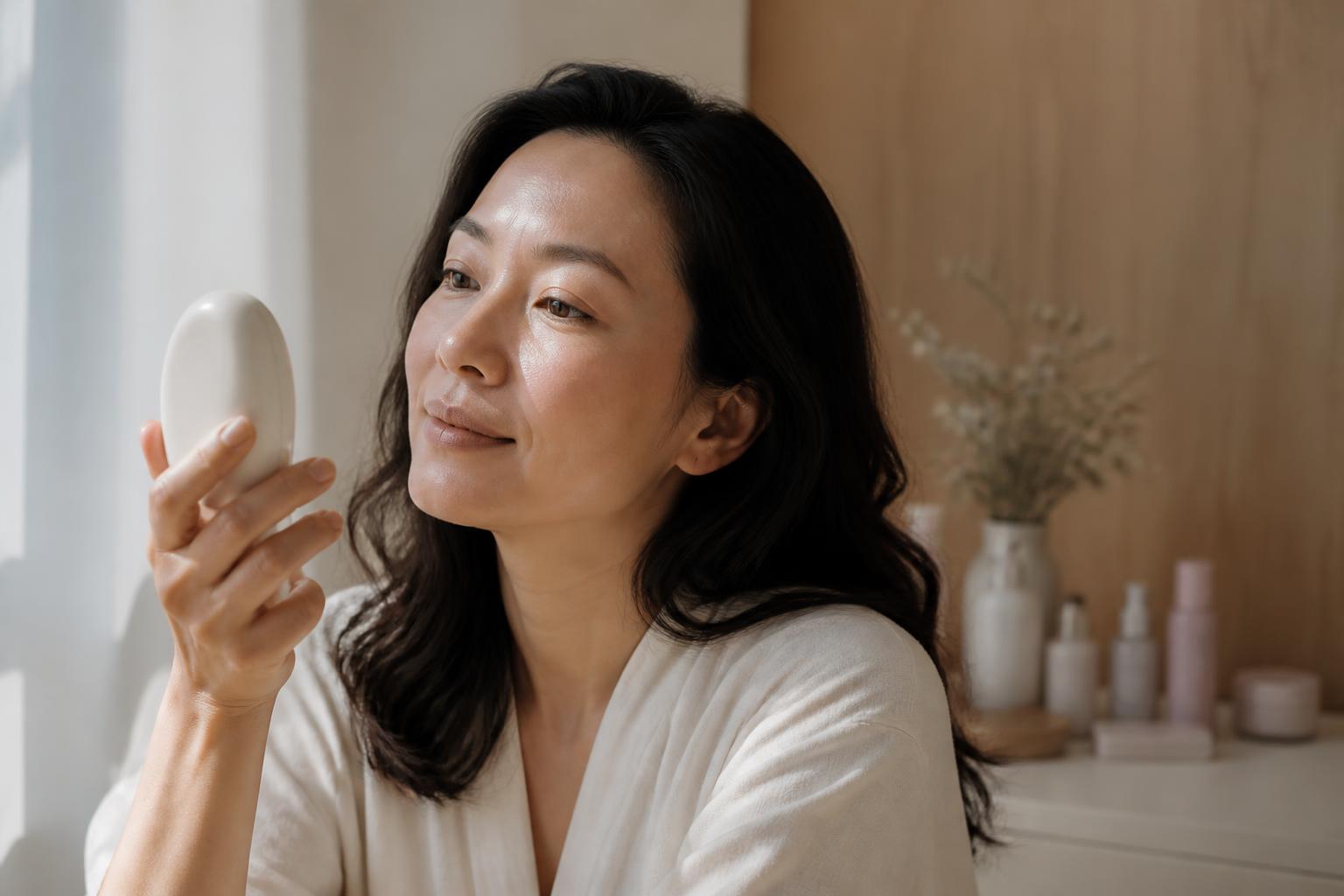
A friend walked into Sephora at ION Orchard last month for a foundation shade match and walked out with a printout saying her skin hydration was at 18%. She's 46, uses a solid routine, and her skin feels fine. The number rattled her. She wondered if she'd been doing everything wrong.
Sephora's AI skin scanner is appearing in more Singapore stores, and it's generating a lot of curiosity. The technology promises to measure hydration, texture, pores, fine lines, and more in under a minute. The experience feels official. You get a report. But what do those numbers actually mean, and when should you adjust your routine based on them?
What the scanner actually measures
The device uses high-resolution imaging and algorithms trained on thousands of skin images. It captures your face under controlled lighting and analyzes surface-level markers: moisture content in the outer layer of skin, visible texture and unevenness, pore size and distribution, and the appearance of fine lines.
Those hydration percentages refer to the stratum corneum, the outermost layer of your skin. That layer fluctuates constantly depending on when you last applied product, how long you've been in air-conditioning, and whether you've recently washed your face. A reading of 18% hydration might sound low, but context matters. If you took the scan an hour after cleansing in a cold, dry Sephora, the number reflects that moment, not the overall health of your skin.
The scanner also flags areas of uneven tone or texture. In Singapore's humidity, some of that unevenness comes from oil oxidation or sunscreen pilling rather than intrinsic skin concerns. The algorithm doesn't always distinguish between a temporary surface issue and a deeper pattern.
The technology has limits
The scanner works from images. It can't measure anything happening below the skin's surface: inflammation, barrier integrity, or how your skin responds to a product over time. It can't detect sensitivity triggers, and it won't tell you if that tightness you feel after cleansing is from a compromised barrier or just a formula mismatch.
The device is designed to guide product recommendations. If the scan flags dehydration, the recommendation might be a serum at $90 when a $20 hydrating toner from Guardian would do the same work.
The other limitation is comparison. The scan might say your hydration is lower than average, but average is a statistical construct built from the dataset the algorithm was trained on. If that dataset skews toward a different climate or age group, the baseline won't reflect what's normal for your skin in Singapore's heat and humidity.
What it can't tell you
The scanner won't identify rosacea, eczema, or fungal concerns. It won't explain why your skin reacts to certain ingredients. It can't tell you if your barrier is compromised, though it might flag dryness or rough texture as a side effect.
It also can't account for how your skin behaves across the day. Many people in Singapore experience an oil spike by midday after spending the morning moving between humid outdoor air and refrigerated MRT cabins. A single snapshot doesn't capture that pattern. Tracking your skin over weeks with a tool like Roona gives you a clearer picture of what's consistent and what's situational.
The scanner won't measure how your skin feels. Comfort, tightness, sensitivity: those are subjective but real. A hydration reading might come back normal while your skin feels parched, or vice versa. Both data points matter.
When the results are useful
The scan works best as a starting point when you're new to skincare or genuinely unsure what your skin needs. If you've never thought about pore congestion or texture and the scan flags it, that's useful information. You can look for products with salicylic acid or niacinamide and see if they make a difference.
The technology is also helpful for tracking visible changes after introducing a new product or adjusting your routine. If you start using a retinoid and your hydration reading drops, that's a signal to add more moisture or scale back frequency.
But the scan should confirm what you already suspect, not override what you observe. If your skin feels balanced and the scan says you need more hydration, trust your skin first. The algorithm doesn't live in your face.
How to use the data without overthinking
Treat the printout as one input among several. Compare the findings with how your skin actually feels and behaves. If the scan flags uneven texture and you've noticed the same thing when you apply makeup, that's alignment. If the scan says your skin is dehydrated but you're not experiencing tightness or flaking, the number might not be actionable.
Ask questions. The beauty advisor running the scan can explain what each metric means and how it connects to specific product categories. You can also ask what the recommendation would be at different price points. Not every solution needs to be the most expensive option on the shelf.
Give any new products time. A scan might suggest you need more exfoliation or hydration, but adding three new products at once makes it impossible to know what's working. Introduce one thing, use it consistently for a few weeks, and reassess. You can always return to Sephora for a follow-up scan if you want another data point.
Finally, remember that skincare is not a problem to solve in one visit. Your skin will change with the weather, with stress, with age. A scan taken in November might look different in March. The goal is a routine that feels sustainable and keeps your skin comfortable, not a perfect score on someone else's algorithm.
The scan is a tool, not a diagnosis
My friend went back to her routine after that first scan. She didn't overhaul everything based on one number. A few weeks later, her skin still felt fine. She realized the hydration reading was a snapshot, not a verdict.
If you're curious about the technology, try it. The scan is free, and it might surface something useful. But keep it in proportion. The best feedback loop is still the one between you and your skin: what feels good, what doesn't, and what's worth keeping. A simple log of what you're using and how your skin responds will tell you more over time than any single in-store reading.
The numbers are interesting. Your skin's comfort matters more.
Trend source: The Irish Sun (SG)
Keep reading
-
Fermented Red Rice in Skincare: What It Actually Does
Red rice ferment is showing up in serums and creams. What fermentation actually changes, what the ingredient can offer skin, and how to use it. 18 August 2026 -

Why 'Clinical' Skincare Keeps Landing on Sephora Shelves
Clinic-channel brands like Medik8 are moving into mainstream retail in Singapore. Here is what 'clinical' really tells you, and how to read the label yourself. 4 August 2026 -
7 Viral Glass-Skin Hacks: What Actually Works
Spoon massages, overnight sheet masks, slugging and more: a calm look at which viral glass-skin hacks affect your skin and which are just satisfying to film. 31 July 2026