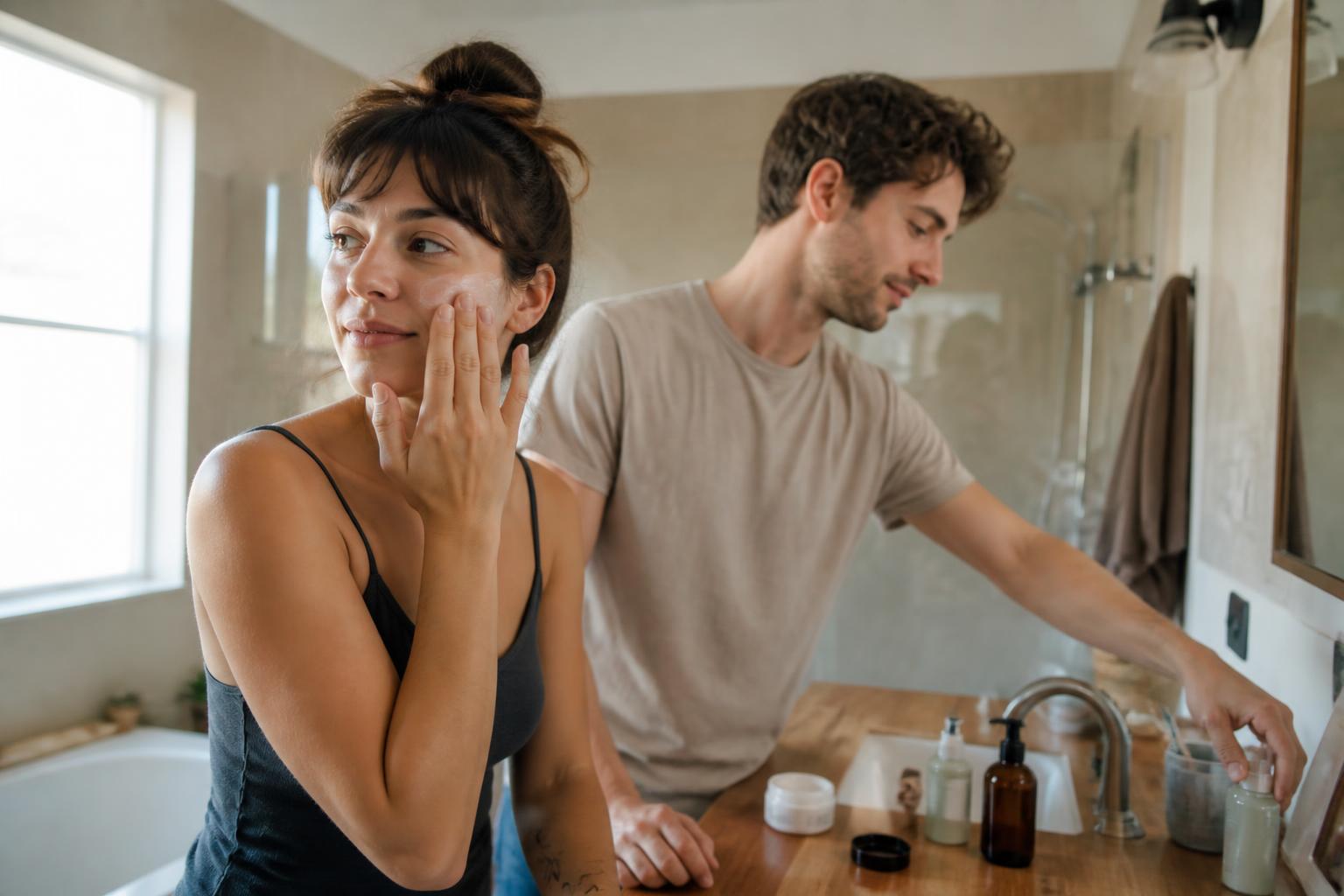
You reach for the moisturizer in the heavy glass jar, the one on the top shelf, and it isn't yours. It's better than yours. You use it anyway, and you say nothing about it at breakfast.
Tom Holland has cheerfully admitted to raiding Zendaya's skincare, which is the kind of celebrity detail that lands because most people living with a partner have done some version of it. Sharing a bathroom means sharing a shelf, and sharing a shelf means the good cream gets used twice as fast. That's mostly harmless. Some of it, though, is worth thinking about, because two people rarely have the same skin, the same tolerance for actives, or the same reason for buying the product in the first place.
What's usually fine to share
Most of the boring middle of a routine travels well between two people. Cleansers, basic moisturizers and body lotion are formulated for broad use, and dispensed in a way that keeps them reasonably clean.
Safe bets for a shared shelf: gel or cream cleansers in a pump bottle, plain moisturizers built around glycerin, ceramides or squalane, sunscreen as long as you both actually like wearing it, body lotion and hand cream, and lip balm in a tube rather than a pot.
Sunscreen is the one where sharing does real good. A single big bottle of a texture you both tolerate, parked next to the coffee maker or by the front door, gets used more often than two separate bottles neither of you loves. If one of you prefers a mineral formula and the other finds mineral filters too heavy or too grey, buy two. Preference is the whole ballgame with SPF, since the product only works when it's on your face.
Where sharing starts to cause problems
Actives are where a shared shelf gets expensive, in skin comfort rather than money. A retinoid your partner has been using nightly for two years is not a product you can pick up mid-stride. Their skin has adjusted through weeks of flaking, tightness and the odd raw patch. Yours hasn't. Borrowing it for a week can leave you with a compromised barrier, stinging when you wash your face, and a strange dry sheen along the jaw that takes longer to settle than the experiment was worth.
The same goes for strong exfoliating acids and high-percentage vitamin C. These are dose-and-frequency products, and the frequency belongs to the person who built it up.
Worth keeping separate: prescription retinoids, tretinoin especially, which are prescribed for one person's skin; over-the-counter retinal and retinol serums, unless you're both already using them; glycolic or salicylic exfoliants above gentle everyday strength; benzoyl peroxide, which bleaches towels and pillowcases and dries out skin that isn't breaking out; and anything a dermatologist wrote a name on.
There's also a timing question people forget. If one partner is pregnant or trying to be, retinoids and some other ingredients usually come off the shelf entirely, and that's a conversation with a clinician rather than a swap you sort out yourselves.
Two skin types, one bathroom counter
Most couples aren't matched. One person's face is oily by noon in the summer and merely fine in January. The other tightens up the moment the heat kicks on in October. A single routine will underserve one of you.
The workable setup is a shared base and separate specifics. Share the cleanser, share the sunscreen, share the body lotion. Keep your own moisturizer and your own treatment step. That usually means four or five products each, not a full second shelf, and it removes the low-grade friction of watching someone use half your serum on their neck.
If you want to know whether a shared product is actually working for you, change one thing at a time and give it a few weeks. Swapping cleanser and moisturizer in the same week and then wondering why your chin feels raw is a dead end. Logging what you used and how your skin felt makes the pattern obvious faster than memory does, and you can track your routine with Roona if you'd rather not keep it all in your head.
Jar hygiene, droppers and the eye area
Packaging matters more than most people assume. A wide-mouth jar collects whatever is on the fingers going into it, twice as often when two people use it. Pumps and airless tubes are cleaner by design.
If you're sharing out of a jar, a small spatula solves it. Keep one next to the jar and use it every time. It feels fussy for about three days and then becomes automatic.
Droppers deserve the same care. Don't touch the glass tip to your face, and rinse it if you do. Eye creams are the one category where being precious about it pays off, since the eye area is where bacteria and viruses spread most easily between people. If either of you gets recurrent styes, conjunctivitis or cold sores, keep eye products and lip products entirely separate. Same for any pot you dip a finger into during a flare.
One more thing that gets shared without anyone deciding to: face towels and pillowcases. Two people, one bath towel, and a bit of active acne is a combination worth avoiding. Separate face cloths cost almost nothing.
When one of you starts reacting
Say your skin gets tight and slightly stingy a week after you started using their cleanser. That's a barrier signal, not a sign you need something stronger. Pull back to a short routine: gentle cleanser at night, plain moisturizer morning and evening, sunscreen in the day. Nothing exfoliating, nothing with fragrance high in the ingredient list, nothing new. Skin that's irritated rather than damaged usually settles within a couple of weeks on that.
If you're getting small bumps in a pattern you don't recognize, or itching along the eyelids and neck, fragrance and essential oils are the usual suspects, and both are common in products marketed on how nice they smell. A dermatologist can patch test properly if it keeps coming back. That's genuinely worth doing rather than guessing through six more bottles.
Making it work without keeping score
Sharing a shelf works best when it's deliberate. Buy the shared items in larger sizes and the personal ones in standard sizes, put the shared products at the front of the counter and personal ones in a drawer or bag, and agree that prescriptions are off limits, no exceptions. Check in when the season turns, since October skin and July skin want different amounts of oil, and replace anything that smells off or has changed color, especially vitamin C.
A partner's routine can also be a decent shortcut. If they've been using a ceramide moisturizer through three dry winters and their skin is calm, you have a data point you'd otherwise pay twenty dollars to collect. Borrow the idea, then buy your own bottle.
If you're curious about how a shared shelf is actually treating your skin, keeping a simple log with Roona is an easy way to spot which products are doing the work and which ones you're only using because they were closest. No pressure either way. The good cream is still fair game.
Trend source: People.com (US)
Keep reading
-

Sephora Afterpay Sale Singapore: What to Buy and Skip
Make smarter Sephora Afterpay Sale purchases in Singapore with a practical guide to useful skincare, makeup and haircare deals worth skipping. 27 August 2026 -
What Longevity Science in Skincare Really Delivers
Darkfin Labs' Ulta launch brings longevity skincare to a wider audience. Learn what the science can support, where claims stretch, and what to use. 8 October 2026 -

Sephora's Tween Skincare Lawsuit: What Parents Need to Know
A clear guide for Singapore parents on the Sephora youth skincare lawsuit, ingredient labels, age-appropriate routines, and safer shopping decisions. 8 October 2026