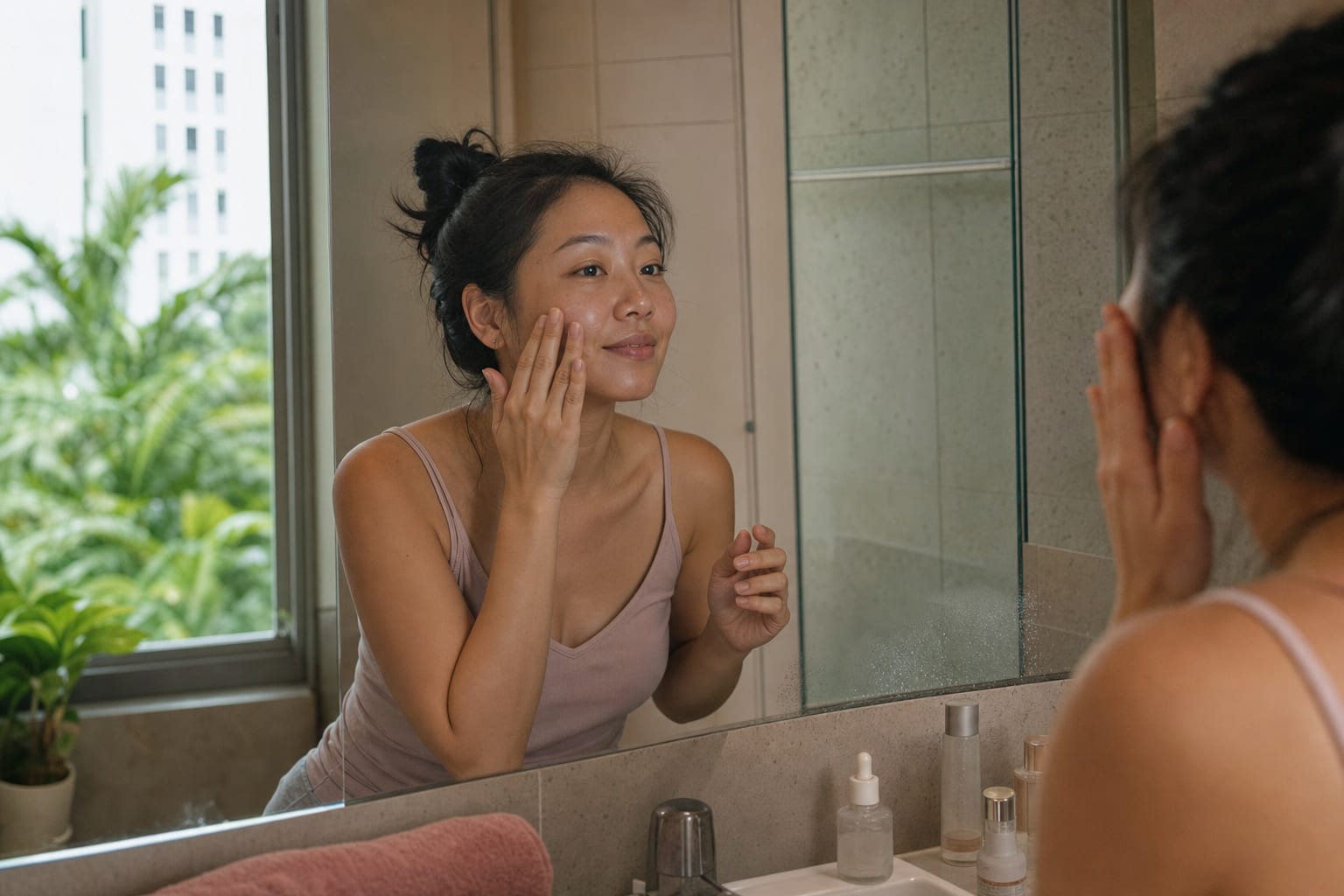
You add the cream you saw on your For You page three times last week, walk from Orchard MRT to the office, and by the time you sit down at your desk your face feels like cling film. Half an hour under the aircon vent and it's tight instead. Same product, two completely different verdicts within an hour.
That gap is the whole problem with buying beauty from TikTok. Most viral formulas are developed and reviewed in dry, temperate places where a thick occlusive layer feels like relief. Here, your skin is already sitting in high ambient humidity for most of the day, then getting pulled the other way indoors. A product doesn't have to be badly made to be wrong for that.
So instead of ranking hype, it's more useful to sort viral categories by how they behave in heat, sweat and cold dry air.
The viral categories that genuinely suit Singapore
Some things travel well. Broadly, thin textures, water-soluble humectants and anything designed to sit under sunscreen without piling.
- Watery essences and lightweight hydrating toners. Humidity means the air is doing part of your hydration work, so a glycerin or hyaluronic acid based layer is often enough on its own.
- Niacinamide serums. They stay comfortable in the heat, and if you're dealing with visible pores, uneven tone or oiliness across the T-zone, this is the most-reviewed viral ingredient that actually earns its place in a tropical routine.
- Gel and fluid sunscreens, especially the Korean and Japanese formulas widely stocked at Watsons, Guardian and Sephora. Sunscreen is the single most repeated recommendation for a reason: UV here is strong year round, not seasonal.
- Cleansing balms and oils. The double cleanse trend makes real sense when you're layering sunscreen every day and sweating through it.
- Salicylic acid cleansers or leave-on liquids at low percentages, used a few times a week, for congestion along the jaw and chest after gym or a long day outdoors.
- Cushion compacts with a sheer finish. They tend to sit better than full-coverage liquid foundation once your skin is warm and slightly damp.
What these share is that none of them ask your skin to hold onto a heavy layer through a 32 degree afternoon.
The viral buys that fight the climate
This is where the shopping-cart regret usually lives. None of these products are poorly formulated, they're just built for a different environment.
Thick petrolatum-based slugging balms are the clearest example. Slugging went viral in winter climates where the goal is to stop water escaping from skin into painfully dry air. Do that on a humid night, especially if you're an oil-rich or acne-prone skin type, and you're trapping sweat and sebum against your face for eight hours. If you want the barrier benefit, some people apply a thin layer only on dry patches, or only on nights when the aircon runs cold all night.
Heavy cream moisturisers in tubs have the same issue. Rich shea and butter-forward textures pill under sunscreen and slide once you're outdoors. A gel-cream usually delivers the same comfort with less weight.
Then there's the trend for stacking multiple actives in one sitting: a strong vitamin C in the morning, retinol plus an exfoliating acid at night. Sweat, friction from wiping your face and frequent sunscreen reapplication all add up to more physical disturbance of the skin surface than most reviewers account for. Sensitivity shows up faster here than the routine video suggests.
Glitter or heavily emollient lip oils are a small one, but worth saying: they collect dust on a windy walk and slide off in a way matte formulas don't.
Powder-heavy setting sprays and mattifying primers get bought in bulk every time a video promises all-day control, and they mostly manage a few hours before they need a blot paper reset. That's not failure, it's just a realistic expectation.
Aircon is the variable nobody accounts for
Most viral routines assume one environment per day. Yours has at least two. The commute is warm and wet, the office or the MRT is dry and cold, and your bedroom overnight is probably the driest air your skin sees all day.
A few things that help without adding steps:
- Keep a mist or a hydrating essence at your desk and use it once mid-afternoon, then press a light moisturiser over the top if your skin feels tight.
- Treat your night routine as the drier climate. That's where a slightly richer moisturiser earns its keep, not at 8am.
- If you sleep with the aircon on every night, consider that your "dry season" and adjust your evening layer accordingly.
- Watch your lips and the skin around your eyes first. They flag aircon dehydration before your cheeks do.
A three-week way to test anything viral
The research-heavy approach most Singapore readers already take to ingredient lists works just as well applied to your own skin. It just needs a record.
- Add one new product at a time and give it at least two to three weeks before deciding.
- Note how it feels at three points: after your commute, mid-afternoon under aircon, and before bed. A product that feels lovely at night and greasy by 10am is a night product.
- Check texture compatibility before you commit to a full routine. If it pills under your sunscreen, nothing else about it matters, because you'll stop wearing sunscreen properly.
- Keep the old version of your routine intact while you test. Changing three things at once makes the result unreadable.
Writing this down beats remembering it, especially when a reaction shows up two weeks after you started something. If you'd rather not keep notes in your phone's memo app, you can track your routine with Roona and see the pattern across weeks instead of guessing.
Buying smarter than the algorithm
A few habits that reduce the number of near-full bottles in your bathroom cabinet:
- Read the first five ingredients. That's where texture is decided, and texture is what makes or breaks a product in this climate.
- Prefer sample or travel sizes for anything thick, fragranced or high in actives. Sephora and the pharmacy chains often carry smaller formats of popular launches.
- Be sceptical of any viral product whose main promise is occlusion, and generous towards anything whose main promise is sun protection or gentle hydration.
- Ignore before-and-after content. Lighting, angle and makeup do most of that work.
- If a reviewer's climate isn't mentioned, assume it isn't yours.
One more thing worth holding onto: a product working differently on you than on the person who sold you on it isn't a sign that something is wrong with your skin. It's a sign your air is different from theirs. Oily skin in a humid climate is skin doing something sensible.
Where to start if you're rebuilding
If a lot of the shelf isn't working, strip back rather than add. A gentle cleanser, one hydrating layer, a sunscreen you actually enjoy wearing, and a moisturiser at night is a complete routine for this climate. Once that feels stable for a few weeks, add one viral thing you're genuinely curious about, and give it a fair trial.
The hype cycle will keep moving. Your skin, and the weather it lives in, changes far more slowly, which means you can afford to be unhurried about all of it. If keeping track of what you've tried would help, Roona is there when you want it.
Trend source: The Everymom (SG)
Keep reading
-
Sephora Afterpay Sale Singapore: What to Buy and Skip
Make smarter Sephora Afterpay Sale purchases in Singapore with a practical guide to useful skincare, makeup and haircare deals worth skipping. 27 August 2026 -
Why Asian Skin Is Not a Monolith, Says Dr Teo Wan Lin
Dr Teo Wan Lin explains why Asian skin needs more than one beauty label, with practical formulation lessons for Malaysia's climate and routines. 27 August 2026 -
Beauty Literacy: How to Read Skincare Claims
Beauty literacy means reading skincare claims the way you'd fact-check a headline. Here's how to decode labels, ads and advice without the overwhelm. 14 August 2026